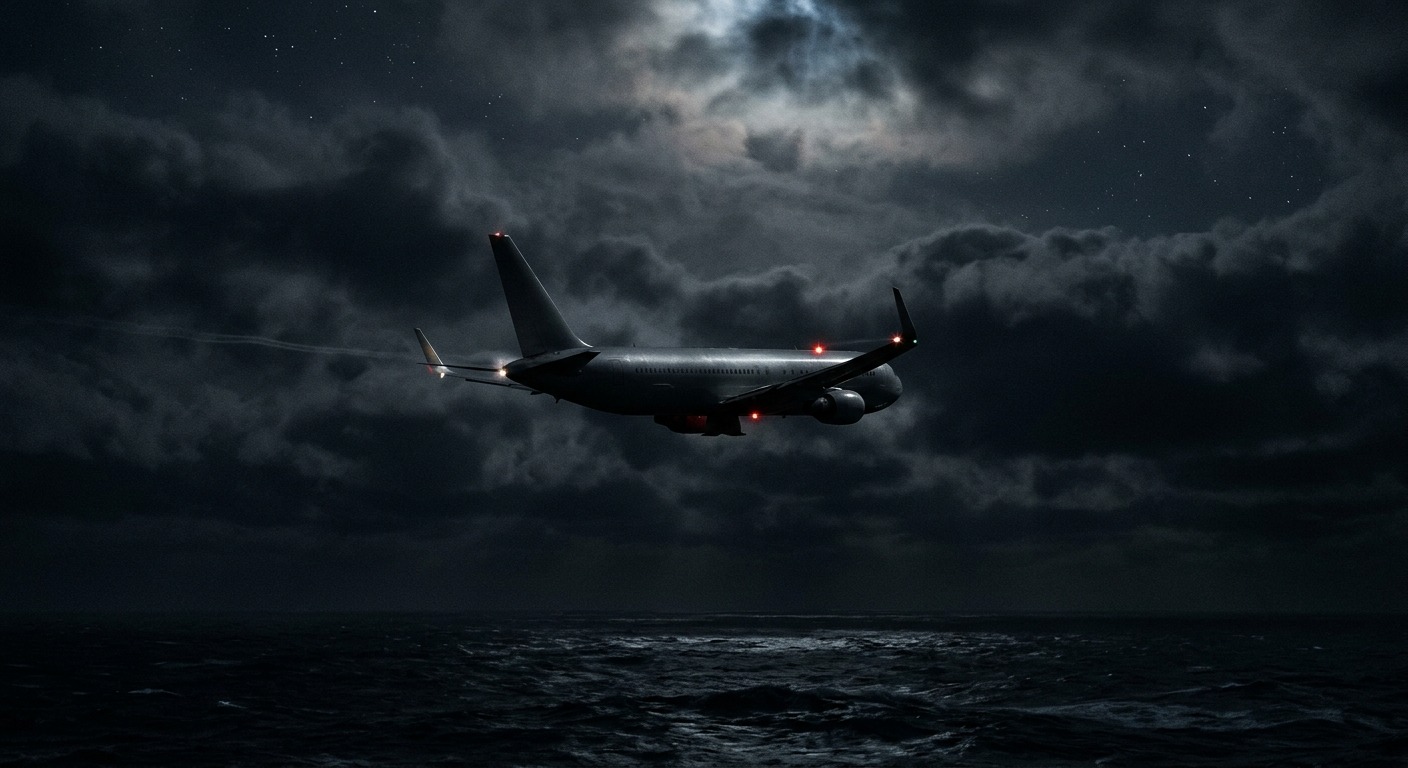
EgyptAir 990: Crash Timeline, Cause and Investigation Findings
EgyptAir Flight 990, a Boeing 767 flying JFK to Cairo, crashed into the Atlantic Ocean on October 31, 1999, killing all 217 aboard. The NTSB concluded the relief first officer’s flight control inputs caused the crash but never determined why. Egypt’s ECAA disputed this, citing possible mechanical failure.
There are few aviation mysteries as politically charged as the crash of EgyptAir 990. Investigators recovered cockpit recordings, examined wreckage pulled from 250 feet of ocean, and spent over two years testing competing theories. Yet the final verdict split two nations: American investigators pointed to deliberate human action, while Egyptian authorities insisted mechanical failure was the more plausible explanation.
What Was EgyptAir Flight 990?
EgyptAir Flight 990 was a scheduled passenger flight operating from Los Angeles to Cairo with a stopover at John F. Kennedy International Airport in New York. On October 31, 1999, the Boeing 767-366ER crashed into the Atlantic Ocean roughly 60 miles south of Nantucket, Massachusetts, killing all 217 people on board.
Key Facts: EgyptAir Flight 990 at a Glance
|
Detail |
Information |
|
Aircraft |
Boeing 767-366ER, registration SU-GAP |
|
Built |
1989; ~33,219 airframe hours, 7,556 cycles |
|
Engines |
Two Pratt & Whitney PW4060 |
|
Route |
Los Angeles → JFK (New York) → Cairo |
|
Departure |
JFK runway 22R, 01:19 EST, October 31, 1999 |
|
Crash site |
~60 miles (100 km) south of Nantucket, Atlantic Ocean |
|
Occupants |
217 (no official breakdown confirmed here) |
|
Survivors |
0 |
|
Investigating body |
NTSB, with Egypt’s ECAA participating |
|
Final report |
NTSB/AAB-02-01, released March 21, 2002 |
How Did the Crash of EgyptAir 990 Unfold Minute by Minute?
The crash of EgyptAir 990 occurred in roughly four minutes, beginning when the relief first officer was left alone in the cockpit. The aircraft dove from cruise altitude, briefly leveled off, climbed, then dove a second time before breaking apart and striking the ocean at high speed.
Timeline With Calculated Intervals
|
Time (EST) |
Event |
Interval |
|
01:19 |
Takeoff from JFK runway 22R |
— |
|
01:35 |
Cleared to climb to FL330, direct DOVEY |
+16 min |
|
~01:40 |
Relief first officer Gameel al-Batouti asks to relieve the command first officer early |
+5 min |
|
01:48 |
Captain leaves cockpit for the lavatory |
+8 min |
|
01:48:30 |
Unintelligible comment recorded |
+30 sec |
|
01:48:40 |
Relief first officer says quietly, “I rely on God” |
+10 sec |
|
01:49:45 |
Autopilot manually disengaged |
+65 sec |
|
01:49:53 |
Throttles moved to idle |
+8 sec |
|
01:49:54 |
Abrupt nose-down elevator input; load factor drops from ~1G to ~0.2G, then -0.2G |
+1 sec |
|
01:49:57–01:50:05 |
Phrase repeated 7 more times; captain re-enters, asks “What’s happening?” |
+8 sec |
|
01:50:08 |
Aircraft exceeds 0.86 Mach; master warning sounds; final (11th) repetition |
+3 sec |
|
~01:50:21 |
Elevators move into “split” condition; engine start levers moved to cutoff |
+13 sec |
|
01:50:24 |
Throttles pushed full forward; speedbrakes deployed |
+3 sec |
|
01:50:31–01:50:37 |
Captain repeats, “Pull with me” |
+7 sec |
|
01:50:36–01:50:38 |
FDR and CVR stop recording |
— |
|
~01:52 |
Final radar return; aircraft strikes the Atlantic Ocean |
— |
Why does the phrase “I rely on God” matter? The relief first officer repeated the Arabic phrase “I rely on God” 11 times in roughly 90 seconds while the aircraft dove, even as the captain shouted questions. According to the NTSB (Report AAB-02-01, 2002), this calm repetition during an emergency was “not consistent with the reaction that would be expected from a pilot who is encountering an unexpected or uncommanded flight condition.”
What Caused the Negative-G Dive and Split Elevators?
The dive occurred because the elevators moved into a “split” condition one side commanding nose-up, the other nose-down a state only achievable through opposing control column inputs from both pilot seats, not mechanical failure alone. This produced negative G-forces and pushed the aircraft past its maximum operating speed.
A few plain-English points worth understanding:
- Negative G: When an aircraft pitches down abruptly, occupants and loose objects can momentarily float as if weightless. Flight 990’s load factor dropped from a normal 1G to around -0.2G during the initial dive.
- Split elevators: The 767’s left and right elevators normally move together. A “split” only occurs when roughly 50 pounds-force of opposing pressure is applied to each control column simultaneously one pilot pushing forward, another pulling back.
- Mach exceedance: At 01:50:08, the aircraft exceeded 0.86 Mach, beyond its designed cruise speed, placing extreme structural stress on the airframe.
- Why the flight data recorder can’t “prove” intent: The FDR records control surface positions and speeds, not which pilot touched which lever. This is a central reason the cause remained disputed the data shows what happened to the airplane, not conclusively who did what or why.
What Did the NTSB Conclude About EgyptAir Flight 990?
The NTSB determined that the probable cause was the relief first officer’s flight control inputs, but it explicitly stated it could not determine why he acted as he did. The board tested every proposed mechanical failure scenario and found none matched the physical evidence.
NTSB’s official probable cause statement reads:
“The National Transportation Safety Board determines that the probable cause of the EgyptAir flight 990 accident is the airplane’s departure from normal cruise flight and subsequent impact with the Atlantic Ocean as a result of the relief first officer’s flight control inputs. The reason for the relief first officer’s actions was not determined.”
Additional NTSB findings, according to the agency’s report and public statements:
- No evidence of “any failure condition within the elevator system” that could have caused or prevented recovery from the initial pitch-over.
- No evidence of “any airplane system malfunction, conflicting air traffic or other event” that would explain the inputs.
- “The captain’s actions were consistent with an attempt to recover the accident airplane and the relief first officer’s were not.”
- NTSB researchers did examine mechanical possibilities, including whether sheared rivets in a bellcrank assembly could cause an elevator power control unit (PCU) disconnect one of several technical scenarios tested, not a finding of actual cause.
Why Did Egypt Reject the NTSB’s Conclusion on 990 EgyptAir?
Egypt’s Civil Aviation Authority rejected the NTSB’s finding and maintained that mechanical failure, likely involving the elevator control system, was a more plausible cause. The ECAA argued the American investigation was rushed and shaped by mistranslated cockpit audio.
NTSB vs. ECAA: Where the Two Investigations Diverged
|
Point |
NTSB Position |
ECAA (Egypt) Position |
|
Primary cause |
Relief first officer’s flight control inputs |
Mechanical failure, “plausible and likely” |
|
Elevator system |
No failure found; split condition only possible via manual input |
Possible failure of a right elevator power control unit |
|
Translation of cockpit audio |
Phrase accurately understood as “I rely on God” |
Claimed mistranslation skewed focus onto the pilot |
|
Investigation process |
Followed ICAO Annex 13; two-year technical review |
Said NTSB “rushed to judgment” before wreckage was fully retrieved |
|
Motive |
Not determined |
Rejected suicide/intentional-act theory entirely |
The ECAA’s formal statement argued that “NTSB investigators failed to consider a credible body of evidence supporting multiple failures in the aircraft’s elevator control system as the probable cause of the accident and, as a result, further investigation is required.” Egyptian officials also said errors in translating the cockpit voice recorder caused investigators to focus prematurely on the first officer.
Some outside aviation analysts, including Aviation Week’s Jim McKenna, argued the NTSB leaned heavily on Boeing-supplied data and noted that two prior incidents of 767s experiencing elevator control problems linked to icing had prompted an FAA airworthiness directive a point Egypt’s side used to argue mechanical failure had not been fully ruled out.
One unproven claim surfaced publicly: a former EgyptAir captain alleged the relief first officer acted out of revenge against a superior who was on board. This remains an allegation reported in media interviews, not a conclusion reached by either official investigation.
What Compensation Did Victims’ Families Receive After EgyptAir Flight 990?
There are no consumer ticket fees tied to this historical flight today “fees and charges” in this context means the compensation, insurance, and legal settlement figures paid to victims’ families. Reported figures ranged from a flat $100,000 per passenger to total insurance payouts estimated between $87.2 million and $116.3 million.
Compensation and Liability Figures
|
Source / Claim |
Amount |
Per-Victim Calculation |
|
International law floor (per lawyer Gerald Baker, Guardian, Nov 1999) |
$133,000 per family, regardless of cause |
$133,000 x 217 ≈ $28.86 million total |
|
First lawsuit filed (Guardian, Nov 1999) |
$50 million (£32m) sought for one victim’s death and pre-death suffering |
— |
|
EgyptAir’s stated flat rate (BBC, Jan 2000) |
$100,000 per passenger |
$100,000 x 217 = $21.7 million total |
|
EgyptAir chairman’s revised estimate (BBC, Jan 2000) |
87.2m–116.3m total insurance payout |
$87.2m ÷ 217 ≈ $401,800 per victim; $116.3m ÷ 217 ≈ $535,900 per victim |
|
EgyptAir’s later position (BBC, Jan 2001) |
Agreed not to contest liability in US claims, without admitting fault |
Lawyer Michel Baumeister said damages could exceed $1 million per case under then-updated federal law |
Choose which figure matters depending on what you’re measuring: if you want the legal minimum guaranteed regardless of fault, use the $133,000 international-law floor. If you want what EgyptAir’s insurers actually projected paying out, use the 87.2m–116.3m range, which works out to roughly 400,000–536,000 per victim more than four times EgyptAir’s originally stated flat rate.
For context, modern strict-liability limits under the Montreal Convention (not the law applied to Flight 990 in 1999) sit at 128,821 SDR, or about US$175,000, as of the 2019 inflation adjustment; some sources cite a further-adjusted figure of $202,500 (151,880 SDR). These are current benchmarks for comparison only, not amounts awarded in this case.
What Changed in Aviation Safety After EgyptAir Flight 990?
EgyptAir Flight 990 intensified debate over leaving a single pilot alone on the flight deck, reinforced support for hardened, locked cockpit doors after 9/11, and highlighted weaknesses in cross-border investigation cooperation under ICAO Annex 13.
Key areas of lasting influence:
- Single-pilot-alone risk: The case is frequently cited in discussions about the dangers of leaving one pilot alone in the cockpit, a concern that resurfaced after Germanwings Flight 9525 in 2015, when several airlines adopted (and later partially relaxed) two-person cockpit occupancy rules.
- Cockpit security: Post-9/11 FAA mandates for reinforced, locked cockpit doors address a different threat (hijacking), but the broader conversation about who can access the flight deck and when traces partly back to incidents like this one.
- Investigation protocol under Annex 13: Flight 990 is a textbook example of ICAO Annex 13 structure, where the state where the accident occurred (the US) leads the investigation while the state of aircraft registry (Egypt) participates a framework that strained badly here due to political sensitivities.
- Translation and evidence protocols: The dispute over how cockpit audio was translated and interpreted highlighted the importance of rigorous, multi-party verification of recorder transcripts in multinational investigations.
How Is EgyptAir Flight 990 Different From EgyptAir Flight 804?
EgyptAir Flight 990 and EgyptAir Flight 804 are two entirely separate accidents, 17 years apart, involving different aircraft, routes, and causes. Flight 990 was a 1999 Boeing 767 crash in the Atlantic; Flight 804 was a 2016 Airbus A320 crash in the Mediterranean, with investigators still disagreeing on cause as of late 2024.
EgyptAir Flight 990 vs. EgyptAir Flight 804
|
Detail |
Flight 990 |
Flight 804 |
|
Date |
October 31, 1999 |
May 19, 2016 |
|
Aircraft |
Boeing 767-366ER |
Airbus A320-232 (SU-GCC) |
|
Route |
Los Angeles–JFK–Cairo |
Paris CDG–Cairo |
|
Occupants |
217 |
66 (56 passengers, 10 crew) |
|
Crash location |
Atlantic Ocean, south of Nantucket |
Mediterranean Sea, ~290 km north of Alexandria |
|
Immediate cause dispute |
Pilot control inputs (NTSB) vs. mechanical failure (ECAA) |
Explosion/fire near cockpit (Egypt’s ECAA) vs. oxygen-mask-related fire (France’s BEA) |
|
Final reports |
NTSB: March 21, 2002 |
Conflicting reports released October 30, 2024 |
|
Survivors |
0 |
0 |
If you’re researching “EgyptAir flight” disasters generally, these two cases are the most commonly searched and most frequently confused, despite sharing almost nothing in common beyond the airline name and a lack of survivors.
Frequently Asked Questions
How many people died on EgyptAir Flight 990?
All 217 people on board were killed when EgyptAir Flight 990 crashed into the Atlantic Ocean on October 31, 1999. There were no survivors, and the aircraft was destroyed on impact.
What was the cruising altitude of EgyptAir Flight 990 before the dive?
The aircraft was cruising at Flight Level 330 (33,000 feet) when the relief first officer disengaged the autopilot and the initial dive began, according to NTSB flight data recorder analysis.
How many times did the relief first officer say “I rely on God”?
According to NTSB cockpit voice recorder analysis, the relief first officer repeated the Arabic phrase, translated as “I rely on God,” 11 times across roughly 90 seconds as the aircraft entered its dive.
What was the maximum negative G-force recorded during the crash of EgyptAir 990?
Flight data showed the load factor dropped from a normal 1G to approximately -0.2G during the initial nose-down maneuver, producing a brief weightless sensation in the cabin.
How long did the NTSB investigation into EgyptAir Flight 990 take?
The NTSB investigation lasted roughly two years and four months, concluding with the release of final report AAB-02-01 on March 21, 2002.
What is the official NTSB cause of the EgyptAir Flight 990 crash?
The NTSB’s probable cause cites “the relief first officer’s flight control inputs” but explicitly states “the reason for the relief first officer’s actions was not determined.”
Did Egypt accept the NTSB’s findings on 990 EgyptAir?
No. Egypt’s Civil Aviation Authority rejected the NTSB’s conclusion, maintaining that mechanical failure of the elevator control system was a plausible and likely cause of the accident.
How much compensation did EgyptAir pay victims’ families?
Reported figures varied: EgyptAir initially cited a flat $100,000 per passenger (about $21.7 million total), while its chairman later estimated total insurance payouts between $87.2 million and $116.3 million, or roughly 400,000–536,000 per victim.
Is EgyptAir Flight 990 the same as EgyptAir Flight 804?
No. They are unrelated accidents: Flight 990 was a 1999 Boeing 767 crash in the Atlantic Ocean with 217 fatalities, while Flight 804 was a 2016 Airbus A320 crash in the Mediterranean Sea with 66 fatalities.
What happened to the elevators during the EgyptAir 990 dive?
Flight data showed the elevators entered a “split” condition, with one side commanding nose-up and the other nose-down a state the NTSB said is only possible through opposing manual control inputs from each pilot seat, not a single mechanical fault.

Azeem breaks down airline baggage policies, fare-class benefits, and peak pricing rules into practical guidance for smooth trip planning. He verifies every fee and dimension against official airline sources so travelers can pack with confidence.