Philippine Airlines Pet Policy: The Complete 2026 Guide
Traveling with a furry companion takes more planning than packing your own suitcase. Philippine Airlines, the country’s flag carrier, has specific rules covering everything from crate sizes to vaccination paperwork and missing a single requirement can leave your pet grounded at the airport.
Whether you’re moving a Labrador from Manila to Cebu or shipping a cat from the USA to the Philippines, here’s what you need to know before you book.
Does Philippine Airlines Allow Pets to Travel?
Yes, Philippine Airlines allows pets to travel but not in the passenger cabin. Pets are accepted as checked baggage on the same flight as their owner, or shipped separately through PAL Cargo. The only animals permitted inside the cabin are trained service dogs accompanying passengers with disabilities.
This sets Philippine Airlines apart from some carriers that welcome small pets in the cabin. If cabin travel is essential for your pet, you may need to compare other airlines. For everyone else, the checked baggage and cargo options cover most domestic and international journeys.
Three ways pets travel with Philippine Airlines:
- Checked baggage Pet flies in the cargo hold on your flight; you check it in at the counter.
- PAL Cargo Pet ships separately, ideal for unaccompanied animals or oversized crates.
- Service dogs only Trained assistance dogs ride in the cabin free of charge.
What Are the General Requirements for Pet Travel?
Every pet traveling with Philippine Airlines needs valid health and identification documents. At minimum, you’ll need a veterinary health certificate issued within 10 days of travel, proof of current rabies vaccination, and an import or export permit for international routes.
Requirements tighten for international flights, where destination countries set their own entry rules. Skipping a document is the most common reason pets are denied boarding.
|
Document |
Domestic |
International |
|
Veterinary health certificate (within 10 days) |
Required |
Required |
|
Rabies vaccination record |
Required |
Required |
|
Bureau of Animal Industry (BAI) permit |
Recommended |
Required |
|
Destination country import permit |
Not needed |
Required |
|
Microchip (ISO standard) |
Optional |
Often required |
Verification tip: Always confirm requirements with the Bureau of Animal Industry (BAI) and your destination’s animal quarantine office before booking. Rules change, and some countries require blood titer tests months in advance.
What Is the Philippine Airlines In-Cabin Pet Policy?
Philippine Airlines does not allow pets in the cabin. Cats, dogs, and other small animals must travel as checked baggage or cargo. The single exception is a trained service dog that assists a passenger with a documented disability, which travels in the cabin at no charge.
If you’ve flown other carriers that permit a small dog under the seat, expect a different experience here. Plan for your pet to fly in the climate-controlled hold instead.
Service dog example: A passenger who is visually impaired can bring a certified guide dog into the cabin, provided the dog is harnessed and documentation is presented at check-in. Emotional support animals do not qualify for cabin travel under current policy.
How Do Pets Travel as Checked Baggage?
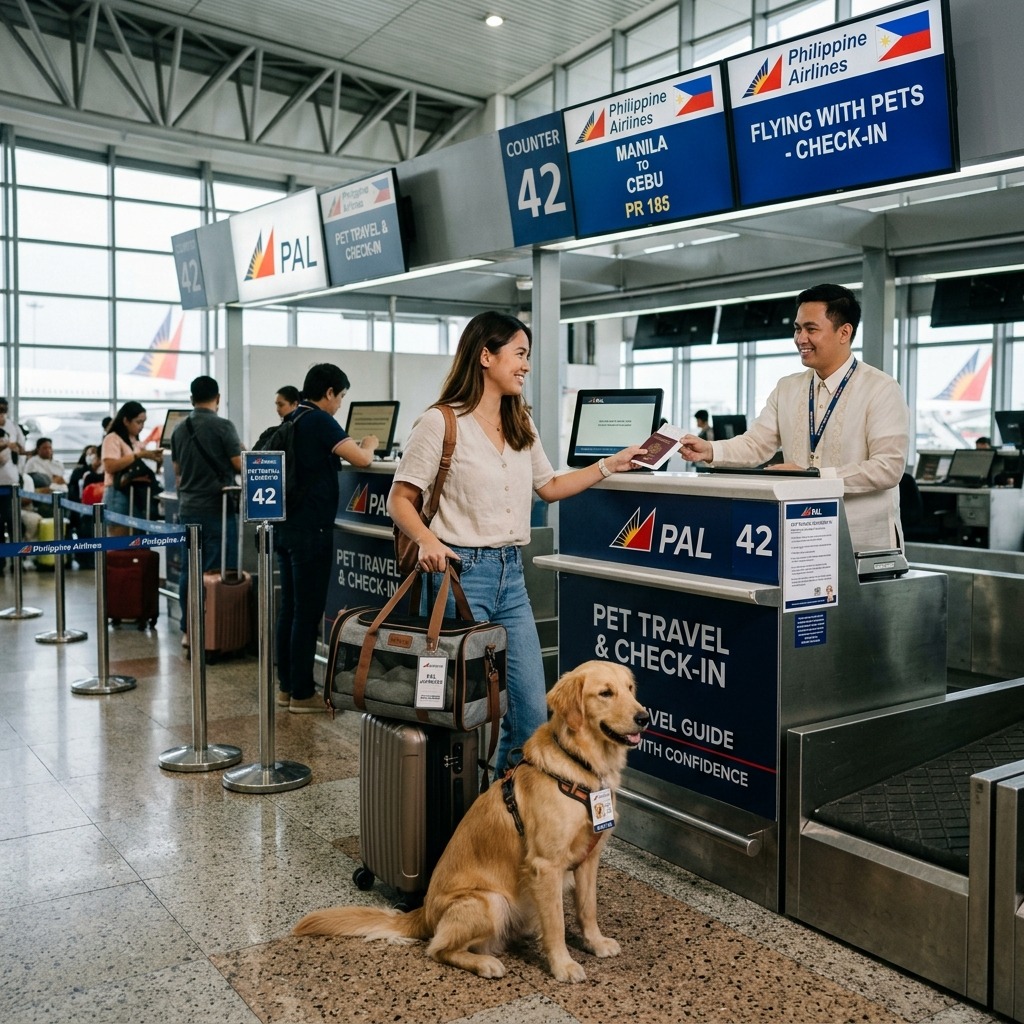
Pets travel as checked baggage when they accompany you on the same flight and fit within the airline’s crate and weight limits. The pet and crate are weighed together, and the combined weight determines your fee. You must book this service in advance, as space in the hold is limited.
Approved crates must be rigid, well-ventilated, leak-proof, and large enough for the pet to stand, turn, and lie down comfortably.
Crate size guide:
|
Pet size |
Approx. weight (pet + crate) |
Crate example |
|
Small (cat, small dog) |
Up to 10 kg |
50 × 33 × 33 cm |
|
Medium (beagle, spaniel) |
10–25 kg |
70 × 50 × 55 cm |
|
Large (labrador, retriever) |
25–45 kg |
90 × 60 × 65 cm |
Real-world example: A 20 kg beagle in a 5 kg crate counts as 25 kg of excess baggage. On a domestic route, that combined weight is charged at the per-kilo excess rate, not your standard luggage allowance.
What Is the Philippine Airlines Pet Cargo Policy and Price?
PAL Cargo transports pets that travel unaccompanied or that exceed checked-baggage limits. Cargo is the right choice when you’re not on the same flight as your pet, when crates are oversized, or when moving multiple animals. Pricing depends on weight, crate dimensions (volumetric weight), and route.
|
Route type |
Estimated cargo price range |
|
Domestic (e.g., Manila–Davao) |
PHP 3,000 – PHP 7,000 |
|
Short international (e.g., to Hong Kong) |
PHP 10,000 – PHP 20,000 |
|
Long-haul (e.g., to USA) |
PHP 40,000 – PHP 90,000+ |
Prices are estimates and vary by season, crate size, and current rates. Always request an official quote from PAL Cargo.
Cargo example: Shipping a 30 kg crate from Manila to Los Angeles is priced on volumetric weight if the crate is bulky. A 90 × 60 × 65 cm crate can be charged on dimensional weight rather than actual weight, raising the total cost.
What Are the Breed and Size Restrictions?
Philippine Airlines restricts snub-nosed (brachycephalic) breeds because they face higher breathing risks at altitude and in heat. These breeds may be refused or accepted only under strict conditions. Size is limited by crate dimensions the aircraft hold can accommodate.
Commonly restricted brachycephalic breeds:
- Bulldogs (English and French)
- Pugs
- Boxers
- Boston Terriers
- Shih Tzus
- Persian and Himalayan cats
Seasonal note: During hot months, restrictions on flat-faced breeds tighten further. Some routes may suspend acceptance of these breeds entirely during peak summer temperatures.
How Much Does It Cost to Bring a Dog on a Plane in the Philippines?
Bringing a dog on a domestic Philippine flight typically costs between PHP 2,000 and PHP 7,000, depending on the combined weight of the dog and crate. International travel costs significantly more, often PHP 10,000 to PHP 90,000+ via cargo, due to permits, longer handling, and volumetric pricing.
Sample domestic fee calculation:
- Dog + crate weight: 25 kg
- Excess baggage rate (illustrative): PHP 150 per kg
- Estimated cost: 25 × 150 = PHP 3,750
Sample international scenario: A medium dog shipped from Manila to Singapore may cost PHP 12,000–18,000 once cargo handling, permits, and crate fees are added. Always budget extra for veterinary visits and import paperwork.
What Is the Philippine Airlines Pet Policy for Domestic Flights?
For domestic flights within the Philippines, pets travel as checked baggage or cargo with simpler paperwork than international routes. You’ll need a recent veterinary health certificate and rabies vaccination proof. Booking 48 hours or more in advance is strongly advised because hold space is limited.
Domestic travel skips the import permits and quarantine steps that international journeys require, making it the easiest way to fly with a pet in the Philippines.
What Is the Philippine Airlines Pet Policy for International Flights?
International pet travel with Philippine Airlines requires destination-country import permits, an internationally recognized health certificate, current rabies vaccination, and often a microchip and blood titer test. Pets usually travel as checked baggage or cargo, never in the cabin. Some countries also enforce quarantine on arrival.
Because each country sets its own rules, the destination’s regulations not just the airline’s determine what you need.
Quarantine example: Some destinations require advance import approval and may hold pets for inspection on arrival. Australia and similar strict-entry countries can require months of preparation, including titer testing and reserved quarantine slots.
How Do You Bring a Pet From the USA to the Philippines?
To bring a pet from the USA to the Philippines, you need a USDA-endorsed health certificate, proof of rabies vaccination, and an import permit from the Philippine Bureau of Animal Industry (BAI) secured before departure. The pet travels as checked baggage or via cargo, and BAI inspects the animal on arrival.
Step-by-step from the USA:
- Visit a USDA-accredited vet for a health exam and certificate.
- Confirm rabies vaccination is current and documented.
- Apply for a BAI import permit before you fly.
- Book pet travel with Philippine Airlines or PAL Cargo in advance.
- Present all documents at check-in and at BAI inspection on arrival.
Cost note: Shipping a dog from the USA to the Philippines often runs PHP 40,000 to PHP 90,000+ (roughly USD 700–1,600) depending on weight, crate size, and whether a pet relocation service is used.
What Is the Philippine Airlines Cat Policy?
Philippine Airlines treats cats the same as dogs: they cannot fly in the cabin and must travel as checked baggage or cargo in an approved carrier. Cats need a health certificate, rabies vaccination, and a secure, ventilated crate. Snub-nosed breeds like Persians face the same restrictions as flat-faced dogs.
Cat travel tip: A 4 kg domestic shorthair in a 2 kg carrier is charged on the combined 6 kg weight. Acclimate your cat to the carrier for at least a week before travel to reduce stress.
How Do You Book Pet Travel With Philippine Airlines?
Booking pet travel requires advance coordination because cabin and hold space for animals is limited. You cannot simply show up with a pet reservations must be confirmed before your flight, ideally at the time you book your own ticket.
Booking steps:
- Book your passenger ticket first.
- Contact Philippine Airlines reservations to request pet travel (checked baggage) or PAL Cargo for separate shipping.
- Submit health and vaccination documents for review.
- Confirm crate dimensions meet airline specifications.
- Arrive early on travel day for inspection, weighing, and check-in.
Tips for a Smooth Pet Travel Experience
A calm, well-prepared pet travels best. Small steps in the weeks before your flight make a big difference on travel day.
- Crate training: Let your pet sleep and eat in the crate for days before departure.
- Hydration: Attach a spill-proof water dish; freeze water so it melts slowly.
- Feeding: Avoid a heavy meal right before the flight to prevent nausea.
- Exercise: Give your pet a good walk before check-in to burn off energy.
- Identification: Label the crate with your name, contact number, and the pet’s name.
- Vet check: Ask your vet about calming options; avoid sedatives unless approved.
Important Considerations and Disclaimers
Air travel carries real risks for animals, especially flat-faced breeds and pets with health conditions. Philippine Airlines and PAL Cargo set liability limits, and extreme weather can delay or cancel pet acceptance. Seasonal heat restrictions are common during Philippine summer months.
Booking confirmation does not guarantee acceptance final approval happens at check-in after the animal and documents pass inspection. Always confirm the latest policy directly with Philippine Airlines, as rules and fees change.
Frequently Asked Questions
Does Philippine Airlines allow pets in the cabin?
No. Only trained service dogs assisting passengers with disabilities are allowed in the cabin. All other pets travel as checked baggage or through PAL Cargo.
How much does it cost to bring a dog on a domestic Philippine flight?
Domestic pet travel typically costs PHP 2,000 to PHP 7,000, based on the combined weight of the dog and crate and the route’s excess baggage rate.
How much does it cost to ship a dog from the USA to the Philippines?
Shipping a dog from the USA to the Philippines usually costs PHP 40,000 to PHP 90,000+ (about USD 700–1,600), depending on weight, crate size, and whether you use a relocation service.
How many days before travel must the health certificate be issued?
Most routes require a veterinary health certificate issued within 10 days of travel. International destinations may add stricter timing rules.
Are emotional support animals allowed on Philippine Airlines?
No. Emotional support animals do not qualify for cabin travel under current policy. Only certified service dogs ride in the cabin.
Which breeds are restricted on Philippine Airlines?
Snub-nosed (brachycephalic) breeds such as bulldogs, pugs, boxers, Boston terriers, Shih Tzus, and Persian cats face restrictions or refusal due to breathing risks.
How far in advance should I book pet travel?
Book pet travel as early as possible ideally when you reserve your own ticket because hold and cargo space for animals is limited. Allow at least 48 hours for domestic flights.
Does the crate weight count toward the pet fee?
Yes. The pet and crate are weighed together, and the combined weight determines your checked-baggage or cargo fee.
Do I need a permit to bring a pet into the Philippines?
Yes. International arrivals require an import permit from the Bureau of Animal Industry (BAI), secured before departure, plus a health certificate and rabies vaccination proof.
Can cats fly with Philippine Airlines?
Yes. Cats travel as checked baggage or cargo in an approved carrier with a health certificate and rabies vaccination. Like dogs, cats are not permitted in the cabin.

Muhammad Naeem is a travel researcher with 5+ years of experience analyzing airline rules and global travel regulations. He specializes in simplifying complex airline policies to help travelers avoid extra fees and fly with confidence. His work focuses on accuracy, clarity, and up to date information across international carriers.