Volaris Pet Policy: The Complete 2026 Guide for Dogs & Cats
Volaris allows dogs and cats to travel in-cabin, as checked baggage, or via air cargo. In-cabin pets must weigh under 26 lbs (pet + carrier combined) in a carrier no larger than 44 × 30 × 19 cm. Fees reach up to $190. Only dogs qualify as service animals under current DOT rules ESAs are no longer recognized as service animals by Volaris.
What Are the Volaris Pet Travel Options?
Volaris offers three ways to transport a pet: in-cabin travel, checked baggage, and air cargo. The right option depends on your pet’s size, weight, breed, and route.
|
Travel Option |
Who It’s For |
Max Weight (Pet + Carrier) |
Available On |
|
In-Cabin |
Small dogs & cats |
26 lbs / ~12 kg |
Select Volaris-operated flights |
|
Checked Baggage |
Dogs & cats too large for cabin |
100 lbs / 45 kg |
Select routes |
|
Air Cargo |
Unaccompanied or very large pets |
Varies |
Contact Volaris Cargo |
Important: Pet services both on-board and checked are not available on Frontier-operated flights, whether direct or connecting. Always verify which airline operates your specific route before booking.
What Are the Rules for In-Cabin Pet Travel on Volaris?
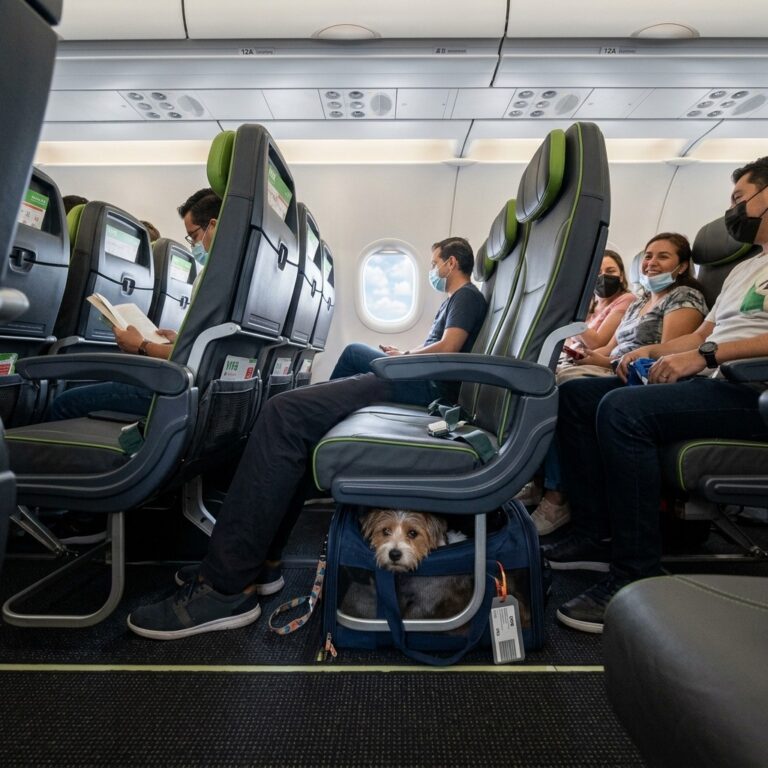
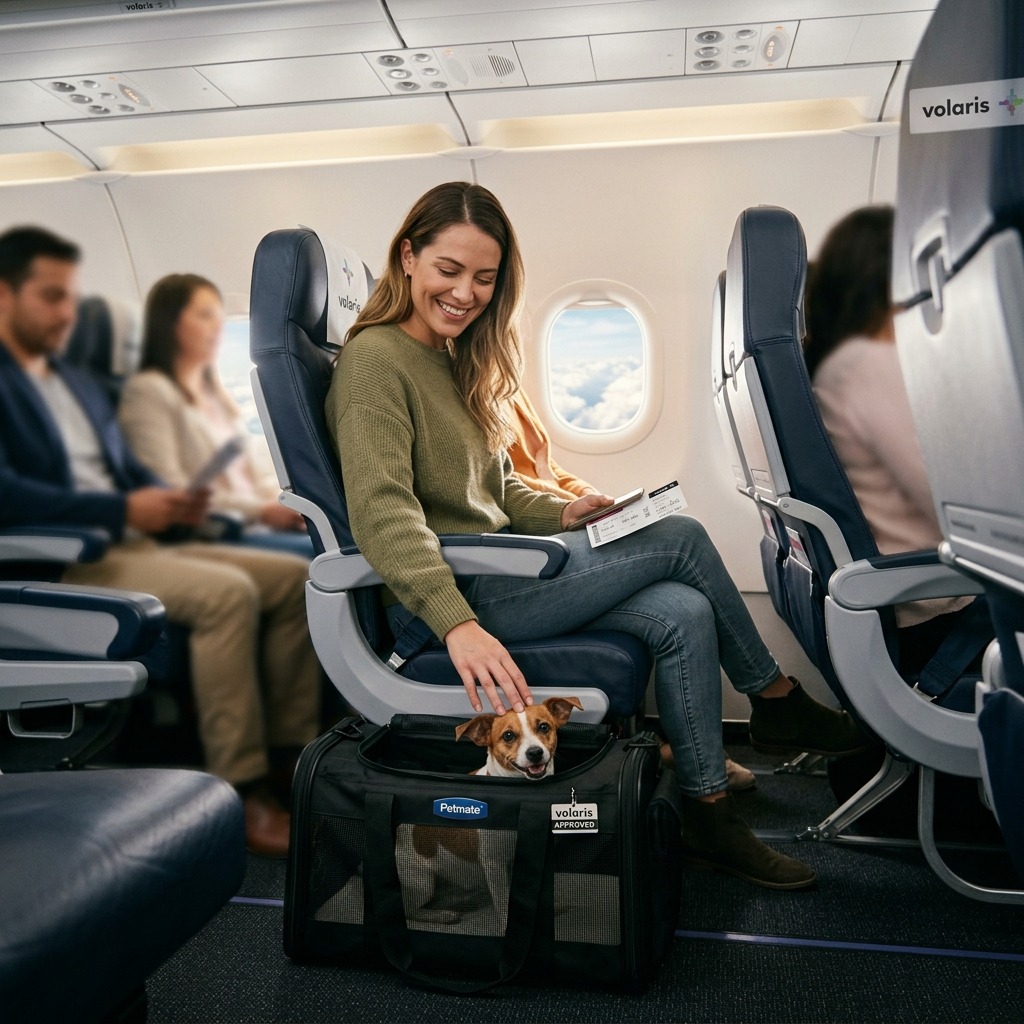
In-cabin pet travel on Volaris is available for small dogs and cats that fit inside an airline-compliant carrier placed under the seat in front of you. The combined weight of the pet and carrier must not exceed 26 lbs (approximately 12 kg), and the carrier dimensions cannot exceed 44 cm long × 30 cm wide × 19 cm high (17.5″ × 12″ × 7.5″).
Carrier Requirements for In-Cabin Travel
Your pet’s carrier can be made of fabric, rigid plastic, or a “bubble” style. It must:
- Allow your pet to stand, turn around, and lie down comfortably
- Have secure fasteners (heavy-duty zippers recommended)
- Have a waterproof bottom with an absorbent pad
- Fit fully under the seat in front of you no part of the pet or carrier may extend out
- Provide adequate ventilation on at least three sides (four sides for international routes)
Seating Restrictions for Pets in the Cabin
Not all seats are available when traveling with a pet. Volaris applies the following restrictions:
- Dogs may be seated in any window seat except premium seats and emergency exit rows
- Cats are assigned only to the last row window seats
- Bulkhead and exit row seats are off-limits for all pet passengers
Each Volaris flight accommodates up to 16 pets total: 10 dogs and 6 cats. On flights departing from or arriving in Bogotá (BOG), the cap drops to just 6 pets: 3 dogs and 3 cats. Book early spots fill up.
What About a Pet Stroller?
If you travel with a pet stroller, it is charged as additional baggage. The fee depends on whether it qualifies as carry-on or checked baggage. Alternatively, you can swap it for your included baggage allowance at no extra cost if it meets the required dimensions.
What Are the Rules for Checked Baggage Pet Travel on Volaris?
For pets too large to travel in the cabin, Volaris offers a checked baggage option. The combined weight of the pet and carrier must not exceed 45 kg (100 lbs).
Checked Baggage Carrier Specifications
The carrier must be:
- Rigid, clean, waterproof, and well-ventilated
- Free of wheels
- Scratch-proof with an anti-escape closure
- Fitted with handles for lifting
- Clearly labeled with your contact information (name, phone, address) and your pet’s information (name, age, sex)
How to Size a Checked Pet Carrier Correctly
|
Dimension |
How to Measure |
|
Length |
Nose to base of tail + ¼ of that length |
|
Width |
Twice the widest point of the animal’s body |
|
Height |
Maximum 90 cm |
Example: A dog measuring 60 cm from nose to tail base would need a carrier at least 75 cm long (60 + 15). A dog 30 cm wide at the shoulders needs a carrier at least 60 cm wide.
Age Requirements
Pets must be at least 4 months old to travel as checked baggage. Pets under 4 months, sick, pregnant, or deceased animals are not permitted on any Volaris flight.
Does Volaris Offer Air Cargo for Pets?
Yes. Volaris offers air cargo transport for larger or unaccompanied pets. Unlike checked baggage, air cargo animals are booked under an air waybill and checked in at the airline’s cargo facility not the passenger terminal. The airline tracks pets throughout the journey and is responsible for their care during layovers.
For specific air cargo rates, crate requirements, and availability, contact Volaris Air Cargo directly. This option is particularly relevant for large dogs, pets traveling to countries that require cargo-only entry, or situations where no accompanying passenger is present.
What Health Documents and Vaccinations Does Volaris Require?
Documentation requirements differ based on whether you’re flying domestically within Mexico or internationally.
Domestic Flights Within Mexico
- Vaccination booklet showing the first rabies vaccine application or a current booster (valid for 1, 2, or up to 3 years)
- If your pet is receiving the rabies vaccine for the first time, it must be administered at least 30 days before travel
- Pets 15 months or older must have a current booster and do not need to wait 30 days
- Proof of current deworming (not older than 6 months, calculated from the date of return)
- Completed Volaris pet travel form
International Flights What Does Volaris Pet Policy International Require?
International documentation requirements add several layers. Health certificates must:
- Be issued by a licensed veterinarian and include the original plus a simple copy
- Be printed on official letterhead with the veterinarian’s license number
- Be dated within 5 days of the start of your trip
- If your return is more than 5 days after the issue date, a new certificate is required
For travel to Honduras, dogs must also be vaccinated against distemper, adenovirus/hepatitis, parvovirus, parainfluenza, leptospirosis, and rabies. Cats must be vaccinated against rabies, viral rhinotracheitis, calicivirus, feline panleukopenia, and feline viral leukemia.
For travel to Peru, dogs need parvovirus, distemper, hepatitis, leptospira, parainfluenza, and rabies vaccines. Both dogs and cats must have internal and external deworming within 15 days prior to travel. A Zoosanitary Export Certificate issued by SAGARPA/SENASICA/SENASA/CENTREX is required upon arrival.
For travel from Central or South America into Mexico, an Animal Health Certificate is required.
What Are the Volaris International Pet Requirements for the USA?
Traveling with a dog to the United States involves the most complex documentation of any Volaris route, and the rules vary based on where your dog has been in the past 6 months.
| Dog’s Origin (Last 6 Months) | Key Requirements |
| Low-risk country (Mexico, Costa Rica) | Microchip, CDC Dog Import Form confirmation, min. 6 months of age, healthy appearance, arrive at declared CDC airport |
| High-risk country (El Salvador, Guatemala, Peru, Colombia, Honduras) — U.S.-vaccinated | Microchip, CDC Dog Import Form, U.S. rabies certification or USDA-endorsed health certificate |
| High-risk country — vaccinated outside USA | Microchip, valid rabies titer or CDC-registered quarantine reservation, arrive at MIA, JFK, LAX, or IAD only |
All dogs entering the U.S. must be free from external parasites, including screwworms (Cochliomyia hominivorax). Dogs flying to the U.S. from high-risk countries must be at least 6 months old and carry a microchip detectable by a universal scanner.
Are There Breed Restrictions on Volaris?
Yes and this section is where many travelers get caught off guard. Volaris restricts two distinct categories of breeds.
Brachycephalic (Flat-Faced) Breeds Requiring a Liability Waiver
These breeds can travel in-cabin or as checked baggage, but passengers must sign a liability waiver at the counter:
Brachycephalic dogs: Affenpinscher, American Staffordshire Terrier, Boston Terrier, Boxer (all breeds), Bulldog, Cane Corso, Chow Chow, Dogue de Bordeaux, English Toy Spaniel, Brussels Griffon, Japanese Chin, Lhasa Apso, Mastiff, Pekinese, Pit Bull, Presa Canario, Pug (all breeds), Sharpei, Shih Tzu, Tibetan Spaniel, and Staffordshire Bull Terrier.
Brachycephalic cats: Burmese, Exotic Shorthair, Himalayan, and Persian.
Small dogs also requiring a waiver: Australian Silky Terrier, Beagle, Bichon Frise, Chihuahua (all breeds), Toy Fox Terrier, French Poodle, Schnauzer, Yorkshire Terrier, and Dachshund.
Breeds Banned from All Volaris Flights
The following breeds are completely prohibited from traveling on Volaris, either in-cabin or as checked baggage, due to being classified as dangerous or aggressive:
Pit Bull (all breeds), Staffordshire Terrier, American Staffordshire Terrier, Shar Pei, Boxer (all breeds), Bull Terrier, American Bulldog, Bullmastiff, Akita Inu, Dogo Argentino, Fila Brasileiro, Anatolian Shepherd, Doberman, Rottweiler, Japanese Tosa, Dogue de Bordeaux, Akita Americano, Neapolitan Mastiff, Presa Canario, German Shepherd, and Italian Mastiff.
Note that some breeds such as Pit Bull, American Staffordshire Terrier, and Dogue de Bordeaux appear on both the brachycephalic and banned lists. The ban takes precedence. These animals cannot fly on Volaris under any circumstances.
How Should You Prepare Your Pet for a Volaris Flight?
Getting your documentation in order is only half the preparation. The physical and behavioral readiness of your pet matters just as much.
Pre-Flight Feeding and Hydration
Feed and give water to your pet four hours before the flight. A full belly and adequate hydration reduce anxiety and minimize the chance of an upset stomach during the journey.
Carrier Acclimatization
Begin introducing your pet to its carrier days or weeks before travel. Place familiar items a worn shirt, a favorite toy inside to create a positive association. Pets that are comfortable in their carrier show significantly less stress during travel.
Should You Sedate Your Pet Before Flying?
No. Both the American Veterinary Medical Association (AVMA) and the International Air Transport Association (IATA) advise against sedating pets before flying. Sedation increases the risk of cardiac or respiratory complications during flight, particularly at altitude. Discuss anxiety management alternatives with your veterinarian before the trip.
Temperature Restrictions for Checked and Cargo Pets
Volaris will not accept pets as checked baggage or air cargo when actual or forecasted temperatures at any airport on the itinerary fall outside the following range:
- Maximum: 85°F (29.4°C)
- Minimum: 45°F (7.2°C)
Pets may be accepted below 45°F with a veterinarian-issued acclimation certificate, but no pet will be transported at temperatures below 20°F (-6.6°C). Brachycephalic pets face stricter summer temperature limits due to their respiratory vulnerability.
What Is the Volaris Pet Policy on Emotional Support Animals?
Volaris no longer recognizes emotional support animals (ESAs) as service animals. As of January 2021, the U.S. Department of Transportation revised Air Carrier Access Act (ACAA) regulations, and ESAs no longer carry the same protections as trained service animals. Volaris aligns with this ruling.
If your ESA is a dog or cat that weighs under 26 lbs (pet + carrier), it can fly as a regular pet subject to standard fees and documentation. A dog over that weight, or an ESA of any other species, cannot be accommodated under the ESA designation.
What Are Volaris Service Dog Requirements?
Volaris service dog requirements apply to trained dogs that perform specific tasks for a person with a disability. Psychiatric service dogs (PSDs) are treated identically to other service dogs under current DOT rules a meaningful distinction from the pre-2021 framework.
Required documentation for service animals on Volaris:
- Valid vaccination certificate or card showing current vaccinations
- Health certificate on official letterhead from a licensed veterinarian, including the veterinarian’s license number
- Completed DOT Service Animal Air Transportation Form (required for flights to or from the United States)
- Volaris pet transportation form (provided at the counter)
Behavioral requirements:
- The service dog must be harnessed, collared, and leashed at all times
- It must fit at the passenger’s feet without encroaching on other passengers or cabin operations
- It must show no signs of aggression
- It cannot be seated in an exit row
Notify Volaris at least 48 hours before departure if you’re traveling with a service animal. Service dogs travel at no additional charge. Even for service animals, international travel requirements including vaccinations and health certificates apply at the destination country’s border. The flight accommodation is free; the border entry requirements are not.
How Do You Book Pet Travel on Volaris?
Adding a pet to a Volaris flight is straightforward, but timing matters. Here’s how to do it:
- During booking on volaris.com, navigate to the seat selection step and look for the “Travel with your pet” option
- Choose between on-board or checked travel
- If you’ve already booked your flight, add the pet service through My Trips
- Alternatively, add the service at the airport counter, via the Volaris app, or by calling the Volaris call center
Call center numbers:
- USA: +1 855 VOLARIS (865-2747)
- Mexico: +52 (55) 1102 8000
- Costa Rica: +506 4000 0229
- Guatemala: +502 2301 3939
- El Salvador: +503 2504 5540
- Colombia: +57 60 1744 3272
- Honduras: +504 2202 7900
- Peru: +511 644 9040
You can also contact Volaris via WhatsApp at +52 55 5898 8599 or through Facebook Messenger.
Check-In Times for Pet Travel
- Domestic flights: Arrive at the check-in counter at least 2 hours before departure
- International flights: Arrive at least 3 hours before departure
Airport security may require an additional inspection of your pet and carrier. This is outside Volaris’s control build extra time into your arrival to accommodate it.
How Much Does Volaris Charge for a Pet?
Volaris pet travel costs up to $190 USD per pet per flight segment. Fees must be paid online at booking or at the airport counter. Service animals travel free.
Cost scenario examples:
- A round-trip domestic flight with an in-cabin pet: up to $380 total ($190 × 2 segments)
- A one-way international flight with a checked pet: up to $190
- A round-trip international flight with a checked pet: up to $380
Volaris pet fees are per flight segment, not per round-trip booking. Factor this into your overall travel budget. Always confirm the exact fee on the Volaris Additional Services fees page, as pricing can vary by route and season.
Is Volaris a Good Airline for Pet Travel?
Volaris is a reasonable option for pet travel within its network particularly for travelers flying between Mexico, the U.S., and Central America. As an ultra-low-cost carrier, Volaris keeps base fares competitive, and its pet policy is structured and clearly documented on the official website.
That said, there are important trade-offs to consider:
Strengths:
- Three transport options (cabin, checked baggage, air cargo)
- Accepts both dogs and cats
- Service dogs travel free
- Online and app-based booking available
Limitations:
- Not available on Frontier-operated routes
- Strict breed bans and liability waivers for brachycephalic and “dangerous” breeds
- Per-flight-segment pet fees can add up quickly on multi-leg trips
- Bogotá routes have reduced pet capacity limits
- International documentation requirements are complex
If your pet is a healthy, non-brachycephalic dog or cat under 26 lbs, Volaris offers a functional and affordable way to travel together. For larger dogs, brachycephalic breeds, or international routes involving the U.S., prepare to do more documentation legwork than you would with some other carriers.
Frequently Asked Questions
How do I add a pet to my Volaris flight?
During online booking, select “Travel with your pet” at the seat selection step and choose in-cabin or checked travel. If already booked, add the pet through My Trips on volaris.com, the Volaris app, or at the airport counter before departure.
How much does Volaris charge for a pet?
Volaris charges up to $190 USD per pet, per flight segment. A round-trip journey equals two fees up to $380 total. Service dogs travel free. Fees can be paid online or at the counter.
What is the Volaris pet fee for international flights?
The same fee structure applies internationally up to $190 USD per segment. However, international routes also require additional documentation, including health certificates and country-specific vaccination records, which may carry separate veterinary costs.
What do you need for a Volaris service dog on domestic and international flights?
Domestic Volaris service dog requirements include a valid vaccination certificate, a veterinarian-issued health certificate, and the Volaris pet form. International flights to or from the U.S. additionally require the DOT Service Animal Air Transportation Form submitted at least 48 hours before departure.
Does Volaris accept emotional support animals in 2026?
Emotional support animals are no longer classified as service animals under DOT rules updated in January 2021. Volaris follows this ruling. ESAs may travel as regular pets (subject to standard fees and weight limits) but receive no special accommodation or free travel.
Can a Chihuahua fly on Volaris without restrictions?
Chihuahuas appear on Volaris’s small breed list requiring a liability waiver but they are not banned. A Chihuahua that fits within the carrier weight and size limits can travel in-cabin or as checked baggage, provided the owner signs the waiver at the counter.
Can my dog fly Volaris if it’s been in Guatemala in the last 6 months and is entering the USA?
Yes, but with significant requirements. Guatemala is a high-risk country for canine rabies under CDC rules. The dog must be at least 6 months old, microchipped, and carry a confirmed CDC Dog Import Form. If vaccinated outside the U.S., a valid rabies titer or reservation at a CDC-registered quarantine facility is required, and the flight must land at MIA, JFK, LAX, or IAD.
How many pets are allowed per Volaris flight?
Each Volaris flight allows a maximum of 16 pets: 10 dogs and 6 cats. Flights to or from Bogotá (BOG) are capped at 6 pets total 3 dogs and 3 cats. Book early to secure a spot.
Can I sedate my dog for a Volaris flight?
No. The AVMA and IATA both advise against sedating pets before air travel. Sedation can increase the risk of cardiac or respiratory complications at altitude. Speak to your veterinarian about safe, non-sedative anxiety management options instead.
How do I talk to a human at Volaris by phone?
Call the Volaris U.S. line at +1 855 VOLARIS (865-2747) to reach a customer service agent. For Mexico, call +52 (55) 1102 8000. You can also contact Volaris via WhatsApp at +52 55 5898 8599 or through Facebook Messenger for flight and pet-related inquiries.

Muhammad Naeem is a travel researcher with 5+ years of experience analyzing airline rules and global travel regulations. He specializes in simplifying complex airline policies to help travelers avoid extra fees and fly with confidence. His work focuses on accuracy, clarity, and up to date information across international carriers.