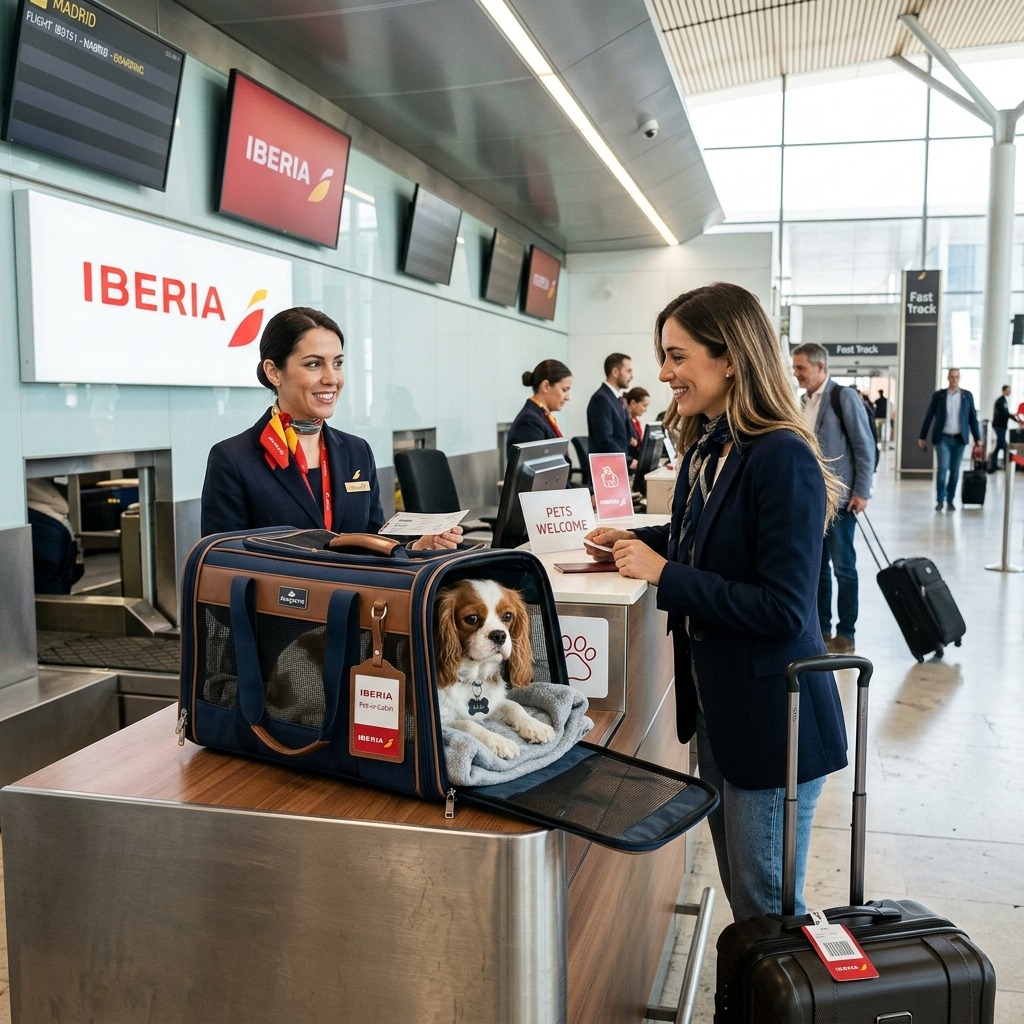
Iberia Airlines Pet Policy: The Complete Guide for 2026
Planning a trip with your four-legged companion can feel daunting, especially when airline rules seem to change with every booking. If you’re flying with Iberia, the good news is that the airline has a clear, structured pet policy that covers cabin travel, checked baggage, and cargo transport.
Whether you’re moving a small dog from the USA to Spain or simply taking your cat on a short European hop, this article will help you book with confidence and avoid surprises at the gate.
What is Iberia’s pet policy?
Iberia’s pet policy permits cats, dogs, and certain birds to travel in three ways: in the cabin (for small animals up to 8 kg including the carrier), as checked baggage in the hold, or as cargo through IAG Cargo for larger animals. Each option carries its own rules, fees, and documentation requirements.
The right choice depends on your pet’s size, your destination, and whether your route is domestic, within Europe, or intercontinental. Below is a quick overview.
|
Travel option |
Pet weight (incl. carrier) |
Typical use case |
|
In-cabin |
Up to 8 kg |
Small dogs, cats, small birds |
|
Checked baggage |
Roughly 8–32 kg |
Medium dogs, multiple small pets |
|
IAG Cargo |
Over 32 kg or special cases |
Large dogs, unaccompanied pets |
Verification tip: Pet rules change frequently. Always confirm current limits with Iberia’s customer service or official channels before booking, as fees and weight thresholds can vary by aircraft and route.
Which pets are eligible to fly with Iberia?
Iberia accepts cats, dogs, and small birds on most routes. Pets must be at least 10 weeks old, fully weaned, and in good health. Aggressive animals, sick animals, and certain restricted breeds are not permitted, and some destinations apply additional entry rules.
Here’s a breakdown of what’s typically allowed:
- Cats and dogs: Accepted in cabin, checked baggage, or cargo depending on size.
- Birds: Small birds may travel in the cabin on select routes; confirm in advance.
- Minimum age: Pets should be at least 10–15 weeks old depending on the destination’s import rules.
- Health: Animals must be healthy, clean, and free of strong odors.
Are there breed restrictions on Iberia?
Yes. Iberia restricts brachycephalic (snub-nosed) breeds from traveling in the hold because they are prone to breathing difficulties at altitude and in heat. Examples include Bulldogs, Pugs, Boxers, and Persian cats. These breeds may sometimes travel in the cabin if they meet the weight limit.
Restricted or high-risk breeds often include:
- French and English Bulldogs
- Pugs
- Boxers
- Boston Terriers
- Persian and Himalayan cats (for hold travel)
- Certain breeds classified as “dangerous dogs” under Spanish law (e.g., Pit Bull Terrier, Rottweiler), which face extra requirements
If you own a flat-faced breed, the safest approach is to keep them in the cabin where temperature and pressure are controlled.
How does Iberia in-cabin pet travel work?
Small pets that weigh up to 8 kg including their carrier can travel in the cabin under the seat in front of you. The carrier must be soft-sided, leak-proof, and ventilated, and your pet must stay inside it for the entire flight. Cabin spots are limited, so book early.
What are Iberia’s pet carrier dimensions?
Iberia’s in-cabin pet carrier must fit under the seat. The maximum recommended dimensions are approximately 45 x 35 x 25 cm for a soft-sided bag. The combined weight of the pet and carrier cannot exceed 8 kg. Always measure before you travel.
|
Carrier type |
Max dimensions (approx.) |
Max weight (pet + carrier) |
|
In-cabin soft carrier |
45 x 35 x 25 cm |
8 kg |
|
Checked/hold crate (IATA) |
Varies by pet size |
Up to ~32 kg combined |
Carrier size example: A 4 kg Yorkshire Terrier in a 2 kg soft carrier totals 6 kg well within the 8 kg cabin limit. A 9 kg Beagle, however, would need to fly as checked baggage or cargo.
Can my pet sit on my lap during the flight?
No. Pets cannot sit on your lap or be removed from their carrier during an Iberia flight. Your pet must remain inside its closed, ventilated carrier, stowed under the seat in front of you, from boarding until you exit the aircraft. This rule applies to all passengers, including those in premium cabins.
How does checked baggage pet travel work?
Pets too large for the cabin but under roughly 32 kg (including crate) can travel in the hold as checked baggage on the same flight as you. They must be in a rigid, IATA-compliant crate with proper ventilation, secure latches, and absorbent bedding. The hold is temperature-controlled and pressurized.
Hold travel requirements include:
- A hard-sided, IATA-approved crate with room for the pet to stand and turn around
- Functioning water and food containers attached inside the crate
- “Live Animal” labels and clear orientation arrows
- Current health certificate and vaccination records
- Advance booking, as space is limited per aircraft
Crate sizing example: A medium dog measuring 50 cm tall needs a crate at least 60 cm high so it can stand fully upright with a few centimeters of clearance.
How does Iberia pet cargo (IAG Cargo) work?
Large pets over 32 kg, unaccompanied animals, and certain breeds must travel through IAG Cargo, Iberia’s dedicated freight service. Cargo bookings are handled separately from passenger tickets and require an appointment, additional documentation, and drop-off at a cargo terminal rather than the passenger check-in desk.
Use IAG Cargo when:
- Your dog exceeds the checked-baggage weight limit
- Your pet is flying unaccompanied
- You’re relocating internationally with strict import controls
- Your route or aircraft doesn’t allow in-cabin or hold pets
Because cargo shipments involve customs clearance and specialized handling, it’s wise to book several weeks in advance and work with a licensed pet relocation agent for intercontinental moves.
What documentation do you need to fly with a pet on Iberia?
To fly a pet on Iberia, you generally need a valid pet passport or health certificate, proof of a current rabies vaccination, a microchip, and for international travel an import permit or entry approval issued by the destination country. Requirements tighten significantly for trips outside the EU.
Standard documentation checklist:
- ✅ Microchip (ISO 11784/11785 compliant)
- ✅ Rabies vaccination (administered at least 21 days before travel)
- ✅ EU Pet Passport (for travel within the EU) or official veterinary health certificate
- ✅ Recent health certificate issued by an accredited vet (often within 10 days of travel)
- ✅ Import permit for non-EU destinations
- ✅ Tapeworm treatment for certain countries (e.g., Ireland, Finland, Malta)
Iberia pet policy international travel: what changes?
For international travel, Iberia follows both its own rules and the import regulations of the destination country. Trips between the EU and non-EU countries require a microchip, rabies vaccination, an official health certificate, and sometimes a rabies antibody titer test or quarantine period.
Can I bring my dog from the USA to Spain?
Yes. To bring a dog from the USA to Spain, your dog needs an ISO-compatible microchip, a valid rabies vaccination given after the microchip, and an EU health certificate endorsed by a USDA-accredited veterinarian within 10 days of travel. No quarantine is required if all paperwork is in order.
USA-to-Spain checklist:
- Microchip your dog first (must be done before or at the same time as the rabies shot).
- Vaccinate against rabies after microchipping; wait at least 21 days before travel.
- Visit a USDA-accredited vet to complete the EU health certificate.
- Get the certificate endorsed by your local USDA APHIS office within 10 days of departure.
- Confirm your dog meets cabin, hold, or cargo requirements based on its weight.
What is the new law in Spain for pets?
Spain’s Animal Welfare Law (Ley 7/2023), which took effect in late 2023 and continues to apply in 2026, treats pets as sentient beings rather than property. It bans leaving animals unattended for long periods, requires owner training courses in some cases, and mandates civil liability insurance for dogs. These rules affect residency, not short visits, but travelers relocating to Spain should be aware of them.
How much does it cost to fly a pet on Iberia?
Iberia pet fees depend on your route. In-cabin pet travel typically costs around €25 for domestic flights, €60–€100 for European routes, and €150–€300+ for intercontinental flights. Checked baggage and cargo fees are higher and calculated by weight and distance. Fees are paid per pet, per flight segment.
|
Route type |
In-cabin (approx.) |
Hold/checked (approx.) |
|
Domestic (Spain) |
€25 |
€40–€80 |
|
Europe |
€60–€100 |
€120–€200 |
|
Intercontinental |
€150–€300+ |
€300–€500+ |
Cost example: Flying a small dog in the cabin from Madrid to New York could cost around €300 one way. A medium dog of 20 kg traveling in the hold on the same route could cost €400–€500, since hold fees scale with weight and distance.
How do I add a pet to my flight?
To add a pet to an Iberia flight, contact Iberia directly by phone or through “Manage your booking” online soon after purchasing your ticket. Because cabin and hold space for animals is limited, request your pet spot as early as possible and pay the applicable fee to confirm it.
Step-by-step booking:
- Book your own flight ticket first.
- Contact Iberia or use “Manage your booking” to request a pet space.
- Provide your pet’s species, weight, and carrier dimensions.
- Confirm the travel option (cabin, hold, or cargo).
- Pay the pet fee to secure the reservation.
- Receive written confirmation before traveling.
What is the Iberia Express pet policy?
Iberia Express, the low-cost subsidiary serving mostly domestic and short-haul European routes, follows a pet policy similar to mainline Iberia. Small pets up to 8 kg including the carrier may travel in the cabin, and the carrier must fit under the seat. Larger pets generally must travel in the hold.
Because Iberia Express operates shorter routes, in-cabin travel is the most common choice for small dogs and cats. Always confirm the specific fee and carrier limits when booking, as low-cost carriers sometimes apply stricter space limits per flight.
What about service animals and emotional support animals?
Iberia accepts trained service dogs (such as guide dogs) in the cabin free of charge when proper documentation is provided. Emotional support animals (ESAs), however, are no longer recognized as service animals on most Iberia routes and are treated as regular pets, subject to standard fees and carrier rules.
Iberia emotional support animal rules
Following changes adopted by many airlines, Iberia generally does not grant emotional support animals special cabin access or fee waivers. An ESA must meet the same 8 kg cabin limit and carrier rules as any other pet, or travel in the hold or cargo if larger. Trained service dogs remain the exception.
If you rely on a psychiatric service dog that is task-trained, contact Iberia in advance with documentation, as policies for genuine service animals differ from those for ESAs.
How do connecting flights and layovers affect pet travel?
For connecting flights, your pet must be eligible on every segment of the journey, including flights operated by partner airlines. Layover policies, aircraft types, and country transit rules can all affect whether your pet can continue. Long layovers may require relief breaks and re-clearance through customs.
Layover tips:
- Confirm pet acceptance on each operating carrier, not just Iberia.
- Check minimum connection times, pets in cargo need extra handling time.
- Research whether the transit country has its own import or transit rules.
- For hold or cargo pets, avoid very short or very long connections when possible.
Frequently asked questions
What is the maximum weight for a pet in Iberia’s cabin?
The combined weight of your pet and its carrier cannot exceed 8 kg for in-cabin travel. Pets heavier than this must travel as checked baggage or through IAG Cargo.
How much does it cost to bring a dog to Spain on Iberia?
Costs vary by route. Expect roughly €25 domestically, €60–€100 within Europe, and €150–€300+ for intercontinental cabin travel. Hold and cargo fees run higher and scale with weight and distance.
How early should I book a pet spot on Iberia?
Book as soon as you’ve purchased your ticket. Each aircraft allows only a limited number of pets in the cabin and hold, so spaces fill quickly especially during peak travel seasons.
Does Iberia allow emotional support animals for free?
No. Iberia treats emotional support animals as standard pets, subject to normal fees and the 8 kg cabin limit. Only task-trained service dogs travel free in the cabin with documentation.
Can brachycephalic breeds fly in Iberia’s hold?
No. Snub-nosed breeds like Bulldogs and Pugs are restricted from hold travel due to breathing risks. They may travel in the cabin if they meet the 8 kg weight limit.
What carrier size does Iberia require for cabin pets?
A soft-sided carrier of roughly 45 x 35 x 25 cm that fits under the seat in front of you. The total pet-plus-carrier weight must stay within 8 kg.
Do I need a quarantine to bring my dog into Spain?
No quarantine is required if your dog has a valid microchip, a rabies vaccination given after microchipping, and a properly endorsed EU health certificate completed within the required timeframe.
Can my pet travel on Iberia Express flights?
Yes. Iberia Express allows small pets up to 8 kg in the cabin under similar rules to mainline Iberia. Larger pets travel in the hold, subject to availability and fees.
How long before travel must my dog’s rabies shot be given?
The rabies vaccination must be administered at least 21 days before travel to the EU and only after your dog has been microchipped. Earlier vaccinations do not count if given before the chip.
What happens to my pet during a connecting flight?
Your pet must be accepted on every segment of the journey. For cargo and hold pets, allow extra connection time for handling, and check whether the transit country has its own import or transit rules.

Muhammad Naeem is a travel researcher with 5+ years of experience analyzing airline rules and global travel regulations. He specializes in simplifying complex airline policies to help travelers avoid extra fees and fly with confidence. His work focuses on accuracy, clarity, and up to date information across international carriers.
One Comment