Delta Hubs: Major Airports, Routes, Fees and Airline Partners 2026
Delta Air Lines operates nine major U.S. hubs led by Atlanta, the world’s largest airline hub plus international bases in Amsterdam, London-Heathrow, Paris, Seoul, and Tokyo. These hubs connect over 300 destinations across six continents through Delta’s SkyTeam partnerships. Checked bag fees rose in April 2026 to $45 (first bag) and $55 (second bag) on most domestic and short-haul international flights.
Delta Air Lines didn’t become one of the world’s largest carriers by accident. Its network relies on a hub-and-spoke system: a handful of strategically placed airports that funnel passengers from smaller markets onto longer, higher-demand routes. Understanding how this system works and what it costs helps frequent flyers book smarter, avoid connection headaches, and get more value from Delta’s loyalty program.
What Are Delta Hubs, and Why Do They Matter?
Delta hubs are airports where Delta concentrates flights, staff, and infrastructure to connect passengers between multiple destinations efficiently. Instead of flying every city pair directly, Delta routes passengers through hubs like Atlanta or Minneapolis-St. Paul, maximizing aircraft use and offering more total destinations than point-to-point service would allow.
Delta currently operates up to 5,500 daily Delta and Delta Connection flights to more than 300 destinations across six continents, according to Delta’s corporate stats and facts page. That scale is only possible because of the hub model it lets Delta serve small and mid-size cities profitably by feeding passengers into larger connecting flights.
Delta Airlines Hubs: Which Airports Are Delta’s Primary Bases?
Delta operates nine primary hubs across the continental United States: Atlanta, Boston, Detroit, Los Angeles, Minneapolis-St. Paul, New York-JFK, New York-LaGuardia, Salt Lake City, and Seattle-Tacoma. Each hub serves a distinct regional and international purpose, from Atlanta’s global gateway role to Seattle’s Pacific Rim connections.
|
Hub |
Airport Code |
Primary Role |
|
Atlanta |
ATL |
Delta’s largest hub; global gateway, Latin America connections |
|
New York |
JFK |
Primary transatlantic gateway |
|
New York |
LGA |
Northeast domestic connections |
|
Los Angeles |
LAX |
West Coast and Asia-Pacific gateway |
|
Boston |
BOS |
New England and secondary transatlantic hub |
|
Detroit |
DTW |
Midwest hub, Asia gateway for eastern U.S. |
|
Minneapolis-St. Paul |
MSP |
Midwest hub, primary Canadian gateway |
|
Salt Lake City |
SLC |
Rocky Mountain regional hub |
|
Seattle-Tacoma |
SEA |
Pacific Northwest, Asia and Alaska gateway |
Exact annual passenger counts vary by source and year, so check the Bureau of Transportation Statistics (transtats.bts.gov) for the most current per-airport figures before citing specific numbers in business or travel planning.
How Does Delta Flight Atlanta Operations Work?
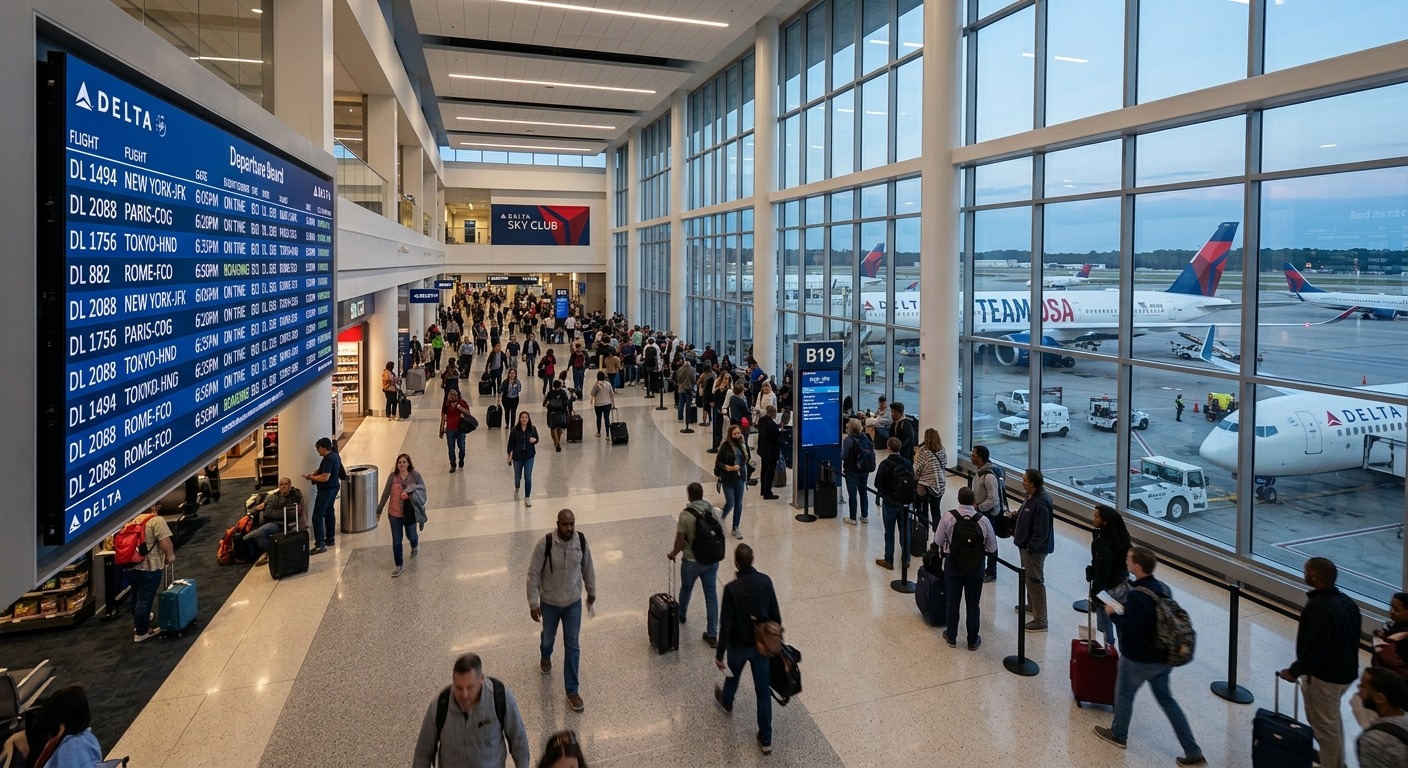
Delta’s Atlanta operation at Hartsfield-Jackson International Airport (ATL) is the airline’s largest and most profitable hub, often described by Delta as the world’s largest airline hub. ATL handled roughly 106.3 million total passengers in 2025, making it one of the busiest airports globally, with Delta operating nearly 1,000 peak-day departures to more than 200 destinations.
ATL functions as Delta’s primary connecting point between North America, Latin America, and the Caribbean. The airport has two main terminals Terminal South for domestic flights and Terminal North for international departures connected by an underground train. Delta operates Sky Club lounges throughout the airport, including locations in Concourse A (open 5:30 a.m.–10:30 p.m.), near Gate A17, Concourse C near Gate C37, Concourse D, and Concourse B near Gate 18. Hours can shift seasonally, so verify current access on delta.com before your trip.
Connection tip: Because ATL handles such heavy traffic, tight layovers carry more risk during peak travel periods or weather delays. Build in at least 60–90 minutes for domestic-to-domestic connections and longer for international transfers.
What Makes Delta’s Hub Strategy a Competitive Advantage?
Delta’s hub strategy works because concentrating operations at fewer airports lowers per-flight costs while multiplying the number of city pairs Delta can serve. A traveler flying from a smaller city like Boise can reach dozens of international destinations by connecting once through a major Delta hub, rather than requiring a direct flight that wouldn’t be commercially viable.
This consolidation also gives Delta negotiating leverage with airport authorities. In Minneapolis-St. Paul, for example, Delta committed to maintaining 10,000 Minnesota jobs and 400 daily departures under an agreement with the Metropolitan Airports Commission illustrating how deeply hub operations are woven into local economies.
Hub concentration does carry risk. When Delta experienced a global IT outage in July 2024 tied to a CrowdStrike software issue, the disruption cascaded across its hub network, costing the airline an estimated $500 million and triggering roughly 7,000 canceled flights. Hubs amplify efficiency during normal operations but can also amplify disruption when something goes wrong system-wide.
Which International Hubs Does Delta Operate?
Delta’s key international hubs and markets include Amsterdam, London-Heathrow, Paris-Charles de Gaulle, Seoul-Incheon, and Tokyo, alongside Latin American gateways in Bogotá, Lima, Mexico City, Santiago, and São Paulo. These hubs extend Delta’s network beyond North America through direct service and joint ventures with international partner airlines.
Delta’s Seoul-Incheon hub is particularly notable: it operates as part of a joint venture with Korean Air that includes a combined operation at that airport, giving travelers seamless connections across Asia. Delta’s transatlantic presence leans on long-standing joint ventures with Air France-KLM and Virgin Atlantic.
Who Are Delta’s Partner Airlines?
Delta’s airline partners include Aeroméxico, Air France, China Eastern, KLM, Korean Air, LATAM, Virgin Atlantic, and WestJet, all connected through the SkyTeam alliance Delta co-founded. These partnerships let SkyMiles members earn and redeem miles, access shared lounges, and book connecting itineraries across partner networks from Delta’s hubs.
|
Partner |
Region/Focus |
|
Air France-KLM |
Transatlantic, Europe |
|
Korean Air |
Asia, joint venture at Seoul-Incheon |
|
Virgin Atlantic |
U.S.-London combined schedules |
|
Aeroméxico |
U.S.-Mexico transborder |
|
LATAM |
North and South America |
|
WestJet |
Canada-U.S. transborder |
|
China Eastern |
China travel |
Delta holds formal joint cooperation agreements with Aeroméxico, Air France-KLM, Korean Air, LATAM, and Virgin Atlantic meaning these aren’t just codeshare arrangements but coordinated schedules, shared revenue, and aligned pricing on overlapping routes.
What Does a Delta Airlines Flight Actually Cost in Fees?
Delta’s checked baggage fees increased in April 2026 from 35/45/$150 to $45 for the first bag, $55 for the second bag, and $200 for a third bag on most domestic and short-haul international flights. These fees apply per direction of travel and can vary by fare class, route, SkyMiles Medallion status, and whether you hold a Delta-branded credit card.
Here’s how those fees add up in practice:
|
Scenario |
Cost |
|
One-way, 2 checked bags |
$45 + $55 = $100 |
|
Round trip, 2 bags each way |
$200 |
|
One-way, 3 checked bags |
$45 + $55 + $200 = $300 |
|
Round trip family, 3 bags each way |
$600 |
|
Round trip, 1 bag each way (old vs. new fee) |
$70 vs. 90(+20) |
Overweight and oversize bags carry additional charges reported by third-party sources at roughly $100 for bags 51–70 lbs and $200 for bags 71–100 lbs on U.S./Canada flights; bags over 100 lbs generally aren’t accepted. If your first bag is overweight, expect something like $45 + $100 = $145 each way though you should confirm exact figures on delta.com or in Delta’s Contract of Carriage, since fee schedules change without much notice.
One advantage of connecting through a hub like Atlanta on a single ticket: airlines typically check bags through to your final destination and charge the bag fee only once per direction, not once per segment. Confirm this applies to your itinerary before you fly, since policies vary by fare type.
What Benefits Do Delta’s Hubs Offer Travelers?
Delta’s hub network gives travelers more routing options, competitive connecting fares, and access to Sky Club lounges and elite status perks at major airports. Flying frequently through a single hub, like ATL or MSP, also accelerates SkyMiles Medallion status, which unlocks fee waivers, upgrades, and priority boarding advantages less available on point-to-point-only carriers.
Delta was named the No. 1 airline for Premium Economy satisfaction by J.D. Power in 2025, recognized as a top U.S. airline by the Wall Street Journal for a fourth consecutive year, and ranked North America’s most on-time airline by Cirium in 2025. Hub efficiency plays a direct role in those on-time numbers, since tighter, well-staffed connections reduce cascading delays.
Frequently Asked Questions
What is Delta’s largest hub?
Atlanta’s Hartsfield-Jackson International Airport is Delta’s largest hub, handling nearly 1,000 peak-day Delta departures to over 200 destinations and described by Delta as the world’s largest airline hub.
How many hubs does Delta Air Lines operate in the U.S.?
Delta operates nine primary U.S. hubs: Atlanta, Boston, Detroit, Los Angeles, Minneapolis-St. Paul, New York-JFK, New York-LaGuardia, Salt Lake City, and Seattle-Tacoma.
How much does Delta charge for a second checked bag?
As of April 2026, Delta charges $55 for a second checked bag on most domestic and short-haul international flights, up from $45 previously. Confirm current pricing on delta.com before booking.
Is Delta a member of SkyTeam?
Yes, Delta Air Lines is a founding member of the SkyTeam alliance, which connects it with partners including Air France-KLM, Korean Air, and Aeroméxico.
What is Delta’s hub for Asia travel?
Seattle-Tacoma and Detroit serve as Delta’s primary U.S. gateways to Asia, while Seoul-Incheon functions as an international hub through Delta’s joint venture with Korean Air.
Does connecting through Atlanta cost extra in bag fees?
No. Airlines typically charge checked bag fees once per direction of travel, not per connection, so a single-ticket itinerary through Atlanta shouldn’t incur duplicate bag charges. Confirm this in Delta’s Contract of Carriage for your specific fare.
Which airport is Delta’s primary transatlantic gateway?
New York-JFK serves as Delta’s primary transatlantic hub, offering extensive European service alongside transcontinental routes to Los Angeles and San Francisco.
How many destinations does Delta serve overall?
Delta serves more than 300 destinations across six continents through a combination of mainline, Delta Connection, and partner airline flights, according to Delta’s corporate facts page.
What changed in Delta’s baggage fee structure in 2026?
In April 2026, Delta raised checked bag fees roughly $10 on the first and second bags and $50 on the third bag, moving from 35/45/$150 to 45/55/$200 on most domestic and short-haul routes.
Which airlines partner with Delta for international connections?
Delta’s international partners include Air France-KLM, Korean Air, Virgin Atlantic, Aeroméxico, LATAM, China Eastern, and WestJet, each supporting connections through specific Delta hubs.

Azeem breaks down airline baggage policies, fare-class benefits, and peak pricing rules into practical guidance for smooth trip planning. He verifies every fee and dimension against official airline sources so travelers can pack with confidence.