Fly Gangwon Baggage Policy: Fees, Limits & Rules Explained
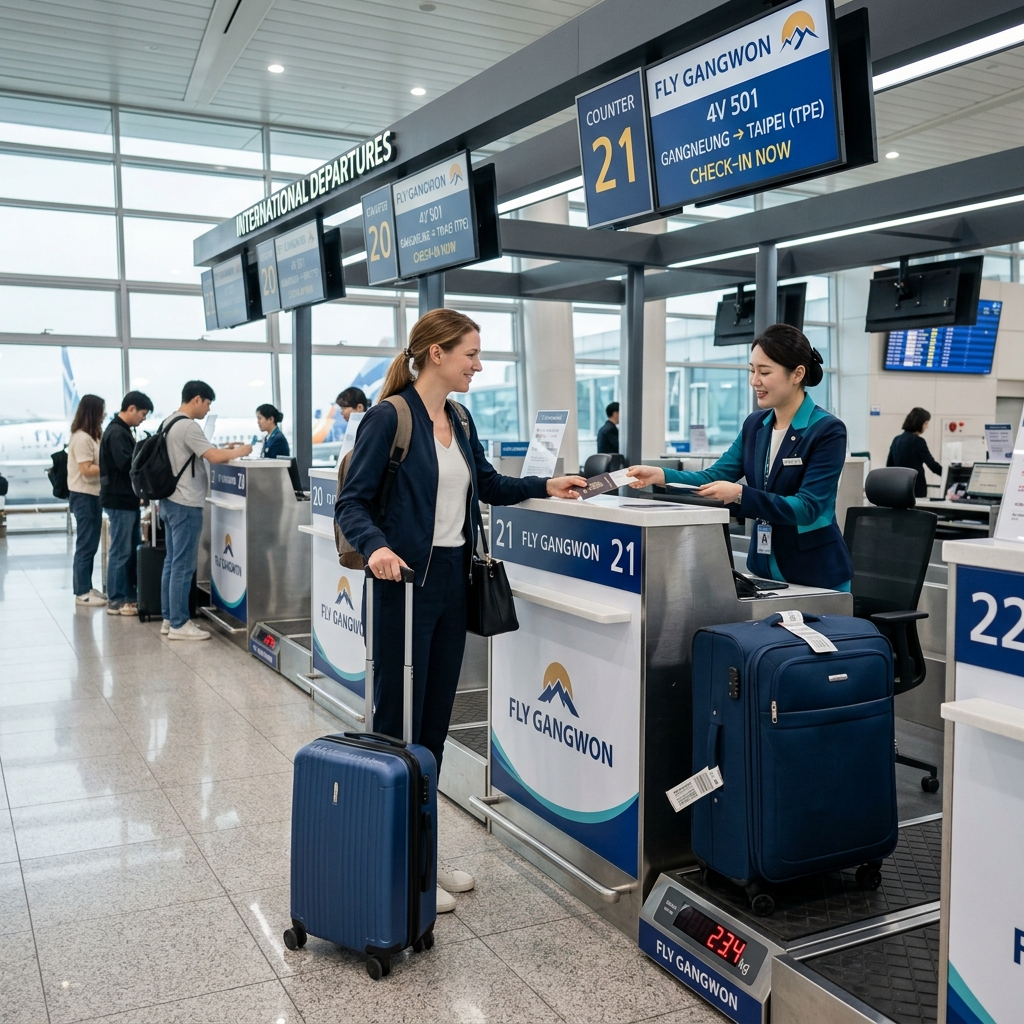
Fly Gangwon allowed one carry-on bag up to 10 kg (55x40x20 cm) and one free checked bag up to 15 kg (203 cm total dimensions) across all fare types. Excess baggage cost KRW 3,000/kg domestically. Since the airline suspended operations in 2023 and relaunched as Parata Air in 2024, its former baggage rules now serve mainly as historical reference for travelers researching old bookings or route history.
Fly Gangwon operated as a South Korean low-cost carrier from its Yangyang International Airport hub between 2019 and 2023, connecting Gangwon Province to destinations across Korea, Japan, Taiwan, and Southeast Asia. Even though the airline suspended flights in May 2023 and was reborn as Parata Air under new ownership in 2024, plenty of travelers still search for its baggage rules whether to understand historical bookings, compare policies with the airline’s successor, or research how Korean low-cost carriers typically structure their fees.
What was Fly Gangwon’s baggage policy?
Fly Gangwon gave every passenger, regardless of fare type, one free carry-on bag (up to 10 kg) and one free checked bag (up to 15 kg). This applied uniformly across the airline’s three fare tiers Super Fly, Smart Fly, and Standard Fly a rarity among budget carriers, which often reserve free checked baggage for higher-tier fares only.
Here’s a snapshot of the core allowances:
|
Baggage Type |
Allowance |
Weight Limit |
Size Limit |
|
Carry-on |
1 bag |
10 kg |
115 cm total (55x40x20 cm) |
|
Checked |
1 bag |
15 kg |
203 cm total dimensions |
|
Infant (international) |
1 bag + stroller |
10 kg |
|
|
Infant (domestic) |
Stroller/car seat only |
What was Fly Gangwon’s carry-on baggage policy?
Fly Gangwon’s carry-on policy allowed one cabin bag per passenger weighing no more than 10 kg, with total dimensions (length + width + height) not exceeding 115 cm, capped at 55 cm x 40 cm x 20 cm. This applied to every fare type, and bags exceeding the limit were subject to excess baggage charges at check-in.
A few practical details worth noting:
- The bag needed to fit under the seat in front of the passenger, since Fly Gangwon’s Boeing 737-800s had limited overhead bin space.
- Musical instruments could be carried on, provided they fit within the same 55 x 20 x 115 cm limit and stayed under 15 kg.
- Unlike full-service carriers such as Korean Air, which permit a separate personal item (like a laptop bag) alongside the carry-on, Fly Gangwon’s published policy didn’t clearly separate out a free personal item allowance travelers were generally expected to consolidate belongings into the single cabin bag.
What was Fly Gangwon’s checked baggage policy for economy passengers?
Since Fly Gangwon operated an all-economy cabin, every passenger regardless of fare tier received the same free checked baggage allowance: one bag up to 15 kg, with total dimensions not exceeding 203 cm. Bags heavier than 32 kg weren’t accepted under any circumstances, even with excess fees paid.
This is notably lower than Korean Air’s domestic Economy allowance of 20 kg, reflecting Fly Gangwon’s positioning as a strict low-cost carrier. For context on how this stacked up:
|
Airline |
Domestic Economy Checked Allowance |
|
Fly Gangwon |
15 kg |
|
Korean Air |
20 kg |
|
Air Seoul |
15 kg |
Special provisions applied to specific items:
- Golf clubs were counted as standard checked baggage with no extra fee a genuine perk compared to airlines that charge separately for golf equipment.
- Sporting equipment (other than golf) incurred a flat KRW 10,000 fee, regardless of whether the free weight allowance was exceeded.
- Infants traveling internationally received an extra 10 kg allowance plus a free foldable stroller; domestic infant travelers received a stroller or car seat allowance only.
What was Fly Gangwon’s baggage policy for international flights?
On international routes to destinations like Taipei, Da Nang, Hanoi, and Clark, Fly Gangwon applied the same base allowance as domestic flights 10 kg carry-on and 15 kg checked but added extra provisions for infants, including 10 kg of additional checked baggage and a free stroller. International passengers also faced earlier check-in cutoffs.
Check-in timing differed meaningfully between domestic and international departures:
|
Flight Type |
Airport Check-in Opens |
Airport Check-in Closes |
|
Domestic |
90 minutes before departure |
20 minutes before departure |
|
International |
2.5 hours before departure (3 hrs from Clark) |
50 minutes before departure |
|
Online (domestic) |
24 hours before |
1 hour before |
|
Online (international) |
24 hours before |
2 hours before |
Because Fly Gangwon didn’t belong to any airline alliance, international travelers couldn’t transfer baggage allowances or rely on partner-airline baggage agreements a contrast to alliance carriers like Korean Air, which coordinates checked baggage rules across Delta, Air France, and other SkyTeam partners.
How much did excess baggage cost on Fly Gangwon?
Fly Gangwon charged excess baggage per kilogram once a passenger exceeded the free 15 kg checked allowance, though the airline’s own published fee schedule wasn’t as granular as competitors like Air Seoul, which breaks fees down by route. Sporting equipment carried a flat KRW 10,000 surcharge on top of any excess weight charges.
To put this in perspective, here’s how a comparable Korean low-cost carrier (Air Seoul) structures its domestic excess fees, which gives a useful benchmark for what Fly Gangwon-style pricing looked like in practice:
Example calculation: A passenger checking a 20 kg suitcase (5 kg over the 15 kg allowance) on a domestic route priced at KRW 3,000/kg would pay an extra KRW 15,000 at the airport.
Example with sporting equipment: A passenger checking a 10 kg suitcase plus a 10 kg pair of skis would pay:
- Excess weight (5 kg over 15 kg allowance): KRW 15,000
- Special sporting goods fee: KRW 10,000
- Total additional charge: KRW 25,000
This structure a flat special-item fee stacked on top of standard per-kilogram excess charges is common across Korean low-cost carriers and is worth budgeting for if you’re traveling with skis, snowboards, or diving equipment.
How does Fly Gangwon’s old policy compare to Parata Air today?
Parata Air, which relaunched in 2024 under new ownership after acquiring Fly Gangwon’s certificate, kept the same core carry-on rules (10 kg, 115 cm total) but restructured checked baggage by route and fare class, and introduced a published per-kilogram excess fee schedule that Fly Gangwon never made fully public.
Here’s how the two compare directly:
|
Feature |
Fly Gangwon (2019–2023) |
Parata Air (2024–present) |
|
Carry-on limit |
10 kg, 1 bag |
10 kg, 1 bag (2 for Business Smart) |
|
Domestic checked baggage |
15 kg, all fares |
15 kg, all fares |
|
Excess fee (domestic) |
Not fully published |
KRW 3,000/kg (airport); KRW 10,000/5kg (advance) |
|
Personal item allowed |
Not clearly specified |
Yes, up to 40x30x15 cm |
|
Gate-check fee |
Not specified |
KRW 20,000 |
|
Sporting goods fee |
KRW 10,000/item |
KRW 20,000/item |
For travelers booking with Parata Air today, the excess baggage fees are meaningfully clearer and higher than what Fly Gangwon charged, particularly for sporting equipment, which doubled from KRW 10,000 to KRW 20,000 per item.
Why should you double-check baggage policies before flying a Korean low-cost carrier?
Baggage rules for Korean low-cost carriers change frequently due to rebranding, ownership changes, and route adjustments as demonstrated by Fly Gangwon’s transition to Parata Air. Always verify current allowances directly on the airline’s official website or through your booking confirmation before packing, since third-party travel sites may display outdated information.
Given that Fly Gangwon no longer operates flights, any traveler flying routes it once served (like Yangyang to Jeju or Taipei) should confirm current terms with Parata Air or whichever carrier now operates that route, rather than relying on legacy policy pages.
Frequently Asked Questions
Was Fly Gangwon’s checked baggage allowance the same for every fare type?
Yes. Unlike many low-cost carriers that reserve free checked baggage for premium fares, Fly Gangwon included one 15 kg checked bag across all three fare tiers: Super Fly, Smart Fly, and Standard Fly.
Did Fly Gangwon charge extra for golf clubs?
No. Golf clubs were treated as standard checked baggage and included in the free 15 kg allowance, unlike skis, snowboards, and other sporting equipment, which incurred a flat KRW 10,000 fee.
What happened to Fly Gangwon’s baggage policy after the airline shut down?
Fly Gangwon suspended operations in May 2023. After acquisition by Winix Inc., the airline relaunched as Parata Air in 2024 with an updated, more detailed baggage fee structure by route and fare class.
Could passengers bring a personal item in addition to their Fly Gangwon carry-on bag?
Fly Gangwon’s published policy didn’t specify a separate free personal item, unlike Korean Air, which permits a laptop bag or handbag (up to 40x30x15 cm) alongside the main carry-on.
How much heavier could a checked bag be before Fly Gangwon refused it outright?
Any single checked bag exceeding 32 kg wasn’t accepted under any circumstances, even if the passenger was willing to pay excess baggage fees.
Did infants get extra baggage allowance on Fly Gangwon international flights?
Yes. Infants on international routes received an additional 10 kg of checked baggage plus a free foldable stroller, while domestic infant travelers received a stroller or car seat allowance only, without extra weight.
How does Parata Air’s sporting goods fee compare to Fly Gangwon’s?
Parata Air charges KRW 20,000 per sporting goods item, double Fly Gangwon’s former KRW 10,000 flat fee for the same category.
Was Fly Gangwon part of an airline alliance that affected baggage transfers?
No. Fly Gangwon wasn’t a member of any global alliance like Star Alliance or SkyTeam, so passengers couldn’t rely on partner-airline baggage agreements for connecting itineraries.
What were Fly Gangwon’s musical instrument rules for checked baggage?
Instruments needed to be packed in a hard case, weigh no more than 15 kg, and fit within 55 cm x 20 cm x 115 cm dimensions to qualify as standard checked baggage.
Is it still possible to book a flight under the “Fly Gangwon” name?
No. Since the 2024 rebrand, all bookings and route operations fall under Parata Air; “Fly Gangwon” no longer exists as an operating airline brand.

Azeem breaks down airline baggage policies, fare-class benefits, and peak pricing rules into practical guidance for smooth trip planning. He verifies every fee and dimension against official airline sources so travelers can pack with confidence.