✈ Updated for July 2026

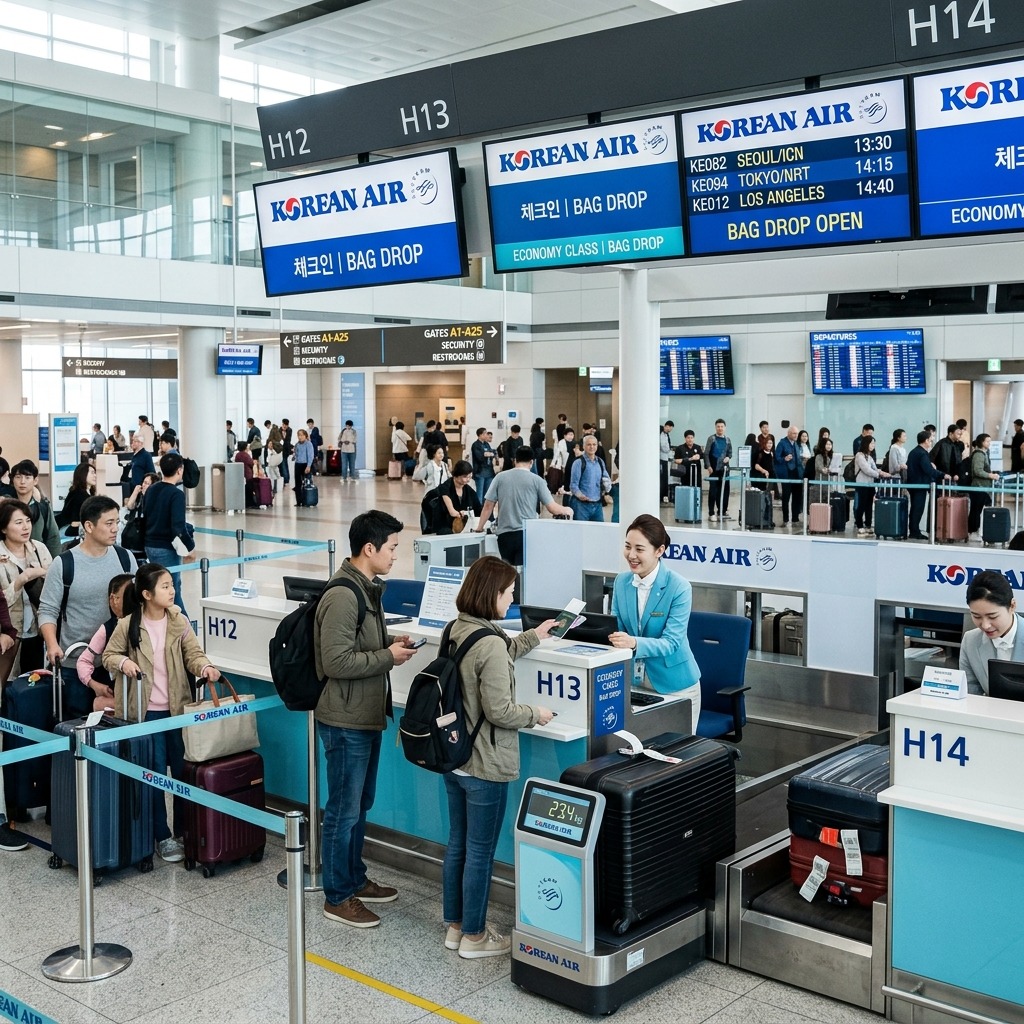
Korean Airlines Baggage Policy 2026

The complete 2026 Korean Air baggage guide — the December 17, 2026 Asiana merger and SKYPASS integration, Morning Calm Club and Morning Calm Premium Club tier perks, Piece vs Weight system by route, the 32 kg / 158 cm hard refusal rule, and every trick to survive Incheon without a fee surprise.

📅 Last Updated: July 23, 2026 ✍ By M Naeem ⏱ 11 min read
Korean Airlines Baggage Policy 2026 – Carry-on and checked bag rules
🚨 Big News — December 17, 2026 Merger

Korean Air Fully Absorbs Asiana — Baggage Impact Now Confirmed

After nearly six years of regulatory work, Korean Air will formally absorb Asiana Airlines on December 17, 2026. The Asiana brand disappears, and all 240 Asiana aircraft, staff, and routes fold into Korean Air under a single operating certificate. For baggage and loyalty this means:

  • Asiana Club members converting to SKYPASS. Existing Asiana Club tier balances migrate into Korean Air's SKYPASS scheme — details of the tier-matching are being finalised with regulators.
  • Asiana exits Star Alliance at 23:59 KST on December 16, 2026. From December 17, all former Asiana routes fly under SkyTeam alliance rules, meaning Star Alliance Gold recognition drops on those flights and SkyTeam Elite Plus applies instead.
  • Baggage rules on ex-Asiana routes align with Korean Air's for tickets issued on or after December 17, 2026. Existing Asiana bookings before that date honour whatever was printed on the ticket.
  • SkyTeam Elite Plus members get +1 checked bag on Korean Air metal — the same benefit that already applies to SKYPASS Morning Calm Club members.

Planning a trip to Seoul or connecting through Incheon? Korean Air is a world-class airline, but their baggage rules can be stricter than what you might be used to with U.S. or European carriers.

Whether you are flying Economy or First Class, knowing the rules before you pack is the only way to avoid hefty fees at the check-in counter.

At a Glance: Korean Air Baggage Allowance (2026)

Before diving into the fine print, here is the quick summary of what you are allowed to bring for free based on your ticket class.

Ticket Class Carry-On Allowance Checked Baggage (General International) Checked Baggage (Americas Routes)
Economy (Saver) 1 Bag + 1 Personal Item
(Max 10 kg / 22 lbs total)
1 piece (23 kg / 50 lbs) 1 piece (23 kg / 50 lbs)
Economy (Standard/Flex) 1 Bag + 1 Personal Item
(Max 10 kg / 22 lbs total)
1 piece (23 kg / 50 lbs) 2 pieces (23 kg / 50 lbs each)
Prestige (Business) 2 Bags + 1 Personal Item
(Max 18 kg / 40 lbs total)
2 pieces (32 kg / 70 lbs each) 2 pieces (32 kg / 70 lbs each)
First Class 2 Bags + 1 Personal Item
(Max 18 kg / 40 lbs total)
3 pieces (32 kg / 70 lbs each) 3 pieces (32 kg / 70 lbs each)

Note: "Americas" includes flights to/from the U.S., Canada, and Mexico. Brazil routes have specific exceptions (see below).

Korean Air Piece vs Weight System: Which Applies to Your Route? NEW

The biggest source of confusion at Korean Air check-in is that the airline uses two entirely different baggage systems depending on your route. Miss the split, and you'll either over-pack (paying overweight fees on Weight Concept routes) or under-pack (leaving allowance on the table on Piece Concept routes). Here's the mental model.

🇺🇸 Piece Concept

Where it applies: Any flight to or from the Americas — United States, Canada, Mexico, Brazil, and other Latin American countries.

How it works: Your allowance is counted in number of bags. Weight limits apply per bag, but you can't combine allowances across bags.

  • Economy: 1-2 pieces × 23 kg / 50 lbs each
  • Prestige: 2 pieces × 32 kg / 70 lbs each
  • First: 3 pieces × 32 kg / 70 lbs each

🌏 Weight Concept

Where it applies: All Asia, Europe, Oceania, Middle East, and Africa routes.

How it works: Your allowance is counted in total combined weight. You can split across as many bags as you want, subject to the 32 kg per-bag hard cap.

  • Economy: 1 bag × 23 kg / 50 lbs
  • Prestige: 2 bags × 32 kg / 70 lbs each
  • First: 3 bags × 32 kg / 70 lbs each
📌 The Practical Test

Look at your itinerary. If it touches the Americas at any point — including a Seoul → Los Angeles → Toronto trip, or a Vancouver → Incheon → Manila trip where Vancouver counts — Piece Concept applies to your whole ticket. Everything else is Weight Concept. This is set by US and Canadian regulator rules that extend the operating carrier of the first Americas-touching segment to the entire itinerary. Check your booking confirmation's "Free Baggage Allowance" line for the definitive answer.

Carry-On Baggage Rules

Korean Air is known for being stricter than average regarding cabin baggage weight. Unlike some US carriers that don't weigh carry-ons, Korean Air staff often weigh bags at the check-in counter or gate.

Economy & Premium Economy

  • Allowance: 1 Carry-on Bag + 1 Personal Item.
  • Weight Limit: 10 kg (22 lbs) TOTAL.
    • Crucial Note: This weight limit is combined. If your roller bag is 9 kg and your laptop bag is 3 kg, you are over the limit.
  • Dimensions:
    • Carry-on: Max 55 × 40 × 20 cm (21 × 15 × 8 in), and the sum of all three dimensions must not exceed 115 cm (45 in) linear.
    • Personal item: Must fit under the seat in front of you (e.g., handbag, laptop bag).

Prestige & First Class

  • Allowance: 2 Carry-on Bags.
  • Weight Limit: 18 kg (40 lbs) combined.
  • Dimensions: Same dimension limits per bag apply (55 × 40 × 20 cm / 21 × 15 × 8 in and 115 cm / 45 in linear).

Pro-Tip: Musical instruments less than 115 cm (45 in) total linear dimensions are allowed as free carry-on, provided they fit in the overhead bin. Violins usually fit; guitars usually do not.

📌 Backpack as Personal Item? Under Seat = Personal, Overhead = Carry-On NEW

A common source of gate disputes at Incheon: a small backpack that fits under the seat in front of you counts as your personal item. A larger backpack that goes in the overhead bin counts as your carry-on bag and takes the place of your roller. The rule follows storage location, not the shape of the item. If your backpack is stuffed enough that it won't fit under the seat, it becomes your carry-on and you cannot also bring a rolling suitcase on Economy. Test-fit at home by placing the packed backpack on the floor next to your desk and sliding your feet forward against it — if your feet still fit, you're fine at Korean Air's under-seat frame.

SKYPASS Tier Baggage Benefits: Morning Calm, Premium & Million Miler NEW

Korean Air's frequent flyer programme is SKYPASS, and it has three lifetime-adjacent elite tiers: Morning Calm Club, Morning Calm Premium Club, and Million Miler Club. Unlike most airline programmes, SKYPASS status is valid for two years per qualification cycle rather than one — a rare piece of good news for infrequent international travellers. Here's what each tier unlocks for baggage on Korean Air and SkyTeam partner metal.

Morning Calm Club
+1 piece

SkyTeam Elite recognition. One extra checked bag on Korean Air and SkyTeam partner flights (matching cabin weight). Priority baggage handling — your bag hits the belt first. 4 lounge passes per year at Korean Air lounges.

Morning Calm Premium Club
+1 piece

SkyTeam Elite Plus recognition. Same +1 checked piece benefit as Morning Calm, plus First Class check-in access, lounge access on every Korean Air flight, off-peak award redemption, and priority security screening at Incheon.

Million Miler Club
+1 piece

Lifetime status. Same +1 checked piece as the other tiers, plus lifetime SkyTeam Elite Plus recognition — no more qualifying every 2 years. Earned once you cross 1 million SKYPASS miles.

How SkyTeam Cross-Alliance Baggage Works

Your Korean Air SKYPASS status is recognised across every SkyTeam partner: Delta, Air France-KLM, Aeromexico, ITA Airways, China Airlines, Vietnam Airlines, and Saudia. But the recognition works on tier equivalence, not on the specific SKYPASS name:

✅ Morning Calm Club = SkyTeam Elite

  • Standard SkyTeam Elite benefits on any partner
  • Priority check-in on partner airlines
  • No guaranteed extra checked bag on partner metal — depends on individual partner's Elite baggage policy

✅ Morning Calm Premium + Million Miler = SkyTeam Elite Plus

  • Full SkyTeam Elite Plus benefits on every partner
  • +1 extra checked bag on partner metal (typically 23 kg / 50 lbs matched to cabin)
  • Priority boarding, lounge access via SkyTeam Elite Plus rules
💡 The Codeshare Exception

Elite benefits may not apply on codeshare-operated flights, depending on the codeshare agreement between the two airlines. For example, a Delta-operated flight sold under a Korean Air "KE" flight number — the extra baggage benefit follows Delta's rules for SkyTeam Elite Plus, not Korean Air's SKYPASS specifics. Always check "Free Baggage Allowance" on your booking confirmation for the definitive answer on codeshare tickets.

Checked Baggage Policy 2026

The checked allowance depends heavily on your route and when you purchased your ticket.

1. International Flights (To/From Americas)

This is the most common route for Western travelers (e.g., Los Angeles to Seoul).

  • Standard Economy: 2 Free Bags (23 kg / 50 lbs each).
  • Economy Saver: Only 1 Free Bag (23 kg / 50 lbs).
  • Prestige: 2 Free Bags (32 kg / 70 lbs each).

2. General International (Asia, Europe, Oceania)

  • All Economy: 1 Free Bag (23 kg / 50 lbs).
  • Prestige: 2 Free Bags (32 kg / 70 lbs each).

3. Domestic Flights (Within Korea)

  • Economy: Total weight allowance of 20 kg / 44 lbs (no piece limit, just total weight).
  • Prestige: Total weight allowance of 30 kg / 66 lbs.

Important Update: Brazil Routes 2025/2026

Historically, flights to/from Brazil had generous 2-bag allowances for everyone.

However, for tickets issued after June 30, 2025, the Economy Saver allowance drops to 1 bag (23 kg / 50 lbs). If you are booking travel for 2026 on a Saver fare, be aware of this reduction.

Korean Air on Domestic Korean Routes: How the Rules Differ NEW

Korean Air's domestic network — Seoul (Gimpo/Incheon) to Busan, Jeju, Daegu, Gwangju, Ulsan, and other regional airports — runs on entirely different baggage rules from international flights. Weight Concept applies (total kilos, not piece count), the ceilings are lower, and free carry-on is more restrictive.

Domestic Feature Economy Prestige (Business)
Checked baggage 20 kg / 44 lbs total (any number of pieces) 30 kg / 66 lbs total (any number of pieces)
Carry-on 1 piece × 10 kg / 22 lbs (55 × 40 × 20 cm / 21 × 15 × 8 in) 2 pieces × 18 kg / 40 lbs total
Personal item 1 (under-seat only) 1 (under-seat only)
Overweight fee (Domestic) KRW 2,000 (~$1.50) per kg over KRW 2,000 (~$1.50) per kg over
Sports gear waiver ✅ Applies ✅ Applies
💡 The Gimpo-Jeju Weekend Optimisation

On the ultra-busy Gimpo → Jeju weekend route (the world's most-flown air corridor by seat count), Korean Air enforces the 20 kg domestic Economy limit strictly. Two people travelling together on the same booking cannot pool weight officially — each passenger's 20 kg is individual. However, distributing packing between two suitcases at 18 kg and 20 kg respectively is cheaper than one 25 kg suitcase paying KRW 10,000 (~$7.50) overweight. Do the math before you pack.

Excess Baggage Fees

If you exceed your free allowance, the fees on Korean Air are charged based on the "Piece Concept." Prices vary by departure country currency.

Fees for Flights to/from the U.S. (USD):

  • Additional Bag (2nd piece for Saver fares): ~$100 USD (varies by route).
  • Additional Bag (3rd piece+): $200 USD per bag.
  • Overweight (24 kg – 32 kg / 53-70 lbs): $100 USD.
  • Overweight (33 kg – 45 kg / 73-99 lbs): $200 USD.
  • Oversize (159 cm – 203 cm / 63-80 in): $200 USD.

Note: Korean Air will strictly not accept any bag over 32 kg (70 lbs) or 158 cm (62 in) on certain routes, regardless of the fee paid, due to labor safety regulations. Always check beforehand.

The 32 kg / 158 cm Hard Refusal Rule: What Won't Fly at Any Price NEW

Korean Air's most under-appreciated rule is the absolute hard refusal at 32 kg (70 lbs) per bag and 158 cm (62 in) total linear dimensions on most international routes. This isn't an overweight fee scenario — it's a physical refusal. You cannot pay your way through it, and the reason is not commercial; it's a labor safety regulation designed to protect ground handlers from lifting injuries.

⚠ Labor Safety Rule

Bags Over 32 kg or 158 cm Cannot Be Checked at Any Price

On flights to/from the United States, Canada, and select other jurisdictions, Korean Air ground staff will not accept a single bag heavier than 32 kg (70 lbs) or larger than 158 cm (62 in) linear, regardless of your fare class, elite status, or willingness to pay overweight fees. The rule protects handlers from cumulative back injury.

Your options if you arrive with a 33 kg bag:

  • Repack at the check-in counter — redistribute weight into a second bag, checked at the extra-piece fee.
  • Ship as Korean Air Cargo — a separate service with its own booking, pricing, and drop-off procedures. Not a same-day option at most airports.
  • Leave items behind — the counter agent will help you split off the heaviest items; Incheon has package-hold services if a friend can retrieve them.
📌 Where the Refusal Rule Applies

Strictly enforced: US, Canada, and Brazil routes (the Piece Concept corridor). Also enforced on most European long-haul routes. On some intra-Asian routes and Korean domestic flights, staff may accept bags between 32-45 kg with a heavy overweight fee, but this is at agent discretion and not policy. If your bag will be over 32 kg, plan for the refusal scenario before you leave home — showing up hoping to talk your way through it is the worst place to discover the rule.

Prestige (Business) vs First Class Baggage Compared NEW

Most Korean Air baggage guides conflate Prestige and First Class as "premium cabins" and gloss over the differences. In reality, First Class buys you one additional checked piece — that's the whole delta. Weight limits, dimensions, carry-on rules, and premium services are otherwise identical.

💼 Prestige Class (Business)

  • Checked: 2 pieces × 32 kg / 70 lbs each
  • Carry-on: 2 bags + 1 personal item, 18 kg / 40 lbs combined
  • Total checked capacity: 64 kg / 141 lbs
  • Total carry-on capacity: 18 kg / 40 lbs
  • Grand total: ~82 kg / 181 lbs

👑 First Class

  • Checked: 3 pieces × 32 kg / 70 lbs each
  • Carry-on: 2 bags + 1 personal item, 18 kg / 40 lbs combined
  • Total checked capacity: 96 kg / 212 lbs
  • Total carry-on capacity: 18 kg / 40 lbs
  • Grand total: ~114 kg / 251 lbs
📌 The Only Real Difference

Both Prestige and First Class receive dedicated check-in counters, priority baggage tags, priority boarding, and lounge access. The only substantive baggage difference is +1 checked piece in First Class (up to 32 kg / 70 lbs of extra allowance). Whether that's worth the fare premium depends on whether you're actually going to fill a third 32 kg bag. For most passengers who aren't relocating, moving art, or transporting professional gear, the Prestige allowance (64 kg checked) is already more than sufficient.

Special Items: Sports & Infants

Sports Equipment (The "Waiver" Rule)

Korean Air has a friendly policy for sports gear like golf clubs, skis, snowboards, and scuba gear.

  • The Rule: If your sports bag + standard checked bag combined weight is within your ticket's weight allowance (e.g., 23 kg / 50 lbs), the oversize fee is waived for the sports bag (up to 292 cm / 115 in).
  • Example: You check a suitcase (10 kg / 22 lbs) and a Golf Bag (12 kg / 26 lbs). Total = 22 kg / 48 lbs. Since this is under the 23 kg limit, you pay no extra fees, even if the golf bag is physically large.

Traveling with Infants

  • International: You can check 1 bag (10 kg / 22 lbs) + 1 fully collapsible stroller + 1 car seat (or bassinet).
  • Domestic: 1 stroller + 1 car seat.

Korean Air Prohibited & Restricted Items Checklist NEW

Beyond weight and size limits, certain items face outright bans or strict handling rules on Korean Air. Some are safety-critical enough to trigger security holds at Incheon. Here's the checklist to run through before you pack — organised by where each item can and cannot go.

Carry-On Only

🔋 Lithium Batteries & Power Banks

Power banks and spare lithium batteries are strictly forbidden in checked baggage — must travel in cabin baggage only. Maximum 160 Wh per battery. Cases must be individually taped or in original retail packaging to prevent short-circuits. Bluetooth earphone cases count as power banks.

Cabin Only

💊 Prescription Medications

Keep all essential medications in carry-on baggage — cabin temperature and pressure protect them, and checked bag delays can be dangerous. Bring prescriptions in original labeled bottles; liquid medications over 100 ml are exempted from the standard security limit with documentation.

US Route Rule

🌡 Powders Over 350 ml on US Routes

US-bound flights follow TSA powder rules — any powder-like substance over 350 ml / 12 oz in carry-on faces additional screening at Incheon security and may be refused if unable to be scanned clearly. Baby formula and medically necessary powders are exempt with documentation.

Prohibited Everywhere

🚭 E-Cigarettes & Vape Devices

E-cigarettes, vape pens, and heated tobacco devices (like IQOS) must be in carry-on only — never checked. Use, charging, or activation of any vape device is prohibited throughout the flight, including in bathrooms. Refills over 100 ml follow standard liquid rules.

Cargo Only

⚔ Firearms & Ammunition

Firearms must be declared and travel as checked baggage in a locked hard case. Ammunition maximum 5 kg / 11 lbs per person, in original packaging. Requires 48-hour advance notification through Korean Air reservations. Weapons cannot travel as carry-on under any circumstances.

Prohibited

🚫 Flammable Liquids

Perfumes over 500 ml, lighter fluid, paint thinners, and camping fuels are prohibited in both cabin and checked baggage. Aerosol cans over 500 ml also prohibited. Small personal-care aerosols (deodorants, hairsprays) under 500 ml are permitted in checked baggage only.

⚠ The Loose Lithium Battery Rule

Loose lithium batteries — the ones not inside a device — cause more Korean Air security holds at Incheon than any other single category. If a battery is not physically installed in an electronic device, it must be individually protected (original retail packaging, individual plastic bag, or terminals taped over) and travel in carry-on only. Discovering loose batteries in checked baggage during hold screening triggers a security escalation that can delay the entire aircraft.

Asiana Merger Impact on Baggage: What Changes December 17, 2026 NEW

The formal Korean Air-Asiana merger completes on December 17, 2026. From that date, Asiana Airlines ceases to exist as an independent operating carrier, its 240 aircraft join the Korean Air fleet, and Asiana Club members convert into SKYPASS members. Here's what actually changes for your baggage.

📅 Tickets Issued Before Dec 17, 2026

  • Asiana Club allowances honoured on Asiana-operated flights already booked
  • Asiana's baggage rules apply on flights operated by Asiana metal until service transitions to Korean Air branding
  • Existing bookings unaffected — whatever was printed on the ticket is what will be enforced at check-in

📅 Tickets Issued On/After Dec 17, 2026

  • Korean Air's baggage rules apply on all routes — including ex-Asiana routes
  • Asiana Club status converts to SKYPASS Morning Calm Club or equivalent (tier-matching finalised with regulators)
  • Former Asiana routes fly under SkyTeam alliance rules — no more Star Alliance recognition

What Asiana Club Members Should Do Now

If you hold Asiana Club status heading into the merger:

  1. Track SKYPASS tier-matching announcements throughout Q4 2026 — Korean Air will publish the specific conversion rules for Asiana Club Diamond Plus, Diamond, Gold, and Silver tiers.
  2. Use existing Asiana Club miles before conversion if the conversion ratio disadvantages you. Book award flights during 2026 to lock in Asiana redemption values.
  3. Note the alliance change: If Star Alliance benefits mattered to you (Lufthansa, United, Turkish Airlines lounge access), those disappear on ex-Asiana routes after Dec 17. SkyTeam lounges become available instead (Air France-KLM, Delta, ITA, Aeromexico).
  4. Baggage-wise: The SKYPASS extra-piece benefit is comparable to what Asiana Club offered, so on this dimension nothing meaningful changes.
💡 The Seamless Baggage Program Bonus

Korean Air's tie-up with Delta at Seattle and Los Angeles includes a Seamless Baggage Transfer program — checked bags can be tagged through from origin to final destination on connecting flights without needing to be re-checked between operating carriers. Post-merger, this program is expected to expand across ex-Asiana routes as well, dramatically reducing missed-connection baggage issues on trans-Pacific itineraries via Seattle or LAX.

Common Questions

Is Korean Air strict about carry-on weight?

Yes. Unlike many U.S. carriers, Korean Air ground staff frequently weigh carry-on bags at check-in. Ensure your roller bag and personal item combined do not exceed 10 kg / 22 lbs (Economy).

Can I pay for extra baggage in advance?

Yes, you can prepay for up to 3 extra bags via the Korean Air website or app. This typically offers a discount compared to airport rates. However, this option is usually not available for code-share flights (e.g., a flight operated by Delta).

Does a laptop bag count as a personal item?

Yes. A laptop bag, handbag, or small briefcase counts as your one personal item. It must fit under the seat in front of you.

What are the rules for Lithium Batteries?

Loose lithium batteries (power banks) are strictly forbidden in checked luggage. They must be in your carry-on. The limit is 160 Wh per battery.

I am a SKYPASS Morning Calm member. Do I get extra bags?

Yes. Morning Calm Club members typically get 1 extra piece of baggage free (excluding flights to/from Americas on Economy tickets).

What happens to my Asiana Club status after the December 17, 2026 merger? NEW

Your Asiana Club status will convert to an equivalent tier in Korean Air's SKYPASS programme when the merger completes on December 17, 2026. Korean Air is finalising the tier-matching rules with regulators, but the general expectation is: Asiana Club Diamond Plus → SKYPASS Million Miler equivalent (lifetime), Asiana Club Diamond → Morning Calm Premium Club, and Asiana Club Gold/Silver → Morning Calm Club. Baggage benefits (+1 checked piece) should carry through cleanly. Note that ex-Asiana routes will switch from Star Alliance to SkyTeam recognition — so if you rely on Lufthansa or United lounge access, that changes.

Does Korean Air use Piece Concept or Weight Concept? NEW

Both — depending on the route. Piece Concept applies to all flights touching the Americas (US, Canada, Mexico, Brazil, other Latin American countries). Weight Concept applies to everything else: Asia, Europe, Oceania, Middle East, and Africa routes. Domestic Korean flights also use Weight Concept (20 kg / 44 lbs Economy, 30 kg / 66 lbs Prestige total). Check your booking confirmation's "Free Baggage Allowance" line — if it lists a number of pieces you're on Piece; if it lists total kilograms you're on Weight.

Can I really not check a 33 kg bag on Korean Air even if I pay the overweight fee? NEW

Correct — on most international routes (particularly US, Canada, and Brazil), Korean Air will refuse a single bag over 32 kg / 70 lbs regardless of how much overweight fee you're willing to pay. This is a labor safety rule to protect ground handlers from lifting injuries, not a commercial decision. Your only options are to redistribute weight into a second bag (paying the extra-piece fee) or ship the excess as Korean Air Cargo (a separate service). Some intra-Asian routes may accept up to 45 kg / 99 lbs at agent discretion with heavy overweight fees, but never count on it.

Final Thoughts

The most common mistake travelers make is ignoring the 10 kg (22 lbs) combined carry-on limit.

Pack smart, weigh your bags at home, and double-check your specific e-ticket for the final word on your allowance.

✈ Ready to Fly?

Disclaimer: Airline policies are subject to change without notice. Always verify the latest details on the official Korean Air website before flying — especially through the December 17, 2026 Asiana merger transition and SKYPASS integration, both of which continue to roll out across the network into 2027.

Similar Posts

Leave a Reply

Your email address will not be published. Required fields are marked *