Simrik Airlines Baggage Policy: Fees, Limits & Rules
Simrik Airlines, a Nepalese domestic carrier that operated from 2009 to 2021, allowed 15–20 kg of checked baggage and 5 kg of hand baggage on its domestic routes, depending on the ticket and travel period. The airline never flew international routes, offered no online check-in, and rebranded to Guna Airlines in 2021.
Anyone researching Simrik Airlines’ baggage rules today is typically doing so for one of two reasons: historical curiosity about a now-defunct Nepalese carrier, or genuine confusion after seeing the airline referenced in booking engines, travel forums, or archived pages that haven’t been updated since operations ceased. Either way, the details matter, especially since Simrik’s baggage rules differed from what most international travelers expect from larger carriers.
What Was Simrik Airlines and Why Did Its Baggage Policy Matter?
Simrik Airlines was a Nepalese domestic airline, founded in 2009, that operated scheduled flights, mountain flights, and charter services within Nepal using small turboprop aircraft until it ceased operations and rebranded to Guna Airlines in 2021. Its baggage policy mattered because its fleet’s small cabin size made strict weight and size enforcement more consequential than on larger jets.
Operating out of Tribhuvan International Airport in Kathmandu, Simrik served routes to Pokhara, Nepalgunj, Bhairahawa, Bharatpur, Simara, Surkhet, and Khamidanda. The airline used a fleet of Beechcraft 1900 and BAe Jetstream 41 aircraft, both of which seat fewer than 30 passengers and have tightly limited cargo holds. This mattered practically: unlike a wide-body jet where a few extra kilograms barely register, weight distribution on a 19-to-29-seat aircraft directly affects fuel calculations and balance, which is part of why airlines like Simrik enforced baggage limits closely.
What Was the Simrik Airlines Checked Baggage Allowance?
Simrik Airlines’ standard checked baggage allowance was 15 kg for domestic economy tickets, though some travelers reported allowances of up to 20 kg depending on fare type and booking date. Baggage exceeding 32 kg per piece was never accepted, in line with international health and safety handling regulations.
|
Baggage Type |
Allowance |
Notes |
|
Checked baggage (standard) |
15 kg |
Per published airline data (2018–2020) |
|
Checked baggage (some fares/routes) |
Up to 20 kg |
Reported by passengers on Kathmandu–Pokhara route |
|
Maximum single piece weight |
32 kg |
Hard limit under international handling regulations |
|
Excess baggage |
Additional per-kg fee |
Rate not publicly listed; charged at check-in |
The discrepancy between the 15 kg figure listed in airline directories and the 20 kg some travelers reported likely reflects Simrik adjusting allowances by fare class or promotional period, a common practice among Nepal’s domestic carriers. If you’re referencing an old Simrik e-ticket or itinerary, always check the fare rules printed on it rather than relying on a single published figure, since allowances weren’t applied uniformly across the airline’s lifespan.
What Was the Simrik Airlines Hand Baggage Allowance?
Simrik Airlines permitted 5 kg of hand baggage per passenger, which had to fit in the overhead locker or under the seat in front. The airline didn’t publish exact hand baggage dimensions, but comparable Nepalese carriers cap cabin bags at 55 cm x 40 cm x 20 cm, a useful benchmark for anyone packing for a similar regional flight.
Liquids in carry-on bags were capped at 100 ml per container, consistent with standard international aviation security rules. Items exceeding this limit, along with any prohibited or dangerous goods, were confiscated at the security checkpoint rather than at the boarding gate, meaning travelers found out about violations earlier in the process than they might on some other carriers.
What Happened If You Exceeded Simrik Airlines’ Baggage Limit?
Passengers exceeding Simrik Airlines’ checked baggage allowance paid an additional per-kilogram fee at check-in, though the airline never published a fixed rate publicly. Based on comparable Nepalese domestic carriers, excess baggage fees for similar routes ranged from roughly NPR 95 to NPR 435 per kilogram.
For context on what this may have looked like in practice:
- Buddha Air charged NPR 165 per kg on Kathmandu–Pokhara and NPR 210 per kg on Kathmandu–Bhairahawa
- Yeti Airlines charged NPR 150 per kg on Kathmandu–Pokhara and Kathmandu–Bhairahawa routes
- Both airlines applied 13% VAT and, in some cases, GST on top of the per-kg rate
If Simrik’s rates tracked similarly, a passenger overweight by 5 kg on a Kathmandu–Pokhara route may have paid somewhere between NPR 750 and NPR 1,050 in excess fees, a meaningful add-on given that base one-way fares on this route were often quoted around USD 75–120. This is a detail competitor pages don’t calculate, but it’s the kind of real-world number that helps travelers budget accurately when researching regional Nepalese air travel.
What Items Were Prohibited in Simrik Airlines Baggage?
Simrik Airlines prohibited all standard dangerous goods in both checked and hand baggage, including flammable materials, compressed gases, corrosives, and explosives, in line with Nepal’s Civil Aviation Authority (CAAN) regulations. Liquids over 100 ml were restricted to checked baggage only.
Commonly restricted items across Nepalese domestic carriers, which likely applied to Simrik as well, included:
- Flammable liquids and aerosols (lighter fluid, certain perfumes in bulk)
- Compressed gases and pressurized canisters
- Corrosive substances, including wet-cell batteries
- Explosives, fireworks, and matches in bulk
- Sharp objects like scissors, knives, and trekking poles (checked baggage only)
- Sporting equipment such as cricket bats or golf clubs (checked baggage only)
Trekking poles are worth flagging specifically, since Simrik operated routes popular with hikers heading to Pokhara and Himalayan trailheads. These had to be checked rather than carried on, a detail easy to miss when packing for a trekking trip.
How Did the Simrik Airlines Check-in Process Work?
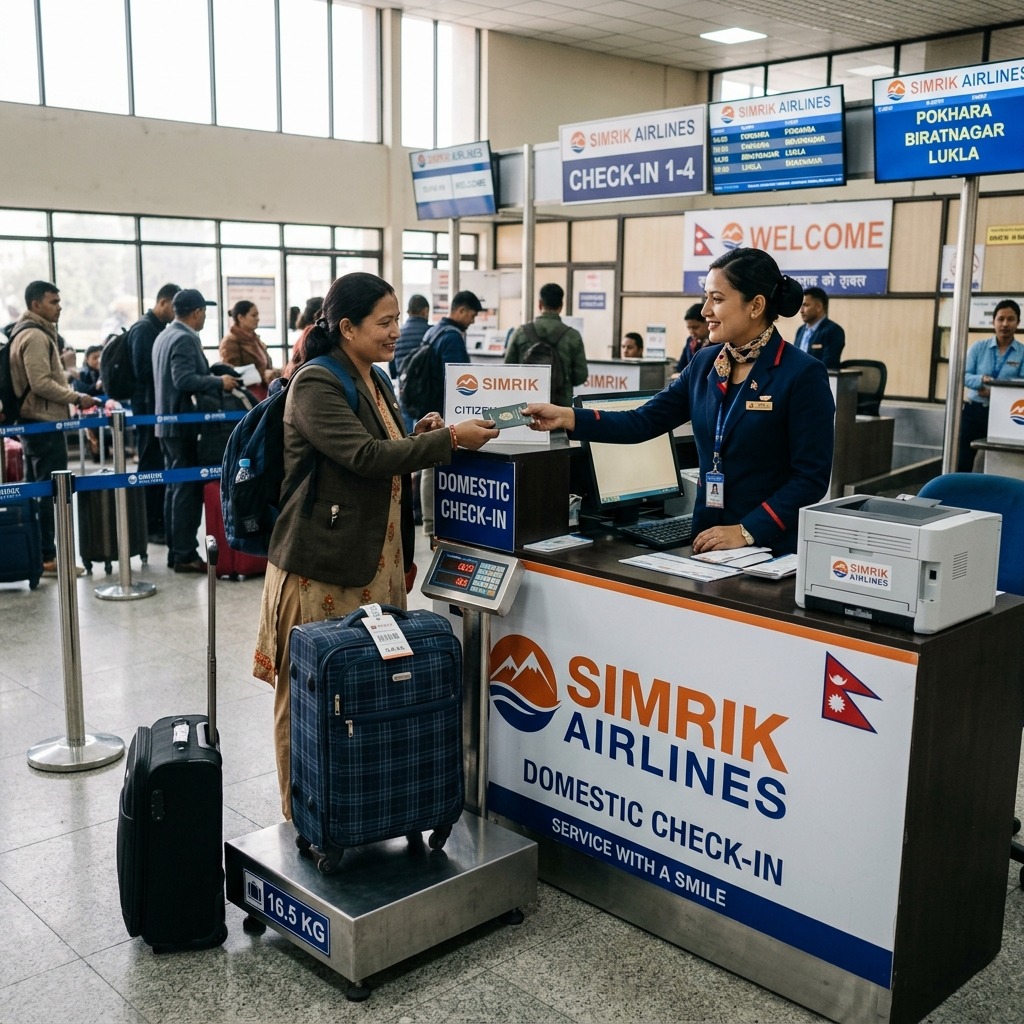
Simrik Airlines did not offer online check-in; all passengers, regardless of whether they carried checked baggage, had to check in at the airport counter before their flight. Passengers were advised to report to the designated Simrik counter as soon as they arrived at the terminal.
This is a meaningful difference from larger international carriers, where online or mobile check-in is standard. Airport-only check-in, combined with the airline’s history of delays (multiple traveler reviews cite delays of 20 minutes to over an hour), meant arriving early wasn’t just a suggestion; it was often necessary to avoid missing a flight, particularly during peak trekking season when counters were busier.
What Was Simrik Airlines’ Baggage Policy for International Economy Travelers?
Simrik Airlines never operated international routes; it was strictly a domestic Nepalese carrier. International travelers who flew Simrik typically did so as a connecting domestic leg after arriving at Tribhuvan International Airport on an international carrier such as Thai Airways, Etihad, Turkish Airlines, or Air Asia.
This distinction matters for a specific reason: baggage allowances don’t automatically carry over between an international flight and a connecting domestic one, especially when the two aren’t on the same ticket or alliance. A passenger arriving from an international economy fare with a 23 kg or 30 kg checked allowance would still have been held to Simrik’s 15–20 kg domestic limit on the connecting flight. This gap in allowance was, and still is, a common surprise for travelers connecting from long-haul international economy to small regional carriers anywhere in South Asia, not just with Simrik. Anyone booking a similar itinerary today on Simrik’s successor routes should treat the domestic leg’s allowance as the binding limit, not the international one.
How Did Simrik Airlines’ Baggage Policy Compare to Other Nepal Domestic Airlines?
Simrik Airlines’ 15–20 kg checked baggage allowance was in line with, or slightly below, comparable Nepalese carriers like Buddha Air and Yeti Airlines, both of which offered tiered allowances of 15–25 kg depending on fare class.
|
Airline |
Checked Baggage |
Hand Baggage |
Excess Fee Range (per kg) |
|
Simrik Airlines |
15–20 kg |
5 kg |
Unpublished (est. NPR 95–435 based on comparable carriers) |
|
Buddha Air |
15–25 kg (fare-dependent) |
5 kg |
NPR 95–435 |
|
Yeti Airlines |
Fare-dependent |
5 kg |
NPR 100–250 |
Choose a carrier with a higher base checked allowance, such as Buddha Air’s top Y fare at 25 kg, if you’re traveling with trekking gear or bulkier luggage. Choose the cheapest base fare, historically Simrik’s positioning, if minimal luggage and lower ticket cost matter more than allowance flexibility. Multiple traveler reviews noted Simrik was consistently the most affordable option on Kathmandu–Pokhara routes, which may explain why its baggage allowances ran slightly leaner than competitors.
What Should Travelers Know About Flying on Simrik’s Small Aircraft?
Simrik Airlines operated Beechcraft 1900 and BAe Jetstream 41 aircraft, both seating fewer than 30 passengers, which meant strict enforcement of baggage limits and very limited onboard storage compared to standard commercial jets. Overhead space was minimal, and larger carry-on bags often didn’t fit as expected.
Passenger reviews consistently note the practical impact of this small-aircraft setup:
- Cabin space was cramped, particularly for passengers over six feet tall
- Aircraft interiors were dated, with some reviewers noting scratched, dirty windows that reduced visibility on mountain-view flights
- Baggage had to be more strictly weighed and measured due to weight-and-balance requirements on smaller aircraft
- Boarding sometimes happened in a single-file line along one side of the cabin, leaving little room to maneuver oversized carry-ons
For travelers flying similar aircraft on successor routes today, packing light and choosing a soft-sided carry-on rather than a rigid suitcase makes it considerably easier to fit hand baggage into the limited overhead space.
What Is Guna Airlines’ Baggage Policy After the 2021 Rebrand?
Guna Airlines, the rebranded successor to Simrik Airlines, has not published a finalized baggage policy as of its relaunch, though it has confirmed that checked baggage will not exceed 32 kg per piece, consistent with international handling regulations. Carry-on rules mirror Simrik’s former policy: bags must fit in the overhead locker or under the seat, with a 100 ml liquid limit.
Guna Airlines relaunched with two Beechcraft 1900C aircraft it already owned, plus five additional Jetstream J41 aircraft acquired from Yeti Airlines, planning to serve routes including Simara, Bharatpur, Janakpur, Bhadrapur, Biratnagar, Nepalgunj, and Tumlingtar. Like Simrik, it does not offer online check-in or a frequent flyer program. Travelers planning to fly Guna Airlines should contact the airline directly or check their e-ticket for the most current baggage figures, since specific weight allowances may still be finalized on a route-by-route basis.
Frequently Asked Questions
Did Simrik Airlines charge different baggage fees for different routes?
Simrik Airlines didn’t publish a route-by-route excess baggage fee chart. However, comparable carriers like Buddha Air charged between NPR 95 and NPR 435 per kg depending on distance, suggesting Simrik’s fees likely varied similarly by route.
Could you bring trekking poles on a Simrik Airlines flight?
Trekking poles were not permitted in hand baggage due to their sharp points but could be packed in checked baggage. This applied broadly across Nepalese domestic carriers serving trekking routes like Pokhara.
Did Simrik Airlines allow extra baggage for infants or children?
Simrik Airlines did not publish a distinct child or infant baggage allowance separate from the standard adult limits. Most Nepalese domestic carriers of the era applied the same 5 kg hand baggage rule regardless of passenger age.
What was the maximum single piece weight Simrik Airlines would accept?
Simrik Airlines would not accept any single checked bag exceeding 32 kg, a limit set by international health and safety handling regulations rather than by the airline itself.
Did Simrik Airlines have a frequent flyer or loyalty program affecting baggage allowance?
No. Simrik Airlines never offered a frequent flyer program, so there was no tiered baggage allowance based on loyalty status, unlike many larger international carriers.
Was Simrik Airlines part of any airline alliance that affected baggage transfers?
Simrik Airlines was not part of any global airline alliance. This meant baggage allowances and check-in did not carry over automatically from partner airlines on connecting itineraries.
How does Simrik’s former 15 kg checked allowance compare to Buddha Air’s lowest fare class?
Simrik’s 15 kg standard allowance matched Buddha Air’s lowest fare classes (Charlie C, Delta D, and Charlie E), which also capped checked baggage at 15 kg, making the two airlines comparable at the budget end.
Can you still find archived Simrik Airlines baggage information for reference?
Yes. Third-party sites like AirlinesHQ and Alternative Airlines retain archived baggage details from when Simrik was operational, though travelers should treat these as historical reference only, since the airline no longer sells tickets.
Did weather affect baggage handling on Simrik Airlines mountain flights?
While Simrik didn’t publish weather-specific baggage rules, mountain and Himalayan sightseeing flights on small aircraft like the Beechcraft 1900D were more sensitive to weight distribution, meaning baggage checks may have been stricter on these specialized flights.
Is Guna Airlines’ checked baggage allowance the same as Simrik’s was?
Not confirmed. Guna Airlines has stated checked baggage won’t exceed 32 kg per piece under international regulations, but a specific standard allowance (like Simrik’s former 15–20 kg) had not been finalized or published as of its relaunch.

Azeem breaks down airline baggage policies, fare-class benefits, and peak pricing rules into practical guidance for smooth trip planning. He verifies every fee and dimension against official airline sources so travelers can pack with confidence.