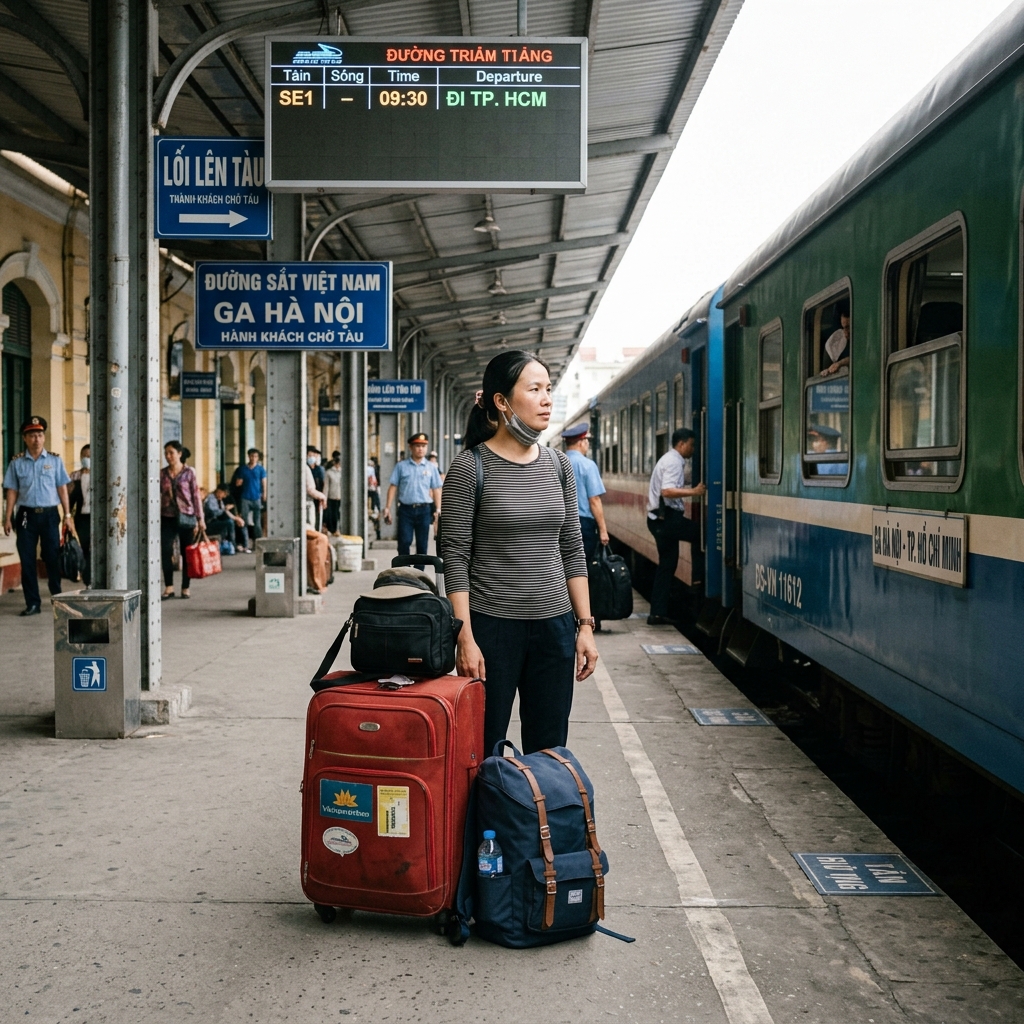
Vietnam Railways Baggage Policy: Fees, Weight Limits & VIP Sleeper Rules 2026
Vietnam Railways allows every passenger a free carry-on of up to 20 kg (max 0.8m × 0.5m × 0.4m). Anything heavier or bulkier must be checked in as consignment baggage, with fees starting at around 1,500–5,000 VND per kg. VIP cabin passengers follow the same weight rules but benefit from more private storage space than standard classes.
Traveling by train is one of the most rewarding ways to see Vietnam. The Reunification Express threads through coastal cities, mountain passes, and rice paddies that no flight will ever show you. But show up at Hanoi station with an overpacked suitcase and no idea what the rules are, and that beautiful journey can turn stressful fast.
How Much Free Luggage Can You Take on a Vietnam Train?
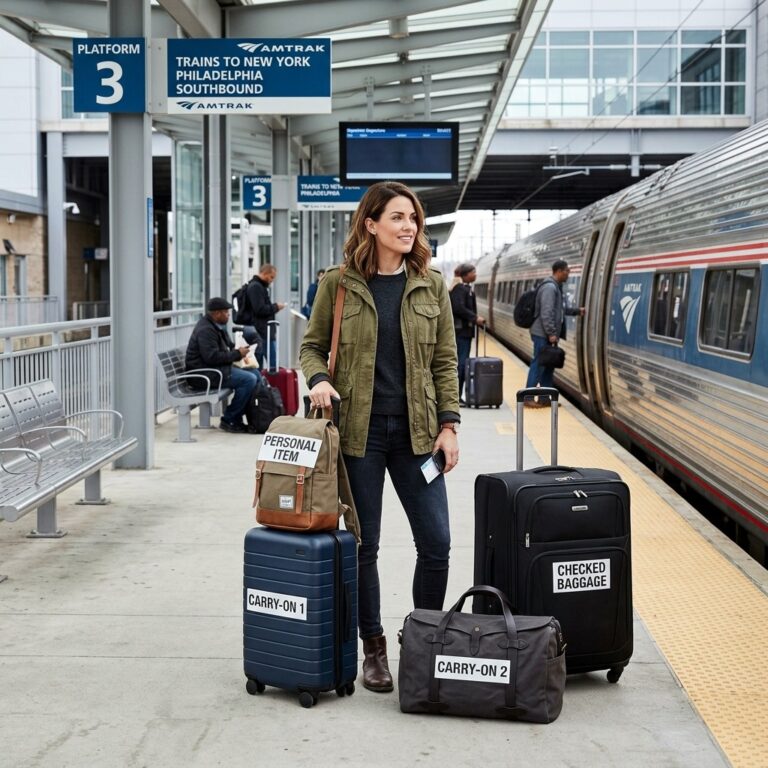
Every valid Vietnam Railways ticket includes a complimentary carry-on allowance of up to 20 kg, provided the bag fits within 0.8m × 0.5m × 0.4m and does not exceed 0.16 m³ in volume. Passengers may also carry one small personal item up to 10 kg (max 30 × 20 × 10 cm). Both items must be stored by the passenger in overhead racks or under the seat.
|
Luggage Type |
Max Weight |
Max Dimensions |
Max Volume |
Cost |
|
Carry-on |
20 kg |
0.8m × 0.5m × 0.4m |
0.16 m³ |
Free |
|
Small personal item |
10 kg |
30 × 20 × 10 cm |
— |
Free |
|
Checked (consignment) |
75 kg/piece |
2.5m × 0.5m × 0.5m |
0.5 m³ |
Fee applies |
One thing competitors consistently fail to mention: the 20 kg limit applies to every passenger regardless of ticket class. Hard seat, soft seat, hard sleeper, soft sleeper, and VIP cabin passengers all share the same free allowance.
How Many KG of Luggage Is Allowed in a Train? Class-by-Class Breakdown
The free allowance is 20 kg across all classes. What changes between classes is the physical storage space available.
|
Train Class |
Berths Per Cabin |
Luggage Storage |
Privacy |
|
Hard Seat |
Open carriage |
Overhead racks, limited floor space |
None |
|
Soft Seat |
Open carriage |
Overhead racks |
None |
|
Hard Sleeper |
6 berths, open |
Rack above top bunk, under lower bunk |
Minimal |
|
Soft Sleeper |
4 berths, lockable |
Under lower bunks, overhead rack |
Lockable door |
|
VIP Cabin |
2 berths, lockable |
Under lower bunks + full upper bunk area unused |
Maximum |
A standard hard-shell 28-inch suitcase (roughly 75 × 50 × 30 cm) technically exceeds the carry-on dimension limit. It must be checked in. If you are traveling in a soft sleeper or VIP cabin, you may be able to store it under the lower bunk, but do so only if it fits staff can require you to check oversized bags regardless of weight.
What Are the Vietnam Railways VIP Sleeper and VIP Cabin Options?
The Vietnam Railways VIP Cabin is a two-berth private compartment the highest class available on the network. The upper bunks are folded away, leaving two lower berths with significantly more space than a standard four-berth soft sleeper. VIP cabins include charging points, bottled water, and upgraded bedding.
VIP sleeper carriages are not operated by Vietnam Railways directly they are run by private tourist train operators (Laman Express, Orient Express, Fanxipan Express, Chapa Express, Violette Train) whose carriages attach to the state railway train. VIP cabin tickets typically cost roughly twice the soft sleeper price:
- Soft sleeper (Hanoi–Da Nang): approximately USD $35–65
- VIP cabin (Hanoi–Da Nang, Laman Express): approximately USD $82–130
- VIP berth (Hanoi–Sapa routes, tourist trains): approximately USD $30–60
From a baggage perspective, VIP cabin passengers benefit most. With only two occupants sharing a private locked compartment, there is significantly more room under the lower bunks and near the window table. A family of two with multiple bags will find the VIP cabin far more practical than a shared six-berth hard sleeper.
How Much Does It Cost to Bring Baggage in Vietnam? (Actual Fees)
When your bags exceed the free carry-on limits, you have two options: check them in as consignment baggage or pay an oversized cabin fee.
Consignment (checked) baggage fees:
- Standard rate: approximately 1,500–5,000 VND per kg (roughly $0.06–$0.20 USD per kg)
- Bulky/light goods charged by volume: 240,000–380,000 VND per m³
- Minimum charge applies to shipments billed at a minimum of 5 kg
Domestic excess baggage fees (vnrailway.com, official rates):
|
Total Checked Weight |
Domestic Fee |
International Fee |
|
Up to 20 kg |
Free |
USD $10 |
|
Up to 30 kg |
VND 50,000 (~$2) |
USD $15 |
|
Up to 40 kg |
VND 100,000 (~$4) |
USD $20 |
|
Additional 10 kg |
VND 20,000 (~$0.80) |
USD $5 |
|
Additional 20 kg |
VND 40,000 (~$1.60) |
USD $10 |
Individual pieces exceeding 32 kg will not be accepted for checked baggage.
What If My Luggage Is 4 KG Overweight?
If your bag weighs 24 kg 4 kg over the free 20 kg carry-on limit you have two paths:
Option 1 Check it in as consignment:
At the standard rate of 1,500–5,000 VND per kg, 24 kg = approximately 36,000–120,000 VND ($1.50–$5.00). Note the minimum 5 kg billing rule, so you would be charged for at least 5 kg even if you are only 4 kg over. Expected cost: 30,000–75,000 VND ($1.25–$3.00) for the first 5 kg bracket.
Option 2 Bring it into the cabin (if space allows):
If a conductor permits oversized luggage in the passenger car, the fee is typically 1/3 of the base luggage rate making it the cheaper route in practice for small overages. Arrive at least 60–90 minutes early to resolve this at the luggage desk before departure.
Real-world takeaway: For a 4 kg overage, the financial penalty on a domestic route is minimal under $5 USD. The bigger challenge is physical: a 24 kg bag that exceeds 0.8m in length must be consigned, meaning it travels in a separate freight car and requires a luggage ticket to claim at the destination.
What Items Are Prohibited on Vietnam Trains?
Vietnam Railways strictly enforces the following prohibited categories under its official regulations:
- Weapons, explosives, and flammables including gas canisters, petrol, and camping stoves
- Strong-smelling foods durian and fresh seafood are banned unless sealed in airtight, odor-proof containers
- Illegal goods narcotics, contraband, and counterfeit items under Vietnamese law
- Bulky items blocking aisles or emergency exits
- Human remains prohibited on passenger trains
- Live animals unless approved in advance and crated securely
Portable gas stoves and electric irons are specifically called out in official Vietnamese railway regulations as fire hazards in enclosed carriages.
How Do You Transport Bicycles, Motorbikes, and Sports Equipment?
Vietnam Railways allows oversize items but charges them by a converted weight equivalent rather than actual weight.
|
Item |
Converted Weight Equivalent |
|
Bicycle |
50 kg |
|
E-bike / Motorbike < 50cc |
100 kg |
|
Motorbike 50cc–125cc |
150 kg |
|
Motorbike 125cc–250cc |
250 kg |
|
Motorbike 250cc–500cc |
450 kg |
|
Motorbike > 500cc |
700 kg |
|
Surfboards / Bulky sports gear |
Charged by volume (1 m³ = 300 kg equivalent) |
All gasoline must be drained from motorbikes before loading. Rear-view mirrors frequently break during transit remove them and carry them in your bag.
Small instruments (violin, flute) that fit within carry-on dimensions travel free. Large instruments and guitars must be checked in hard cases.
Are There Special Rules for Children, Elderly, or Passengers with Disabilities?
This is a content gap not addressed by most competitor guides. Under Vietnam Railways’ current regulations:
- Children under 5 traveling on an adult’s lap are not entitled to a separate baggage allowance
- Children with their own ticket receive the standard 20 kg allowance
- Elderly or disabled passengers do not receive an enhanced baggage allowance under the standard policy, but station staff can assist with handling arrive at least 90 minutes early
- Accessibility note: Major stations including Hanoi (Ga Hà Nội) and Ho Chi Minh City (Ga Sài Gòn) have limited ramp access between platforms. Passengers using wheelchairs should contact Vietnam Railways customer service in advance
How Does Vietnam Railways Baggage Policy Compare to Buses and Flights?
|
Factor |
Vietnam Railways |
Sleeper Bus |
Domestic Flight |
|
Free allowance |
20 kg carry-on |
No stated limit (stored at bunk) |
7–23 kg depending on fare |
|
Excess fee |
~1,500–5,000 VND/kg |
Rarely enforced |
~10 USD per extra kg |
|
Max piece weight |
32 kg (checked) |
Not applicable |
32 kg |
|
Large items (motorbike) |
Yes, with fee |
No |
No |
|
Luggage safety |
Moderate (keep valuables on person) |
Moderate |
High |
|
Practical verdict |
Best for heavy gear, bikes |
Best for budget light packing |
Best for tight itineraries |
For travelers carrying bulky gear surfboards, motorbikes, or multiple large bags Vietnam Railways is the only practical option. For standard backpackers, the 20 kg train allowance matches most budget airline carry-on limits.
What Should You Know About Vietnam Railway Stations and Check-In?
Vietnam Railways operates through major hubs including Hanoi Station (Ga Hà Nội), Ho Chi Minh City Station (Ga Sài Gòn), Da Nang Station, and Hue Station. Practical station tips:
- Arrive at least 30–60 minutes before departure for carry-on passengers
- Arrive 1–2 hours early if checking in consignment baggage; 4 hours if shipping cargo separately
- Luggage storage is available at major stations for short-term fees (~100,000–200,000 VND for several hours)
- Luggage ticket: Keep this safe you need it to claim checked bags at the destination
- For lost or damaged luggage, file a report immediately; claims must be submitted within 7 days
- Helplines: Hanoi Branch 1900 0109 | Saigon Branch 1900 1520 | General 1900 6484
How to Buy Vietnam Railways Tickets and Handle Excess Baggage
Vietnam Railways tickets can be purchased through several channels, each with different pricing:
- dsvn.vn (official site) lowest prices, 0% markup, requires Vietnamese phone number for verification
- 12go.asia full English interface, international card support, 10–30% markup
- Baolau English-friendly, 10–25% markup, strong for Sapa routes
- Hotel desks convenient but add 20–50% markup
Excess baggage and consignment fees must be paid at the station luggage counter on the day of travel. There is currently no online pre-payment option for excess baggage through the official Vietnam Railways site.
Smart Packing Tips for Vietnam Train Travel
- Choose a soft-sided suitcase hard-shell cases often will not fit under soft sleeper bunks
- Use a 4-wheel rolling case or travel backpack train corridors are narrow
- Keep your passport, wallet, and phone in a small bag worn on your person at all times
- Pack a train kit in your carry-on: wet wipes, toilet paper, hand sanitizer, a light jacket (air conditioning runs cold), and snacks
- Label all bags with your name, phone number, and destination
What Happens If Your Luggage Is Lost or Damaged?
Vietnam Railways provides compensation for lost or damaged baggage based on declared value or weight, provided the damage occurred under their custody. To make a valid claim:
- Report to the Train Manager (if on board) or station staff immediately on arrival
- Fill out a formal Loss/Damage Report
- Present your luggage ticket and ID (passport for foreign nationals)
- Submit claims within 7 days
Frequently Asked Questions
Is the 20 kg limit strictly enforced on Vietnam trains?
As of 2026, regulations implemented in February 2024 are actively enforced. Staff at major stations weigh bags at the luggage counter. Enforcement is less consistent in hard seat carriages, but VIP and soft sleeper passengers face stricter checks due to limited cabin storage.
Can I bring two suitcases on a Vietnam train?
Yes, if their combined weight stays within 20 kg and both fit within the dimensional limits. In practice, two standard cabin-sized bags (55 × 40 × 20 cm each) should qualify as one carry-on and one small item.
Does the VIP cabin have extra baggage storage compared to soft sleeper?
Not officially the free allowance is 20 kg for all classes. However, VIP cabin passengers share space with only one other person, leaving the area under both lower bunks and the foldable upper bunk area effectively free for storage.
Can I send luggage ahead on a different train?
Yes. Vietnam Railways’ consignment service allows you to ship bags separately from your journey. They travel in a dedicated freight car and must be collected at the destination cargo counter with your luggage ticket and passport.
Are there extra baggage fees for international routes?
Yes. International routes have a higher fee structure: 20 kg costs USD $10, 30 kg costs USD $15, and 40 kg costs USD $20 compared to the domestic free-up-to-20-kg policy.
What is the cheapest way to deal with 10 kg of excess baggage on a domestic route?
The consignment rate of 1,500–5,000 VND per kg makes 10 kg of excess cost roughly 15,000–50,000 VND ($0.65–$2.10). This is significantly cheaper than equivalent airline excess fees.
Can I bring a full-size bike on a Vietnam train without dismantling it?
Yes. Bicycles do not need to be dismantled but must be checked in as consignment cargo, charged at the 50 kg converted weight equivalent. Expect to pay the standard 1,500–5,000 VND per converted kg.
Is durian allowed on Vietnam trains?
Only if sealed in an airtight, odor-proof container. Station staff may refuse boarding with durian if the smell is detectable, even in packaging. Vexere recommends double-sealing strong-smelling items before arriving at the station.
What happens if I miss the 30-minute pre-departure deadline for baggage check?
Late-arriving passengers with consignment baggage may miss the freight loading window. Vietnam Railways can hold your checked bags and dispatch them on the next available freight car, but this means your luggage arrives separately potentially hours or a day later.
Do private train operators (Laman Express, Violette) follow the same baggage rules?
Private operator carriages attach to Vietnam Railways state trains and passengers follow the same official baggage regulations. However, individual operators may set stricter cabin storage policies. Laman Express and Violette, for example, ask passengers to use soft-sided luggage for under-bunk storage.

Azeem breaks down airline baggage policies, fare-class benefits, and peak pricing rules into practical guidance for smooth trip planning. He verifies every fee and dimension against official airline sources so travelers can pack with confidence.
One Comment