KTX Luggage Policy 2026: Rules, Size Limits & Fees
KTX passengers may bring up to two pieces of luggage. Carry-on bags must not exceed 55 × 40 × 20 cm and 10 kg. Checked luggage is limited to 158 cm (L+W+H) and 20 kg per piece. There are no on-train luggage fees, but station lockers cost ₩2,500–₩30,000 depending on size and location.
Planning a trip across South Korea on the KTX? Before you start throwing clothes into a suitcase, it pays to understand exactly what Korail allows on board. Unlike airlines, the KTX does not enforce baggage limits with the same strict precision but that flexibility disappears fast on a packed holiday train when the end-of-car racks are already full.
What Is the KTX Luggage Limit?
The KTX luggage limit allows each passenger up to two pieces of luggage that they can carry independently. The standard carry-on maximum is 55 × 40 × 20 cm at 10 kg, while larger pieces are capped at 158 cm total dimensions (L+W+H) and 20 kg per piece. Luggage must not block aisles or occupy passenger seats.
According to Korail’s official passenger guidelines, the self-handling requirement is taken seriously. If you cannot lift and manage your bags on your own, staff can ask you to rearrange or remove them. There is no formal check-in counter like at an airport you are entirely responsible for your luggage from platform to seat.
|
Luggage Type |
Max Dimensions |
Weight Limit |
Pieces Allowed |
|
Personal item |
40 × 30 × 15 cm |
3 kg |
1 |
|
Carry-on bag |
55 × 40 × 20 cm |
10 kg |
1 |
|
Checked-style luggage |
158 cm (L+W+H) |
20 kg |
Up to 2 |
Guidelines based on Korail official policy and Korail airport transfer service reference dimensions.
A standard 28-inch suitcase typically measures around 72 × 47 × 29 cm, giving a total of 148 cm technically within the 158 cm limit. A 32-inch suitcase usually exceeds that boundary at approximately 81 × 57 × 33 cm (171 cm total), so it’s worth measuring before you pack.
What Are the KTX Luggage Rules on Board?
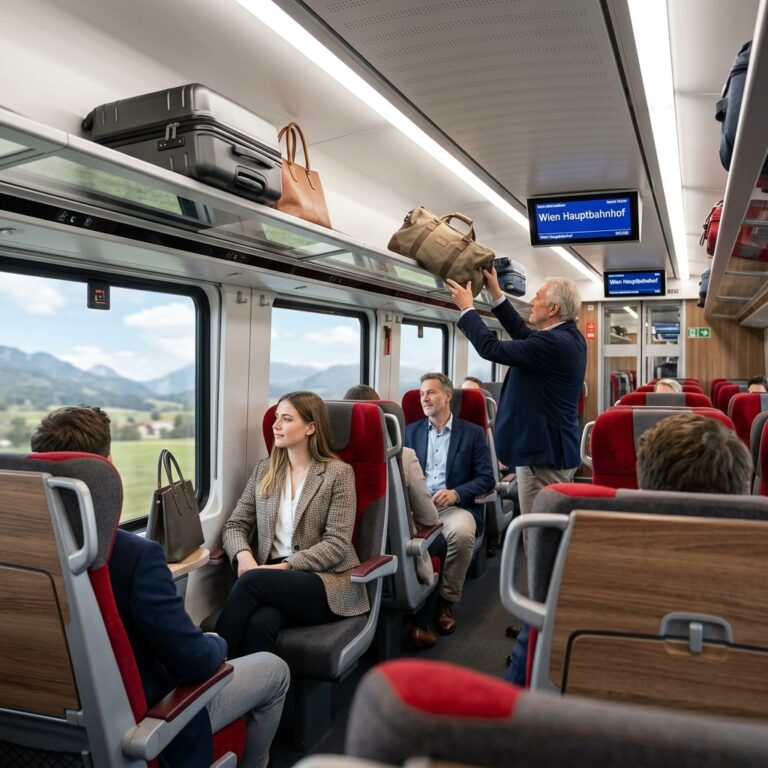
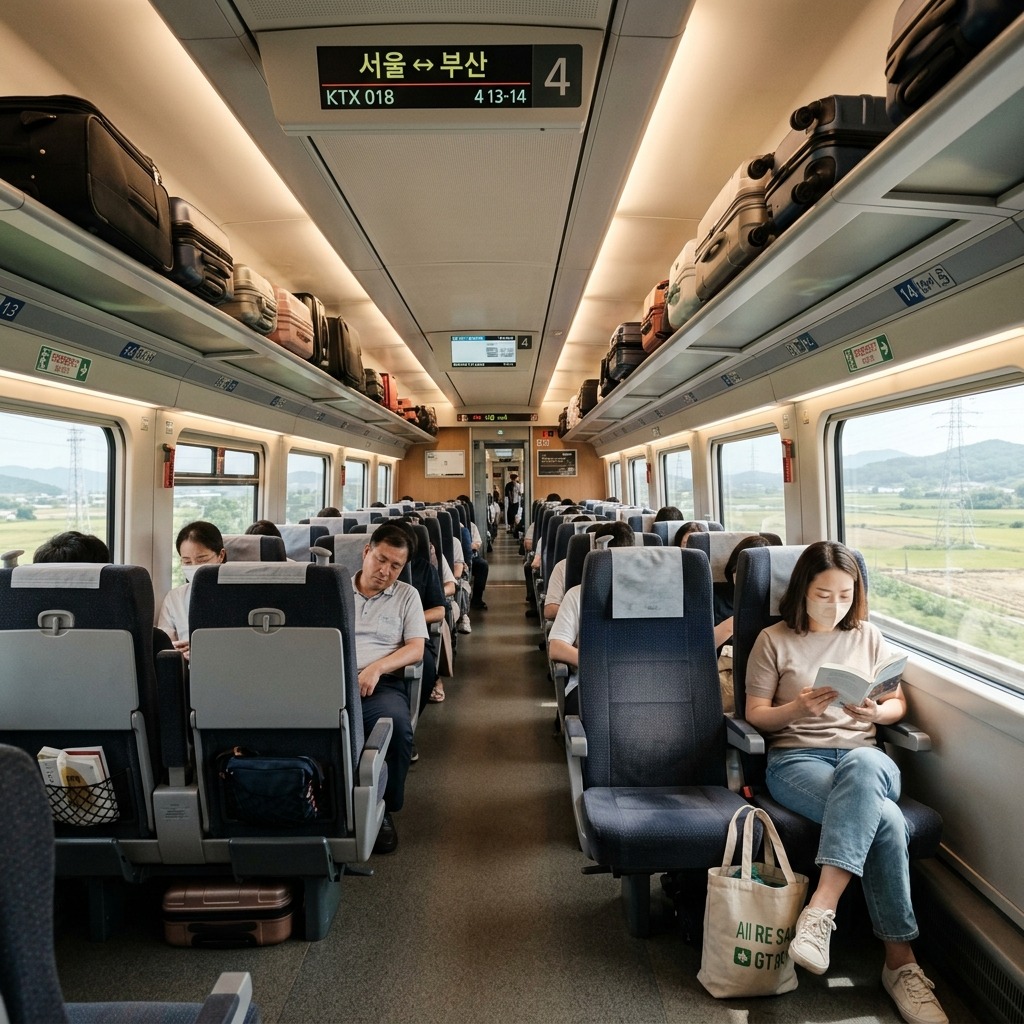
KTX luggage rules require passengers to store bags in one of three designated areas: overhead racks (for smaller items), dedicated end-of-car luggage compartments (for large suitcases), or the space behind the last row of seats in select cars. Bags must not block aisles, doorways, or occupy seats.
|
Train Type |
Main Route |
Luggage Locker Cars |
|
KTX (original) |
Seoul–Busan, Seoul–Mokpo |
Cars 3–5, 7–14, 16–17 |
|
KTX-Sancheon |
Seoul–Busan (newer fleet) |
Cars 1–7 |
|
KTX-Eum |
Seoul–Gangneung |
In-cabin racks near doors |
End-of-car storage operates on a first-come, first-served basis there is no reserved space per ticket. Boarding early is the single most effective strategy for securing rack space on busy routes.
Onboard storage options at a glance:
- Overhead racks: Suitable for backpacks, laptop bags, and carry-on suitcases
- End-of-car luggage racks: For large suitcases and sports equipment
- Behind the last row: Limited space; fits medium suitcases and strollers in select cars
- Under the seat: Small personal items only; not suitable for suitcases
What Is the KTX Luggage Size Limit?
The KTX luggage size limit is 55 × 40 × 20 cm for carry-on bags and 158 cm total (length + width + height) for larger pieces. These are based on Korail’s official guidelines and airport transfer service dimensions, which serve as the practical reference standard for all KTX travel.
Unlike airlines, KTX staff do not measure bags at the gate. Enforcement is inconsistent most travelers with slightly oversized luggage board without issue. However, during peak travel periods like Chuseok (추석), Lunar New Year, and summer holidays, overcrowded trains mean luggage racks fill within minutes of boarding. Oversized bags that cannot fit the racks may need to be rearranged, and staff can ask passengers to move items that block emergency exits or doors.
If your bag fits neatly into a 28-inch suitcase category and weighs under 20 kg, you’re well within the KTX luggage size limit.
Does KTX First Class Have Different Luggage Storage?
KTX first class luggage storage uses the same types of racks as economy class overhead compartments and end-of-car dedicated racks but first class cars tend to be less crowded, which means more rack space is typically available. First class does not offer a separate checked baggage allowance or premium storage service.
KTX first class cabins seat fewer passengers per car (typically 30 seats versus 60+ in economy), which translates directly to less competition for end-of-car luggage space. Travelers carrying large suitcases who want a reliable storage spot will find the first class environment more practical during busy travel seasons.
|
Feature |
KTX First Class |
KTX Economy |
|
Overhead racks |
Available |
Available |
|
End-of-car luggage racks |
Available |
Available |
|
Space competition |
Lower (fewer passengers) |
Higher (full trains) |
|
Dedicated checked baggage |
Not available |
Not available |
|
Extra baggage allowance |
Same policy applies |
Same policy applies |
If securing storage space is a concern, booking a first class seat near a car with a dedicated luggage locker (e.g., Car 1 or 2 on KTX-Sancheon) is a practical workaround.
What Is KTX Checked Luggage?
KTX checked luggage refers to larger bags stored in the dedicated end-of-car racks rather than on your person or in overhead storage. Unlike airline checked baggage, there is no formal check-in counter, no baggage tag process, and no fees charged for placing large suitcases in the onboard luggage compartments.
Passengers handle their own bags throughout the journey. You carry your suitcase to the rack, place it yourself, and retrieve it before or at your stop. If the racks in your car are full, check the adjacent car for example, if you’re seated in Car 8, Car 7 or Car 9 may have open space.
Key rules for KTX checked-style luggage:
- No formal check-in process exists
- No baggage tags or receipts are issued
- You are responsible for your luggage at all times
- Do not leave valuables in end-of-car racks unattended
- Clearly label bags to prevent confusion in shared storage areas
How Many kg of Luggage Is Allowed on a Train?
Korail recommends a maximum of 30 kg total luggage per KTX passenger. This is based on the combined weight of up to two pieces: each piece capped at 20 kg, with carry-on items limited to 10 kg. There is no formal excess baggage fee charged on the train itself, but station-side luggage storage fees apply if you need to leave bags behind.
To put this in perspective: a fully packed 28-inch checked suitcase typically weighs 18–22 kg when loaded. Add a 10 kg carry-on backpack, and you’re at the upper boundary of the 30 kg recommendation. Travelers carrying two large suitcases plus a personal bag should expect to seek station locker services at their destination rather than attempting to manage all items on a crowded platform.
What Are the KTX Station Luggage Storage Fees?
KTX does not charge for storing luggage in onboard racks, but major stations provide coin-operated lockers and staffed storage counters at an additional cost.
Approximate station locker fees (2026):
- Small locker: ₩2,500 (weekday) / ₩2,700 (weekend) per day
- Medium locker: ₩4,500 (weekday) / ₩4,950 (weekend) per day
- Large locker: ₩20,000–₩30,000 per large bag (per use at major hubs)
- LuggageQ (Seoul Station & Hongdae): ₩1,000 per hour, XL lockers measuring 800 × 700 × 1,000 mm
Third-party services like T-Luggage (또타러기지) also offer hotel-to-hotel delivery and door-to-station services. Operating hours run 9:00 AM–10:00 PM, with a call center reachable at 02-6110-2977. Klook-listed luggage delivery platforms such as Trip Easy operate similarly, letting you send bags directly between accommodations.
A solo traveler visiting Seoul, Busan, and Gyeongju for five days with two large suitcases might store one bag at Seoul Station (₩20,000–₩30,000 for the day) while carrying the other on the KTX, then retrieve it on the return leg. Total station storage cost: approximately ₩40,000–₩60,000 for selective storage across the trip far cheaper than hauling both bags through crowded subway connections at every city.
What Items Are Prohibited on KTX Trains?
KTX prohibits any items that pose safety, security, or comfort risks to other passengers. This includes explosives, flammable gases, firearms, and sharp weapons. Oversized or excessively heavy items that cannot be self-managed are also restricted. Korail station staff enforce these rules at boarding.
Prohibited and restricted items on KTX:
- Explosive materials, firearms, and ammunition
- Flammable gases (e.g., butane canisters, aerosols above permitted volumes)
- Unpackaged sharp or bladed items
- Items with strong odors that disturb other passengers
- Luggage that blocks aisles, doorways, or emergency exits
- Animals outside approved carriers
For items that are borderline like camping gas canisters for a hiking trip to Seoraksan it’s advisable to contact Korail directly or check with station staff before boarding.
What Are the Rules for Special Items and Pets on KTX?
Special items such as bicycles, musical instruments, and large sports equipment must be properly packed and stored in designated rack areas without blocking passenger space. Pets must travel in a closed carrier no larger than approximately 45 × 30 × 25 cm, with a combined pet-plus-carrier weight under 10 kg, and require up-to-date vaccinations.
Special items at a glance:
- Musical instruments (small to medium): Stored in overhead racks or luggage compartments; must be in a protective case
- Bicycles: Must be disassembled and bagged; stored in end-of-car racks; check with Korail in advance for specific trains
- Skis and snowboards: Allowed in padded bags; stored vertically in end-of-car racks
- Strollers: Foldable strollers fit in end-of-car racks or the space behind the last row of seats
Pet travel rules:
- Carrier dimensions: approximately 45 × 30 × 25 cm
- Combined weight (pet + carrier): under ~10 kg
- Pet heads must remain inside the carrier at all times
- Vaccinations required; carry documentation
- Aggressive or wild animals are not permitted
- Larger pets (over ~10 kg) are not allowed in the passenger cabin
Practical Tips for Stress-Free KTX Travel with Luggage
Most KTX luggage issues are avoidable with preparation. Here are the strategies that actually make a difference:
- Arrive 15–20 minutes early to board before rack space is claimed
- Choose a seat near luggage racks when booking check the car number layout for your train type
- Measure total dimensions before packing: add length + width + height and confirm it’s under 158 cm
- Weigh bags at home a standard kitchen scale can save you from an awkward rearrangement on the platform
- Label every bag with your name and phone number before placing in shared racks
- Use cable locks in end-of-car racks if leaving valuables unattended during long journeys
- Avoid peak travel days (Chuseok, Lunar New Year, summer Saturdays) when rack space disappears within minutes of boarding
Frequently Asked Questions
What is the KTX luggage limit per person?
Each passenger may bring up to two pieces of luggage totaling no more than 30 kg. Individual pieces should not exceed 20 kg, and carry-on bags are limited to 10 kg.
Can I bring a 28-inch suitcase on KTX?
Yes. A standard 28-inch suitcase typically measures around 148 cm total (L+W+H), which falls within the 158 cm limit. A 32-inch suitcase often exceeds this at ~171 cm and may be problematic on crowded trains.
Is there a fee for checking luggage on KTX?
No. KTX does not charge for placing bags in onboard luggage racks. Fees only apply for station lockers, which range from ₩2,500 to ₩30,000+ depending on locker size and location.
Does KTX first class allow more luggage than economy?
No the same weight and size rules apply to both classes. However, first class cars carry fewer passengers, meaning end-of-car storage racks are less likely to be full when you board.
What happens if my bag is too big for the overhead rack?
Place it in the dedicated end-of-car luggage compartment. If that rack is full, check the adjacent car’s compartment. Do not leave oversized bags in the aisle or on top of other passengers’ luggage.
Are there any KTX trains with no luggage racks?
All KTX and KTX-Sancheon trains have designated end-of-car luggage areas. The KTX-Eum (Seoul–Gangneung line) has in-cabin racks near the doors, which fill quickly due to limited space boarding early is especially important on this route.
Can I bring my dog or cat on KTX?
Yes, pets are allowed in closed carriers (approx. 45 × 30 × 25 cm) with a combined pet-and-carrier weight under ~10 kg. Vaccination records are required and pets must remain fully inside their carrier throughout the journey.
Is there a luggage delivery service for KTX stations?
Yes. T-Luggage (또타러기지) operates 9 AM–10 PM and delivers between hotels and KTX stations. Third-party platforms like Klook also list hotel-to-hotel delivery services via operators such as Trip Easy. LuggageQ offers hourly locker storage at ₩1,000/hour near Seoul Station and Hongdae.
What is the luggage rule for Korail Pass holders?
Korail Pass holders are subject to the same baggage policy as all other passengers. The pass does not grant extra baggage allowance or reserved storage space. Seat reservations near luggage rack cars are still first-come, first-served.
What if both end-of-car racks are full on my train?
Check the racks in the cars directly adjacent to yours. If the entire train is packed, use the space behind the last seat row in your car (available in select cars) or ask a train attendant for assistance. For future trips, upgrading to first class or traveling off-peak reduces this risk significantly.

Azeem breaks down airline baggage policies, fare-class benefits, and peak pricing rules into practical guidance for smooth trip planning. He verifies every fee and dimension against official airline sources so travelers can pack with confidence.