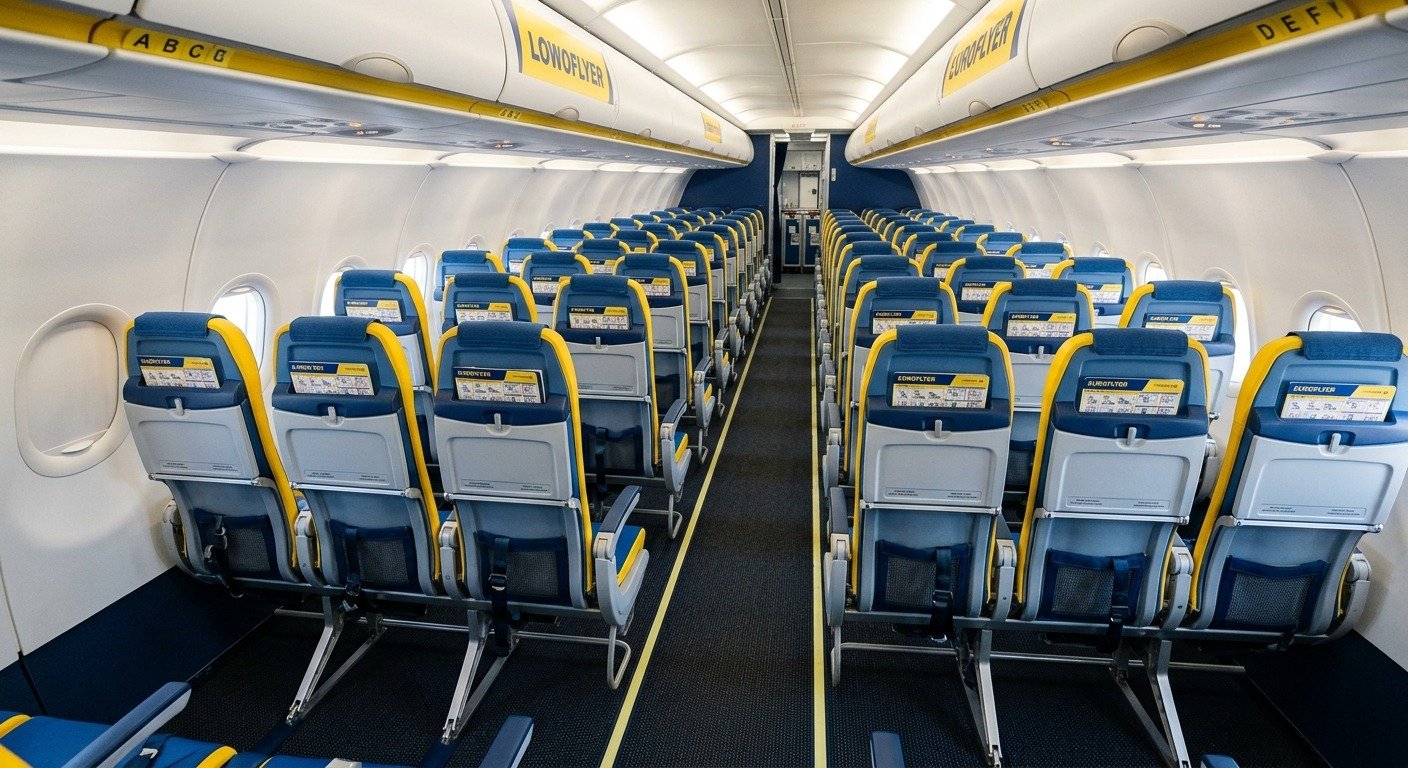
Ryanair Standing Seats: Facts, Safety and 2026 Claims
No. Ryanair does not offer standing seats, and none are planned. Viral posts claiming “standing seats” would launch by 2026 misrepresent a 2012 prototype called the Skyrider, built by Italian manufacturer Aviointeriors. Both Ryanair and Aviointeriors have confirmed to fact-checkers that no such product exists or is in development. No regulator has received a certification application for standing seats either.
Every so often, a photo of a bizarre, saddle-shaped airplane seat resurfaces online, and the internet collectively loses its mind. In May 2025, a fresh wave of posts claimed Ryanair and other low-cost carriers would introduce “standing seats” as early as 2026, supposedly cutting fares even further by letting passengers lean rather than sit. The story spread fast, fueled by a Daily Mail article and a flurry of social shares.
What Are “Standing Seats” and Where Did the Idea Come From?
Standing seats refer to a conceptual airplane seat design that lets passengers lean in a semi-upright position instead of sitting fully, similar to a bicycle saddle. The idea traces back to Ryanair CEO Michael O’Leary’s cost-cutting proposals starting around 2009–2010, and a 2012 prototype called the Skyrider from Aviointeriors.
How the Skyrider Prototype Was Designed to Work
The Skyrider was built by Italian aircraft seat manufacturer Aviointeriors as a conceptual design, never a production product. According to Euronews (2025), mock-ups showed a padded, narrow saddle-style seat with a backrest, harness-style belts for take-off, landing, and turbulence, and vertical poles connecting each row to the cabin ceiling for stability. The design was meant to pack more passengers into short-haul cabins by replacing a traditional seated posture with a leaning one.
Aviointeriors itself addressed the renewed attention directly. In a May 23, 2025 Instagram statement cited by AFP Fact Check, the company said the concept “was never meant to be taken at face value” and confirmed the Skyrider does not appear in its current product catalogue.
Timeline: How the Standing Seat Myth Keeps Resurfacing
|
Year |
Event |
|
2009 |
O’Leary reportedly asks the Irish Aviation Authority about vertical, bar-stool-style seating (SmarterTravel/The Telegraph) |
|
2010 |
O’Leary publicly floats “standing seats” to maximize cabin space (Euronews) |
|
2012 |
Aviointeriors unveils the Skyrider prototype; a regulator reportedly declines a related Ryanair trial request |
|
May 2025 |
Viral posts and a Daily Mail article claim standing seats will launch by 2026 |
|
June 2025 |
AFP Fact Check and Euronews confirm the claims are false |
The pattern is consistent: an old image or quote resurfaces, gets amplified by tabloid-style headlines, and spreads on social media without anyone checking whether the underlying product still exists.
Is Ryanair Actually Planning Standing Flights?
No. Ryanair has told fact-checkers directly that it is not considering standing seats. The airline has no announced product, no regulatory filing, and no timeline for introducing them. The 2025 viral claims originated from a misreading of a 2012 prototype, not from any current Ryanair plan.
According to AFP Fact Check (2025), Ryanair stated it was “not considering introducing the seats” when asked directly. This mirrors O’Leary’s own past comments: AFP notes that as far back as 2009, he acknowledged the EU would likely reject such a configuration on safety grounds, even as he floated the idea publicly for attention.
Why Do Ryanair Standing Seat Rumors Keep Going Viral?
Ryanair standing seat rumors go viral because they combine a real (if outdated) prototype image with Ryanair’s well-known reputation for aggressive cost-cutting stunts. O’Leary has a long history of proposing shocking ideas pay-per-use toilets, a “fat tax,” single-pilot flights that generate headlines without ever becoming policy.
As PR analysts have noted of Ryanair’s media strategy, the airline benefits from headline-grabbing proposals regardless of whether they’re implemented. The attention reinforces its no-frills brand identity at essentially zero cost. That’s part of why these stories keep resurfacing roughly every few years, often triggered by nothing more than an old photo getting rediscovered.
Could Standing Seats Ever Pass Safety Regulations?
Standing seats face serious regulatory hurdles. The European Union Aviation Safety Agency (EASA) has confirmed it has not received any application to certify standing seats for commercial use, and has flagged major evacuation and fuselage design challenges that would need to be solved first.
According to AFP Fact Check (2025), EASA stated: “Such seats would pose significant technical challenges, particularly in terms of emergency evacuation,” adding that current fuselage designs don’t allow passengers to stand safely near windows during an emergency. Any airline pursuing this would face what EASA called “significant challenges, both in terms of aircraft reconfiguration and in demonstrating compliance with strict safety and evacuation requirements.”
What this means in practice:
- No certified standing seat design currently exists for commercial aircraft
- Evacuation speed requirements are a central unresolved obstacle
- Even preliminary safety tests on Skyrider-style seats, per Euronews, only suggested they might meet g-force standards on paper not that they’re approved for use
What Are the Real Barriers Beyond Regulation?
Even if a standing seat design cleared every regulatory hurdle, passenger comfort remains the bigger obstacle. Long periods in a semi-upright, harnessed position risk fatigue and circulation problems, and public tolerance for cramped conditions has limits even among ultra-budget travelers.
|
Factor |
Standing/Leaning Seat |
Traditional Seat |
|
Comfort on short flights |
Unproven, likely poor |
Established baseline |
|
Regulatory certification |
None exists |
Fully certified |
|
Accessibility for mobility-limited passengers |
Major concern |
Accommodated |
|
Evacuation compliance |
Unresolved per EASA |
Already compliant |
|
Passenger appeal (per reader polls) |
Mostly rejected |
Preferred |
Choose a seated option if you have any mobility limitation, travel with children, or fly more than a short regional hop none of which standing-style seating has ever been shown to safely accommodate.
What Is Ryanair Actually Doing to Keep Fares Low?
Ryanair cuts costs through operational efficiency, not passenger discomfort gimmicks. Real strategies include baggage and seat-selection fees, fast aircraft turnarounds, high-density (but conventional) seating layouts, and fuel-efficient aircraft not experimental seating designs.
Illustrative example: if a standard low-cost configuration carries a round number of 180 seated passengers, a hypothetical 20% capacity increase (the figure some outlets cited for Skyrider-style seating) would mean roughly 216 passengers but this remains a theoretical calculation, not a confirmed Ryanair figure, since no such configuration has been certified or deployed.
Ryanair has also introduced legitimate cost-related products. According to Euronews (March 2025), the airline launched a €79 annual “Prime” subscription aimed at frequent travelers, and the carrier has advertised fares as low as €7.99 both genuine examples of how budget airlines compete on price without resorting to standing seats.
Frequently Asked Questions
Is Ryanair really introducing standing seats in 2026?
No. Ryanair has directly told fact-checkers it is not considering standing seats, and no regulator has received a certification application for this type of seating as of 2025 reporting.
What is the Ryanair Skyrider seat?
The Skyrider is a 2012 conceptual prototype built by Aviointeriors, not a Ryanair product. Aviointeriors confirmed it is not part of its current catalogue and was never intended to be taken as a real commercial offering.
Has any airline ever tested standing seats?
Reports indicate Ryanair sought permission from the Irish Aviation Authority around 2009 for vertical seating trials, but no airline has received regulatory approval or operated standing seats commercially.
Why do aviation regulators oppose standing seats?
EASA has stated that standing seats raise unresolved emergency evacuation challenges, since current aircraft fuselage designs don’t accommodate standing passengers safely near exits or windows during an emergency.
How much would a standing seat ticket cost?
No confirmed pricing exists, since no airline offers this option. Older, unverified reports cited figures like £1–£5 for standing versus £25 for seated tickets, but Ryanair has never confirmed these numbers.
Would standing seats actually increase plane capacity?
Some older coverage cited a theoretical 20% capacity increase, but this figure comes from outdated, unverified reporting rather than any certified design or Ryanair data.
Is the standing seat concept safe during turbulence?
This hasn’t been established. No standing seat design has completed full regulatory certification, and specific safety data for turbulence conditions has not been published by any aviation authority.
Are standing seats only being considered for short flights?
Discussion of the concept, where it exists, has centered on very short routes under roughly two hours, since comfort and fatigue concerns would worsen significantly on longer flights.
How does Ryanair actually cut costs if not through standing seats?
Ryanair relies on baggage and seat-selection fees, fast turnarounds, high-density conventional seating, and fuel-efficient aircraft, along with products like its €79 annual Prime subscription.
Should I believe viral posts about new Ryanair seating?
Not without verification. Cross-check claims against direct statements from Ryanair, the named manufacturer, and relevant aviation regulators like EASA before assuming a viral claim is accurate.

Azeem breaks down airline baggage policies, fare-class benefits, and peak pricing rules into practical guidance for smooth trip planning. He verifies every fee and dimension against official airline sources so travelers can pack with confidence.




One Comment