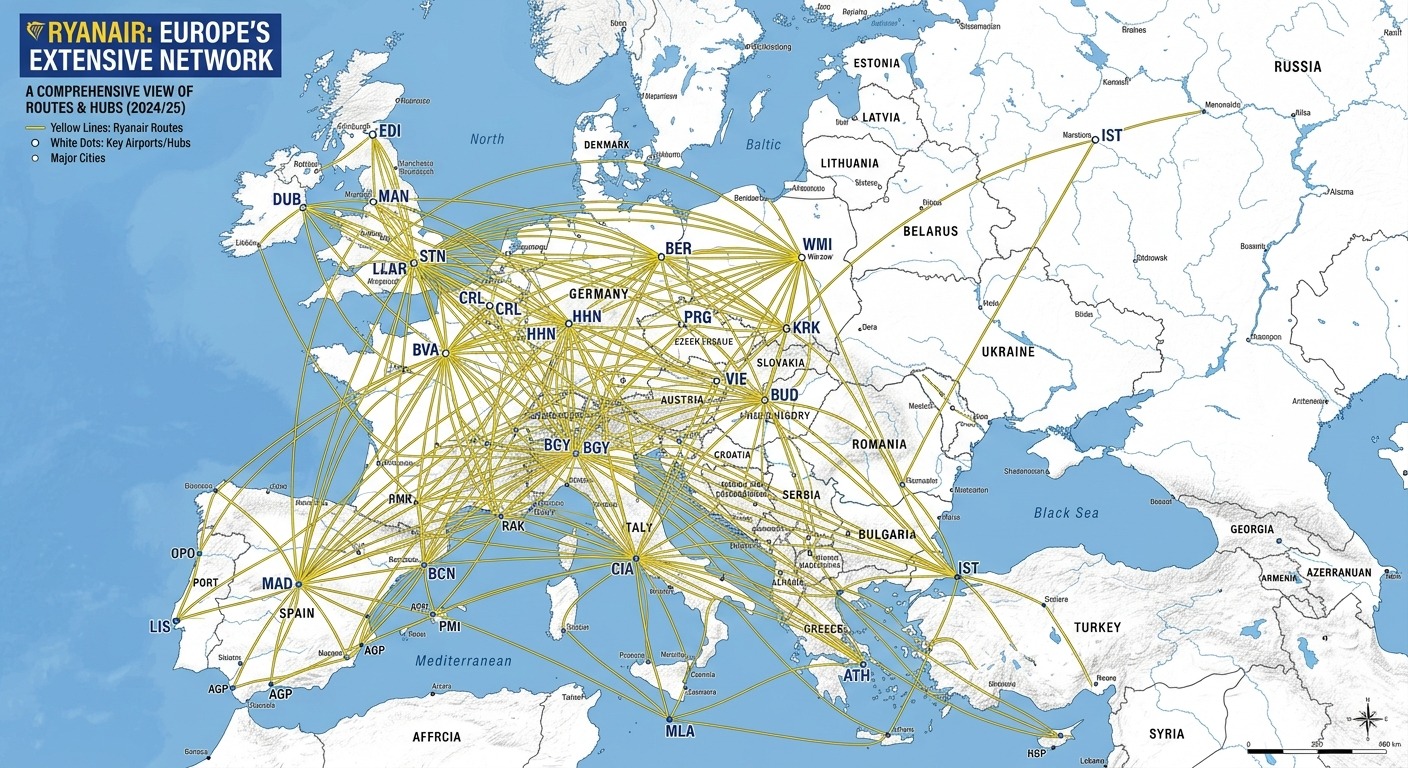
Ryanair Route Map: Destinations, Airports and Busiest Routes 2026
Ryanair operates 232 destinations across 34 countries as of 2026, using 221 airports and 33 operating bases to run over 2,000 daily flights. Italy, France, and Spain anchor the network, while London Stansted and Dublin serve as the largest bases. Ryanair’s point-to-point model prioritizes direct routes over connecting itineraries.
Ryanair didn’t become Europe’s largest low-cost carrier by accident. Its route map is the product of decades of expansion into secondary airports, underserved regional cities, and seasonal leisure markets that full-service carriers often ignore.
What Is the Ryanair Route Map and Why Does It Matter?
Ryanair’s route map is a network of 232 destinations (5 domestic, 227 international) spanning 34 countries, served from 221 airports via 33 operating bases. It matters because it reveals where low-cost, direct air travel is actually available in Europe information that shapes everything from holiday planning to regional economic development around secondary airports.
Key network statistics (2026):
|
Metric |
Figure |
|
Total destinations |
232 |
|
Domestic destinations |
5 |
|
International destinations |
227 |
|
Operating airports |
221 |
|
Operating bases |
33 |
|
Daily flights |
2,000+ |
Unlike legacy carriers, Ryanair rarely serves a country’s primary international gateway. It favors secondary airports Paris Beauvais instead of Charles de Gaulle, Brussels Charleroi instead of Brussels National because landing fees are lower, turnaround times are faster, and route economics improve. The trade-off for travelers is distance: Beauvais sits roughly 85 km from central Paris, a detail worth factoring into any cost comparison.
Which Countries Does Ryanair Serve the Most?
Italy leads Ryanair’s network with 32 destinations, followed by France (25), Spain (24), Poland (18+), and the United Kingdom (15+). These five countries alone account for a significant share of Ryanair’s total footprint, reflecting its strategy of dense coverage across Southern and Western Europe rather than thin service everywhere.
Top 5 countries by destination count:
|
Country |
Destinations |
Primary Hubs |
|
Italy |
32 |
Rome Fiumicino, Milan |
|
France |
25 |
Paris, Lyon |
|
Spain |
24 |
Madrid, Barcelona |
|
Poland |
18+ |
Warsaw, Krakow |
|
United Kingdom |
15+ |
London Stansted, Luton |
Doing the math: Italy’s 32 destinations represent roughly 13.8% of Ryanair’s full 232-destination network. Combine Italy, France, and Spain, and you get 81 destinations about 35% of everywhere Ryanair flies, concentrated in just three countries. That’s a useful data point if you’re weighing where low-cost connectivity is deepest versus where it’s merely present.
What Are Ryanair’s Busiest Routes and Flight Frequencies?
Ryanair’s busiest corridor connects Dublin and London, with up to 11 daily flights between Dublin and London Gatwick alone. High-frequency routes like this reflect strong leisure, business, and diaspora travel demand between major city pairs, and they typically offer the most schedule flexibility for last-minute bookings.
Most popular routes by daily frequency:
- Dublin to London Gatwick: 7–11 flights/day
- Dublin to London Stansted: 6–11 flights/day
- London Stansted to Dublin: 6–11 flights/day
- Dublin to Manchester: 3–10 flights/day
- Rome Fiumicino to Catania: 3–7 flights/day
Here’s an illustrative calculation worth noting: if a route like Dublin–Stansted runs 6 to 11 flights across a typical 16-hour operating day, that works out to a departure roughly every 90 minutes to 3 hours. For travelers, that density means missing a flight rarely derails a whole trip a practical advantage of Ryanair’s high-frequency routes that’s easy to overlook when comparing fares alone.
Longest Ryanair routes:
- Gdansk to Agadir: 6h 20m
- Warsaw to Granadilla (Tenerife): 6h 05m
- Krakow to Granadilla (Tenerife): 5h 45m
These long-haul-for-a-budget-carrier routes show Ryanair stretching its single-aisle fleet into North Africa and the Canary Islands, markets traditionally served by charter operators.
Where Are Ryanair’s Major Operating Bases Located?
Ryanair’s five largest bases by destination coverage are London Stansted (143), Dublin (121), Brussels Charleroi (109), Bergamo/Milan (107), and Málaga (94). Each base acts as a regional launchpad, letting Ryanair connect dozens of cities without relying on a centralized hub-and-spoke model.
Top 5 bases by destination coverage:
|
Base |
Destinations |
Geographic Focus |
|
London Stansted |
143 |
UK, Northern Europe |
|
Dublin |
121 |
Ireland, UK, Europe |
|
Brussels Charleroi |
109 |
Benelux, Central Europe |
|
Bergamo (Milan) |
107 |
Italy, Southern Europe |
|
Málaga |
94 |
Spain, Mediterranean |
The gap between the top and fifth-ranked base is revealing: Stansted’s 143 destinations outnumber Málaga’s 94 by 49 routes roughly 52% more connectivity. That gap illustrates why Stansted functions almost like a secondary European hub for Ryanair, even though the airline’s operating philosophy avoids traditional hub-and-spoke design.
How Has Ryanair’s Route Map Evolved Recently?
Ryanair expanded into North African and Central European markets through October 2026, while scaling back service to Ukraine and several smaller UK regional airports. This pattern reflects a broader strategy: chase growth markets with tourism or diaspora demand, and exit routes disrupted by geopolitical risk or weak regional traffic.
Recent route launches (October 2026):
- Bratislava to Agadir
- Poznan to Porto
- Tirana to Palermo
- Wroclaw to Marrakech
- Nuremberg to Agadir
Terminated routes:
- Ukraine routes (Kyiv, Lviv, Odesa, Kharkiv) ceased due to regional conditions
- Select UK regional airports, including Doncaster Sheffield and Blackpool
Three of the five new routes connect to Agadir or Marrakech, pointing to a clear push into Morocco as a growth market likely driven by sun-seeking leisure demand from Central and Eastern Europe.
How Do You Map Ryanair Flights Before Booking?
To map Ryanair flights, use the airline’s official route map or “Explore” tool on ryanair.com, which lets travelers select a departure airport and see every direct destination served from that point. This is the most reliable way to confirm current routes, since schedules change seasonally and third-party sites may lag behind.
A practical approach:
- Start from your nearest Ryanair base or served airport.
- Filter by month, since many leisure routes (islands, ski destinations) run seasonally.
- Cross-check the airport code against the city name Ryanair’s “Paris” (Beauvais) and “Brussels” (Charleroi) are not the airports most travelers expect.
- Factor in ground transport time and cost from secondary airports into the total trip budget, not just the headline fare.
This last step matters more than it seems. A €25 fare into Beauvais can mean an extra €17–20 and 70+ minutes on a shuttle bus into central Paris costs that interactive map tools rarely show alongside the ticket price.
Does Ryanair Fly to Santorini?
Santorini Airport (JTR) lists Ryanair among its operating airlines, with booking and check-in available through ryanair.com. Because Greek island routes are often seasonal and subject to change, travelers should verify current Santorini connections and origin cities directly on Ryanair’s official route map before planning a trip.
Island routes like Santorini illustrate a broader edge case in Ryanair’s network: seasonal leisure routes can appear and disappear year to year based on demand, aircraft availability, and competition from charter airlines. Always treat island and resort-town connections as provisional until confirmed on the carrier’s live booking engine.
What Routes Does Ryanair Fly from London Stansted?
London Stansted is Ryanair’s largest base, with 143 destinations, making it the airline’s most extensive single point of departure in the entire network. Stansted’s position as Ryanair’s flagship UK base means it typically offers the broadest spread of routes across the UK, Ireland, and continental Europe from one airport.
Because Stansted functions almost as a hub despite Ryanair’s point-to-point design, it’s often the best starting point for UK travelers seeking maximum route choice, even when a closer regional airport offers a handful of direct options.
How Do You Fly from London to Dublin on Ryanair?
Ryanair flies London to Dublin from multiple London airports, most notably London Gatwick and London Stansted, with combined frequencies reaching up to 11 flights per day on each route. Choosing between Gatwick, Stansted, and Luton depends on your home location in London, since travel time to each airport varies significantly.
London airport comparison for Dublin-bound travelers:
|
Airport |
Ryanair Frequency to Dublin |
Best For |
|
London Gatwick |
7–11 flights/day |
South/Southeast London travelers |
|
London Stansted |
6–11 flights/day |
North/East London travelers |
For a same-day business trip, the high frequency on both routes means travelers can often book an early flight out and a late flight back without committing to an overnight stay a practical advantage worth weighing against the cost of last-minute fares, which tend to rise closer to departure.
Ryanair vs Full-Service Carriers: Why the Route Map Looks Different
Ryanair builds its network around point-to-point flying, where each route operates independently rather than feeding into a central hub. Full-service carriers like Lufthansa or British Airways use hub-and-spoke models, routing passengers through major hubs for onward connections. Choose Ryanair if you need a direct, low-cost flight between two specific cities; choose a hub-and-spoke carrier if your trip requires a guaranteed, airline-booked connection.
This distinction carries a real risk: Ryanair generally doesn’t offer through-ticketing or guaranteed self-transfer protection between its own flights. If a traveler books two separate Ryanair tickets to connect through an airport, a delay on the first leg isn’t the airline’s liability for the second. That’s a meaningful edge case missing from most route-map guides, and it’s worth building in extra connection time or booking a single through-itinerary where possible if your trip depends on a tight transfer.
Frequently Asked Questions
How many destinations does Ryanair fly to in 2026?
Ryanair serves 232 destinations across 34 countries in 2026, including 5 domestic and 227 international routes, operated from 221 airports via 33 operating bases.
What is Ryanair’s largest base by number of destinations?
London Stansted is Ryanair’s largest base, offering 143 destinations 49 more than Málaga, the fifth-largest base, a roughly 52% difference in coverage.
What is the busiest Ryanair route?
Dublin to London Gatwick is among Ryanair’s busiest routes, with 7 to 11 flights operating daily depending on the season and demand.
What is the longest Ryanair flight route?
Gdansk to Agadir is Ryanair’s longest route at approximately 6 hours and 20 minutes, followed by Warsaw to Tenerife (Granadilla) at roughly 6 hours 5 minutes.
Does Ryanair use secondary or primary airports?
Ryanair primarily uses secondary airports, such as Paris Beauvais and Brussels Charleroi, instead of primary gateways like Charles de Gaulle or Brussels National, to reduce operating costs.
Which countries does Ryanair serve the most?
Italy leads with 32 destinations, followed by France (25), Spain (24), Poland (18+), and the United Kingdom (15+), together representing a large share of the total network.
Can you connect between two Ryanair flights at the same airport?
Ryanair generally does not guarantee through-ticketing or self-transfer protection between separate bookings, so delays on one leg are not automatically covered for a connecting Ryanair flight.
Does Ryanair fly to Santorini?
Santorini Airport lists Ryanair as an operating carrier, though island routes can be seasonal, so travelers should confirm current connections on Ryanair’s official route map before booking.
Which routes has Ryanair recently launched or cut?
Recent 2026 launches include Bratislava–Agadir and Wroclaw–Marrakech, while Ryanair terminated routes to Ukraine and select UK regional airports like Doncaster Sheffield.
How is Ryanair’s network different from a full-service airline’s route map?
Ryanair operates a point-to-point network with independent routes, while full-service carriers use hub-and-spoke systems that route passengers through central hubs for connections.

Azeem breaks down airline baggage policies, fare-class benefits, and peak pricing rules into practical guidance for smooth trip planning. He verifies every fee and dimension against official airline sources so travelers can pack with confidence.






One Comment