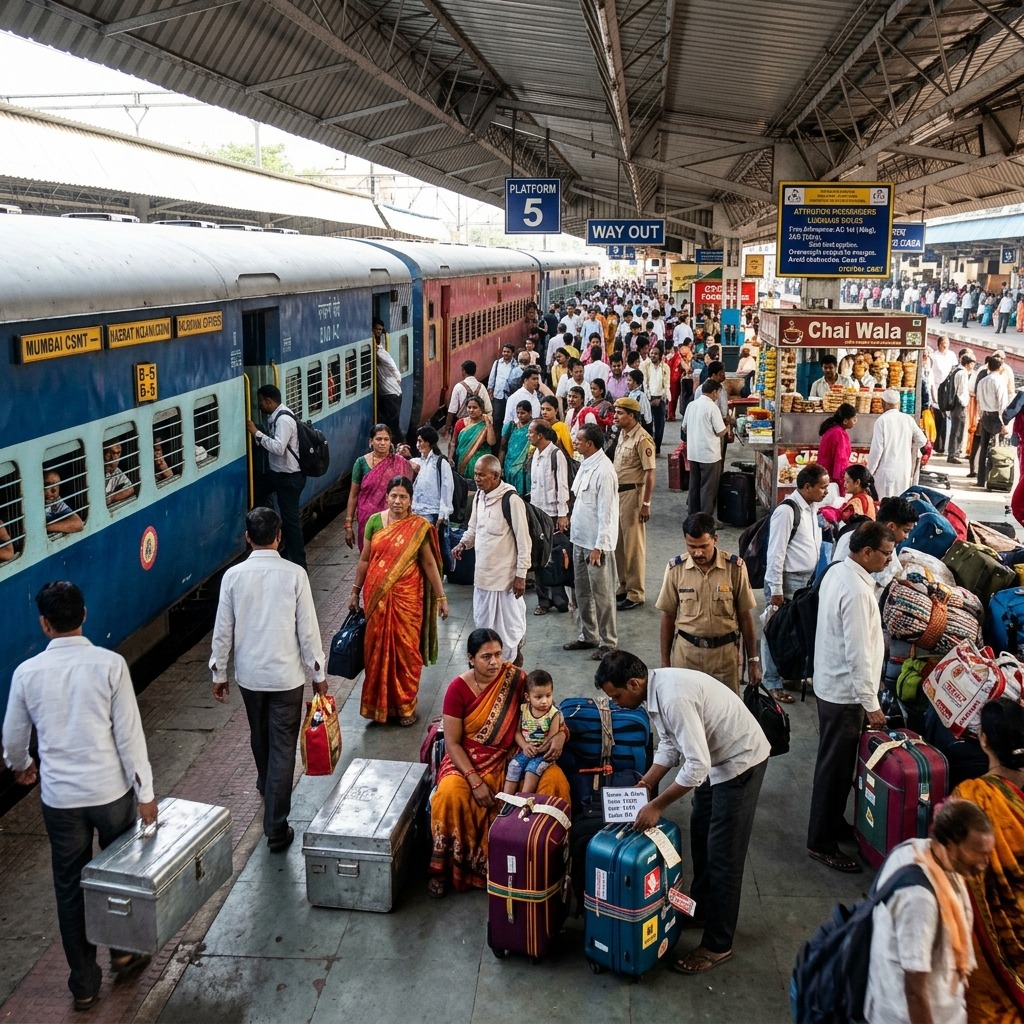
Indian Railways Baggage Policy: Limits, Charges & Rules for 2026
Indian Railways allows free baggage of 35–70 kg depending on travel class. AC First Class passengers get 70 kg free, while General Class passengers get 35 kg. Anything beyond the free limit attracts excess baggage charges starting at ₹30 minimum, calculated at 1.5 times the standard luggage rate.
Every year, Indian Railways carries over 8 billion passengers making it one of the busiest rail networks on the planet. Yet, one of the most common sources of stress for travelers remains baggage. Overloaded compartments, unexpected fines at the station, and confusion over what’s allowed have made luggage rules a pain point for millions.
What Is the Indian Railways Baggage Allowance by Class?
Indian Railways assigns a free baggage allowance based on the passenger’s travel class. The allowance is divided into two categories: free allowance (carried at no cost) and marginal allowance (a buffer zone where charges apply if exceeded without advance booking).
|
Travel Class |
Free Allowance |
Marginal Allowance |
Max Allowed |
|
AC First Class (1A) |
70 kg |
15 kg |
150 kg |
|
AC 2-Tier / First Class (2A/FC) |
50 kg |
10 kg |
100 kg |
|
AC 3-Tier / AC Chair Car (3A/CC) |
40 kg |
10 kg |
40 kg |
|
Sleeper Class (SL) |
40 kg |
10 kg |
80 kg |
|
Second Class / General (2S) |
35 kg |
10 kg |
70 kg |
Free allowance means Indian Railways carries that weight without any charge. Marginal allowance is an additional buffer if your luggage falls within this range and you’ve booked it at the parcel office, you pay standard rates. If caught unbooked, you pay 6 times the standard rate.
What Are the Special Baggage Rules for Children and Senior Citizens?
Children aged 5–12 years, who travel on a half-price ticket, are entitled to a free baggage allowance of up to 50 kg. Children under 5 travel free but receive no baggage allowance. There is no separate concessional baggage allowance specifically for senior citizens under the current policy senior citizens follow the same class-based limits as other adult passengers.
What Are the Luggage Size Limits on Indian Trains?
Beyond weight, Indian Railways enforces dimensional restrictions on luggage. Even if your bag is within the weight limit, an oversized item must be booked in the parcel van.
|
Compartment Type |
Maximum Dimensions (L × B × H) |
|
General / Sleeper / AC First Class / 2AC |
100 cm × 60 cm × 25 cm |
|
AC 3-Tier and AC Chair Car |
55 cm × 45 cm × 22.5 cm |
Luggage exceeding these dimensions even if it’s underweight must be reserved in advance and transported in the luggage compartment. Failure to comply can result in fines or forced repacking at the station.
What Are the Indian Railways Excess Luggage Charges?
Excess baggage charges in Indian Railways are calculated at 1.5 times the standard luggage (Scale-L) rate, based on distance traveled. If caught with unbooked excess luggage during the journey, the penalty is 6 times the standard rate. The minimum booking charge is ₹30.
Here’s an approximate breakdown of base luggage rates (Scale-L) used to calculate excess charges:
|
Distance |
Approx. Rate Per Kg |
|
0–100 km |
₹3–₹4.5 |
|
101–500 km |
₹6–₹8.5 |
|
501–1,000 km |
₹12–₹18 |
|
1,001–2,000 km |
₹22–₹28 |
|
2,001–3,000+ km |
₹35–₹45 |
Practical example: A Sleeper Class passenger traveling 700 km with 55 kg of luggage has 15 kg of excess beyond the 40 kg free allowance. At approximately ₹15/kg (base rate), the excess luggage charge works out to roughly ₹15 × 1.5 = ₹22.5/kg × 15 kg = ₹337.50, subject to the minimum charge of ₹30 and applicable taxes.
If this same passenger had not pre-booked the excess and was caught during the journey, the charge would be ₹15 × 6 = ₹90/kg × 15 kg = ₹1,350 four times more expensive.
How and Where Do You Book Excess Baggage?
- In advance: Book during ticket purchase or at the station before travel
- Day of travel: Visit the station’s parcel/luggage office at least 30 minutes before departure
- Payment: Charges are paid at the luggage counter; a receipt is issued
- Labeling requirement: All luggage must be legibly addressed in English or Hindi; unlabeled bags will not be accepted
Which Items Are Not Allowed on an Indian Train?
Under Section 164 of the Indian Railway Act, 1989, carrying dangerous or prohibited goods is a criminal offense punishable by up to 3 years in jail and/or a fine of ₹1,000.
Strictly prohibited items include:
- Flammable/explosive materials: firecrackers, gunpowder, crackers
- Hazardous liquids: acid, petrol, kerosene, diesel
- Compressed gases: LPG cylinders, aerosols under pressure
- Corrosive chemicals and toxic substances
- Any item that poses a fire or explosion risk in an enclosed compartment
Allowed with conditions:
- Limited personal snacks and drinking water for consumption during travel
- Medicines and medical equipment (in reasonable quantities)
- Small battery-powered devices
Are There Special Rules for Sports Equipment and Musical Instruments?
This is a common content gap in competitor articles and a question many travelers get wrong. Indian Railways does not have a separate published category for sports equipment or musical instruments the way airlines do. Instead, these items are treated as ordinary luggage and governed by the standard weight and dimensional limits of your travel class.
Practical guidance:
- A guitar or violin in a hard case can typically fit within standard luggage dimensions for Sleeper/AC classes; if it exceeds the dimensional limit (100 × 60 × 25 cm), it must be booked separately via the parcel van
- Bicycles, scooters, and cycles must always be booked separately at the parcel office and do not count toward free luggage allowance
- Cricket kits, tennis rackets, or sporting gear exceeding your class weight limit must be pre-booked as excess luggage
- Fragile items must be appropriately packed; Indian Railways is not liable for breakage due to improper packing
The safest approach: weigh and measure all equipment at home, compare against your class limits, and pre-book anything that exceeds them.
What Happens If Your Luggage Is Lost or Damaged?
Competitor blogs largely skip this section but it’s critical for peace of mind. If luggage booked through the official parcel/luggage system is lost or damaged:
- File a claim immediately at the destination station’s parcel office before leaving the premises
- Present your luggage receipt (RR – Railway Receipt) as proof of booking
- Indian Railways’ liability is limited and is calculated based on the declared value at the time of booking, not market value
- For high-value items, purchasing transit insurance (typically 1–3% of declared value) at the time of booking is strongly advised
- Claims for unbooked or informally carried luggage are not entertained this is why advance booking matters
5 Practical Tips to Stay Within Baggage Limits
- Weigh bags at home before traveling; a small luggage scale saves significant money and stress
- Roll clothing instead of folding to reduce bulk particularly effective for AC 3-Tier passengers with the tighter 55 × 45 × 22.5 cm limit
- Pre-book excess in advance online or at the station rather than on the train; the difference between 1.5× and 6× charges is substantial
- Soft-sided bags are easier to compress and fit into overhead racks than rigid suitcases
- Wear heavier items (jackets, boots) during travel if you’re near your weight limit
Frequently Asked Questions
How much luggage is allowed in Indian Railways for free?
Free allowance ranges from 35 kg (General Class) to 70 kg (AC First Class). Sleeper and AC 3-Tier passengers get 40 kg free. These limits apply per passenger, not per compartment.
What is the new luggage policy in Indian Railways for 2025–2026?
The updated policy enforces stricter dimensional limits especially for AC 3-Tier and Chair Car (55 × 45 × 22.5 cm) and enforces enhanced luggage screening at 11 major stations under Northern and North Central Railway zones. Excess baggage penalties remain at 6× standard rates for unbooked items.
What are Indian Railways’ train luggage charges per kg?
Base Scale-L rates range from ₹3–₹4.5/kg for short distances (under 100 km) to ₹35–₹45/kg for journeys over 2,000 km. Excess luggage is charged at 1.5× these base rates; unbooked excess attracts 6× the rate, with a ₹30 minimum charge.
Can I book excess luggage online for Indian Railways?
Yes. Excess luggage can be booked in advance at the time of ticket purchase. On the day of travel, it must be booked at the station’s parcel office at least 30 minutes before departure. Online advance booking is the recommended approach for stress-free travel.
What happens if my luggage exceeds the limit on the train?
If discovered during a journey check, you will be charged 6 times the standard luggage rate for the excess weight. You may also be asked to offload items at the next major station. Pre-booking excess always costs significantly less.
Are there luggage allowance differences between Vande Bharat and regular trains?
Vande Bharat Express operates with Chair Car (CC) and Executive Chair Car (EC) classes. Chair Car passengers follow the standard CC class limit of 40 kg; EC class passengers follow First Class limits. The dimensional restriction of 55 × 45 × 22.5 cm applies to all Chair Car seats.
Can I carry a bicycle or motorbike on an Indian train?
Yes, but only as a separately booked parcel not under free luggage allowance. Motorbike parcel charges by train range from approximately ₹300 to ₹2,000 depending on engine capacity and distance. Registration and insurance documents are required at booking.
Is there a children’s baggage allowance on Indian Railways?
Children aged 5–12 traveling on half-fare tickets are entitled to a baggage allowance of up to 50 kg, regardless of class. Children under 5 travel free but receive no luggage allowance.
What is the penalty for carrying prohibited items on an Indian train?
Under Section 164 of the Indian Railway Act, 1989, carrying banned items such as flammable materials, gas cylinders, or acid is punishable by up to 3 years in prison and/or a fine of ₹1,000. Items may also be confiscated immediately.
How do I file a lost luggage claim on Indian Railways?
File the claim at the destination parcel office before leaving the station premises. Present your Railway Receipt (RR) as proof of booking. Indian Railways’ liability is limited to the declared value at booking. Transit insurance (1–3% of declared value) can be purchased at the time of booking for additional coverage.

Muhammad Naeem is a travel researcher with 5+ years of experience analyzing airline rules and global travel regulations. He specializes in simplifying complex airline policies to help travelers avoid extra fees and fly with confidence. His work focuses on accuracy, clarity, and up to date information across international carriers.