Austrian Airlines Boeing 777-200ER Seat Map Guide
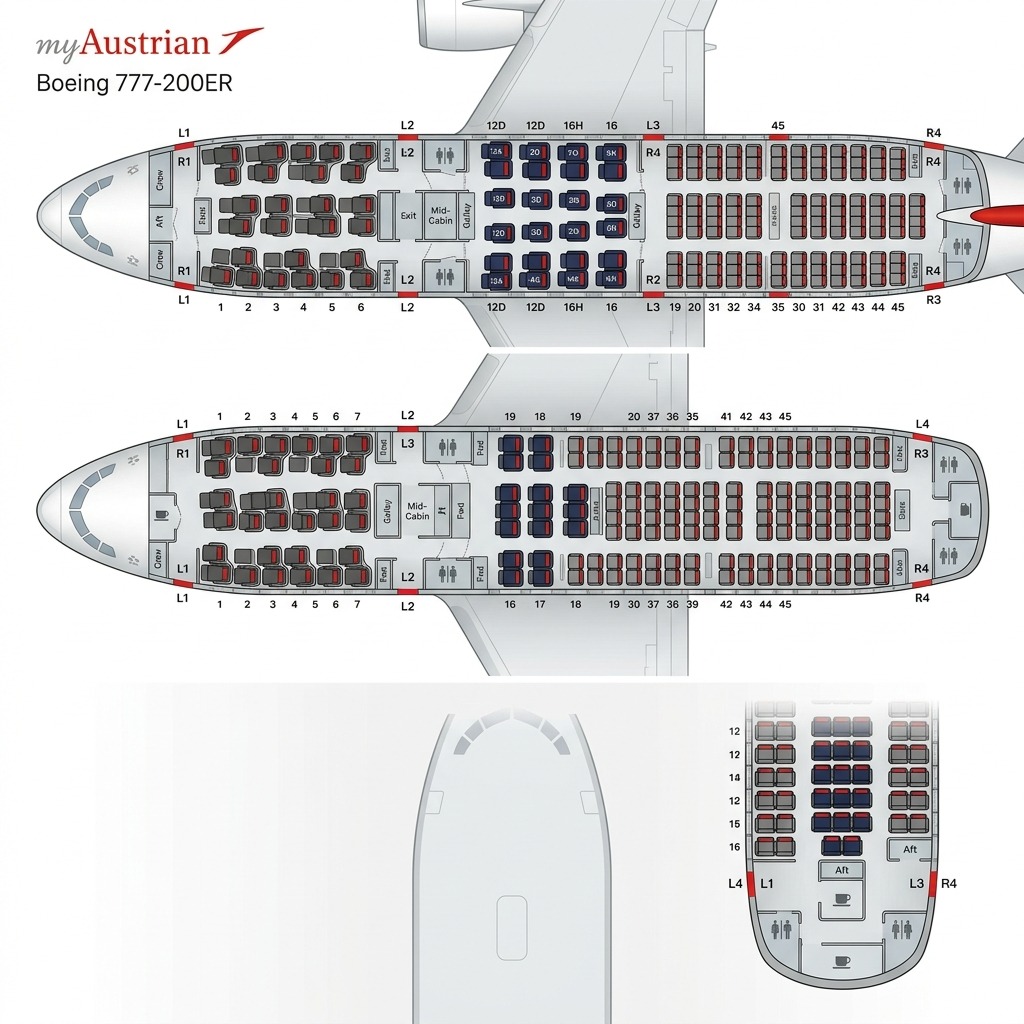
The Austrian Airlines Boeing 777-200ER features a 330-seat configuration across three classes. This layout includes 32 flat-bed Business Class seats, 40 Premium Economy seats, and 258 standard Economy seats. The wide-body aircraft utilizes a staggered 1-2-1 and 2-2-2 design in Business, ensuring maximum cabin density and passenger comfort.
The Boeing 777-200ER serves as a vital flagship aircraft for the Austrian Airlines long-haul fleet. With the capacity to carry hundreds of passengers over 12,100 kilometers, this aircraft successfully bridges Europe with key international hubs. As travel demand grows, understanding the exact layout of this aircraft can dramatically improve your in-flight experience.
What is the seating arrangement on a Boeing 777-200?
The seating arrangement on the Austrian Airlines Boeing 777-200 allocates 32 seats to Business Class, 40 seats to Premium Economy, and 258 seats to Economy Class. Business Class uses a staggered layout, Premium Economy uses a 2-4-2 layout, and standard Economy primarily utilizes a 3-4-3 layout.
The official Austrian Airlines configuration maximizes space while accommodating 330 total passengers. This density allows the airline to service high-demand long-haul routes efficiently.
Cabin Configuration Overview
|
Cabin Class |
Total Seats |
Row Numbers |
Layout Format |
|
Business Class |
32 |
1 – 7 |
Staggered (1-2-1 / 2-2-2) |
|
Premium Economy |
40 |
10 – 15 |
2-4-2 |
|
Economy Class |
258 |
16 – 44 |
3-4-3 |
How is the Austrian Airlines Business Class experience?
The Business Class cabin offers 32 lie-flat seats with a 60-inch pitch and a 20-inch width. Passengers enjoy Lantal air-cushion beds extending to 78 inches. Odd-numbered rows feature highly sought-after private “throne” seats. Amenities include Do & Co catering, noise-canceling headphones, and a signature Julius Meinl coffee menu.
For solo travelers, the standalone “throne” seats (A and K in odd-numbered rows) provide exceptional privacy and dual armrest workspaces. Couples should opt for the paired middle seats (D and G) in even-numbered rows.
- Premium catering: The airline employs Do & Co catering, offering restaurant-quality Austrian dishes like Viennese-style chicken.
- Unique beverages: The signature coffee menu features specialized drinks brewed on demand.
- Seat comfort: The customizable air cushions allow passengers to adjust seat firmness, complete with a built-in massage function.
What to expect in the Austrian Airlines Boeing 777-200 premium economy?
The Austrian Airlines Boeing 777-200 premium economy cabin provides a significant upgrade over standard economy seating. Passengers receive up to 38 inches of pitch, a 19-inch seat width, and a generous 40-degree recline angle. The Austrian Airlines Boeing 777-200 premium economy seat map spans rows 10 through 15.
Choose the Austrian Airlines Boeing 777-200 premium economy class if extra legroom matters more than fully flat beds. The 2-4-2 configuration means fewer middle seats compared to standard economy.
Seat Dimensions by Class
|
Cabin Class |
Seat Pitch |
Seat Width |
Max Recline |
|
Business Class |
60 inches (152 cm) |
20 inches (52 cm) |
180 degrees (Flat) |
|
Premium Economy |
38 inches (94 cm) |
19 inches (48.3 cm) |
40 degrees |
|
Economy Class |
31-33 inches (79 cm) |
17 inches (43.2 cm) |
3 inches |
What are the economy class essentials?
Economy Class on the Boeing 777-200 Austrian Airlines fleet includes 258 seats with a 31-inch to 33-inch pitch and a 17-inch width. Standard amenities include a personal Zodiac Rave touchscreen entertainment system, adjustable headrests, USB power outlets, and a traditional 3-inch seat recline.
When flying in the economy cabin, seat selection makes a massive difference. Taller passengers should target bulkhead rows or emergency exit rows for additional legroom, though these often incur an extra fee during booking.
Does the Boeing 777 200 Austrian Airlines have Wi-Fi?
No, the Boeing 777 200 Austrian Airlines Wi-Fi service is currently unavailable. Austrian Airlines does not equip its long-haul wide-body aircraft with internet connectivity. However, passengers can access the Zodiac Rave in-flight entertainment system, which provides gate-to-gate audio and visual content on high-definition seatback screens.
While short-haul European flights offer FlyNet connectivity, the long-haul fleet remains entirely offline. To ensure a smooth flight, download any necessary podcasts, movies, or work documents before boarding. You can easily charge your devices using the universal power sockets and USB ports located at every seat.
How does AeroSHARK technology improve environmental impact?
AeroSHARK is a specialized surface film mimicking shark skin, applied to four Austrian Airlines Boeing 777-200ER aircraft. This technology reduces aerodynamic drag, cutting fuel consumption by up to 1%. Consequently, the airline projects a reduction of approximately 8,300 tons of CO2 emissions by the year 2028.
Developed jointly by Lufthansa Technik and BASF, this riblet film optimizes airflow around the aircraft fuselage. Austrian Airlines became the first airline globally to deploy this specific technology on the Boeing 777-200ER platform.
How does it compare to other airlines and routes?
The Austrian Airlines 777-200ER offers a higher density layout than the Boeing 777-200ER American Airlines configuration, fitting 330 seats compared to 273. Austrian utilizes this aircraft on flagship long-haul routes, including the popular Boeing 777 200 Austrian Airlines Bangkok service for flights OS25 and OS26.
Different airlines configure identical airframes to suit their specific market demographics. The American Airlines layout prioritizes a larger Business Class footprint, while Austrian focuses on moving high volumes of leisure and premium economy passengers.
Austrian Airlines vs American Airlines 777-200ER
|
Feature |
Austrian Airlines 777-200ER |
American Airlines 777-200ER |
|
Total Seats |
330 |
273 |
|
Business Class Seats |
32 (Staggered) |
37 (Reverse Herringbone) |
|
Premium Economy Seats |
40 |
24 |
|
Economy Seats |
258 |
212 |
Travelers heading to Thailand frequently book the Boeing 777 200 Austrian Airlines Bangkok route. Because the OS25 flight averages over ten hours, upgrading to Premium Economy or securing a “throne” seat in Business Class offers a highly competitive return on investment for passenger comfort.
Next steps for your Austrian Airlines flight
Securing the best seat on the Boeing 777-200ER requires early planning. Log into your booking portal as soon as your reservation is ticketed to review the seat map. If you are a tall passenger, immediately secure an aisle seat or a bulkhead row in Economy. If you value privacy in Business Class, reserve an odd-numbered window seat well in advance. Monitor seat alerts online, as premium spots often open up closer to the departure date due to elite upgrades and cancellations.
Frequently Asked Questions
What are the best economy seats on a 777-200?
The best economy seats on the Austrian Airlines 777-200 are located in the bulkhead rows (typically Row 16) and the emergency exit rows. These seats provide significantly more legroom than the standard 31-inch pitch found in the rest of the cabin.
Is Austrian Airlines a good airline to fly?
Yes, Austrian Airlines is a highly regarded carrier within the Lufthansa Group. Aviation experts consistently praise the airline for its exceptional Do & Co onboard catering, punctuality, and attentive service, particularly in its premium cabins.
Which Boeing to stay away from?
Some travelers actively avoid the Boeing 737 MAX series due to past grounding incidents, though global aviation authorities have since recertified the aircraft. The Boeing 777 series, conversely, maintains one of the most outstanding safety records in modern commercial aviation history.
Is the Boeing 777-200 a comfortable plane?
Yes, the Boeing 777-200 is a very comfortable wide-body aircraft. Its spacious cabin width allows for higher ceilings and better air circulation. However, passenger comfort ultimately depends on the specific seat class and layout chosen by the operating airline.
Where is best to sit on Boeing 777?
The best place to sit on a Boeing 777 is near the front of the aircraft or over the wings. The front cabins experience the least amount of engine noise, while seats positioned directly over the wings experience the least amount of turbulence during flight.
Which is safer, Airbus or Boeing 777?
Both Airbus wide-body aircraft (like the A330 and A350) and the Boeing 777 share impeccable safety statistics. The Boeing 777-200ER has flown millions of hours with a stellar safety record, making it statistically as safe as its direct Airbus competitors.
Which airline retired the 777-200?
United Airlines recently made headlines by retiring its very first Boeing 777-200 aircraft after 30 years of continuous service. Other legacy carriers are slowly phasing out older 777-200 models to make way for newer, more fuel-efficient models like the Boeing 787 Dreamliner.
Do you get free food on Austrian Airlines?
Yes, Austrian Airlines provides complimentary hot meals and beverages on all long-haul international flights, including those operated by the Boeing 777-200ER. Passengers in Economy receive standard multi-course trays, while Business Class passengers enjoy premium plated dining.
Can you upgrade to Premium Economy at the airport?
Yes, if seats remain available, passengers can purchase an upgrade to Premium Economy at the check-in desk or departure gate. Prices vary based on the specific route and current passenger load, but upgrading is generally cheaper at the airport than booking directly.
Do Austrian Airlines 777s have personal air vents?
Passenger reviews indicate that Austrian Airlines Boeing 777-200ER aircraft generally lack individual gasper air vents above the seats. The cabin temperature is controlled centrally by the flight crew, so layering your clothing is highly recommended for long flights.

Muhammad Naeem is a travel researcher with 5+ years of experience analyzing airline rules and global travel regulations. He specializes in simplifying complex airline policies to help travelers avoid extra fees and fly with confidence. His work focuses on accuracy, clarity, and up to date information across international carriers.