Air Busan Baggage Policy: Fees, Allowance, Carry-On & Checked Bag Rules (2026)
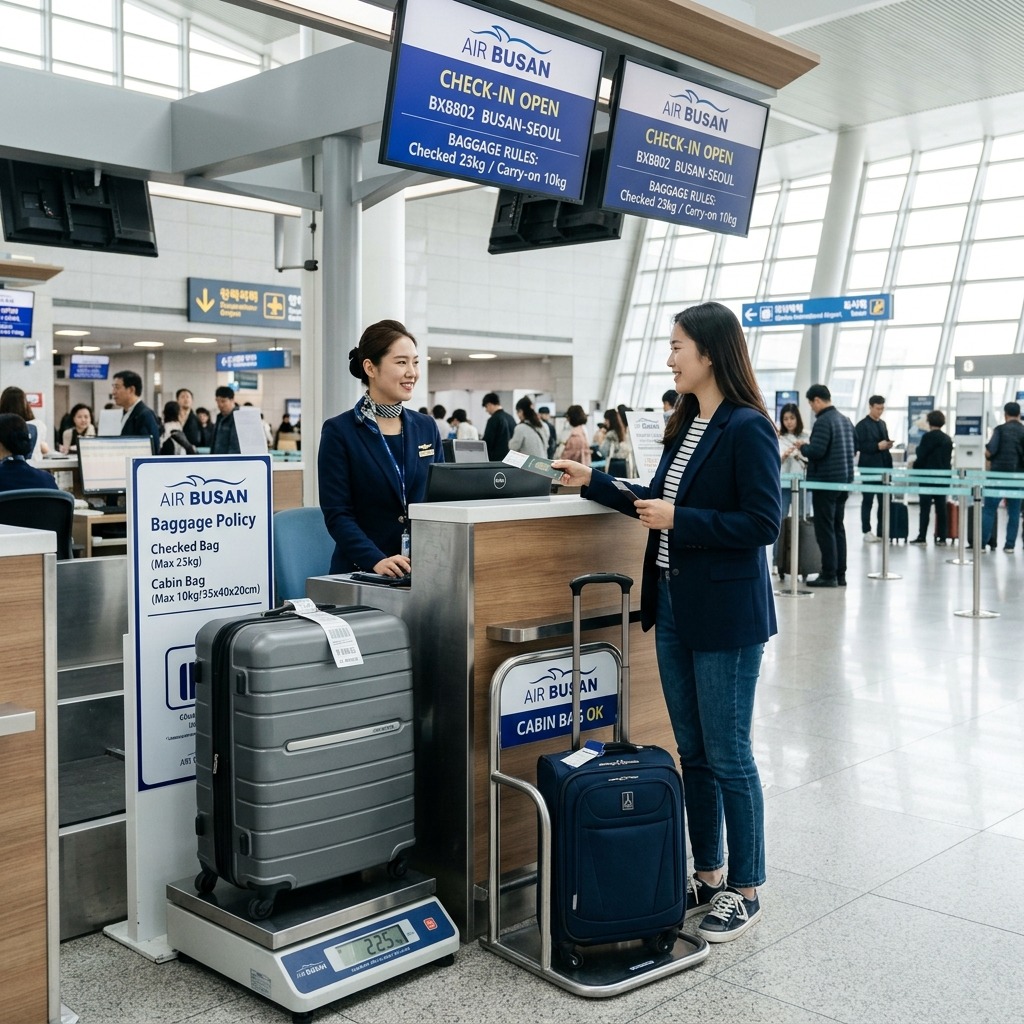
Air Busan allows 1 carry-on bag (max 10 kg, 55×40×20 cm) per passenger in the cabin. Checked baggage depends on fare type: Fly fares include none, Smart fares include ~15 kg, and Premium fares up to 30 kg. Excess fees range from KRW 2,000–18,000/kg depending on route.
Booking a flight with Air Busan and unsure what you can pack and what it will cost you if you pack too much? You’re not alone. Air Busan’s baggage rules vary by fare type, route, and whether you purchase in advance or at the airport. Getting it wrong can add a significant amount to what looked like a budget-friendly fare.
Is Air Busan a Low-Cost Carrier?
Air Busan is a low-cost carrier (LCC) based in Busan, South Korea. Founded as a subsidiary of Asiana Airlines, it operates from Gimhae International Airport (PUS) and ranks as South Korea’s third-largest budget airline. As an LCC, Air Busan charges separately for checked baggage on many fares rather than including it by default.
This matters because many first-time passengers expect a free checked bag to be included it often isn’t on the entry-level Fly fare. Knowing this upfront prevents a costly surprise at the check-in counter.
Is Baggage Allowed on Air Busan?
Yes, baggage is allowed on Air Busan flights. Every passenger receives one free carry-on bag. Checked baggage is either included (depending on your fare type) or can be purchased as an add-on. Special items like sports equipment, musical instruments, and pets are also accepted under specific conditions.
The short answer: you can bring luggage. The more important question is how much, and at what cost both of which depend heavily on the fare class you’ve selected.
What Is the Carry-On Size for Air Busan?
Air Busan’s carry-on (cabin baggage) limit is 1 bag per passenger, with a maximum weight of 10 kg and maximum dimensions of 55 × 40 × 20 cm (total sum of three sides: 115 cm or less). Passengers may also bring one personal item such as a small handbag or laptop bag.
Air Busan Cabin Baggage at a Glance
|
Item |
Limit |
|
Number of bags |
1 carry-on + 1 personal item |
|
Maximum weight |
10 kg |
|
Maximum size |
55 × 40 × 20 cm (or ≤ 115 cm total) |
|
Personal item |
Small handbag or laptop bag |
Key point most blogs miss: Each individual side also has its own maximum. The width must not exceed 40 cm, depth 20 cm, and height 55 cm even if the total stays under 115 cm. Bags that bulge outside these dimensions at the gate may be refused in-cabin.
A good practical rule: if it fits in a standard overhead bin and weighs under 10 kg on your bathroom scale at home, you’re fine.
What Is the Air Busan Checked Baggage Allowance?
Air Busan’s checked baggage allowance depends on your fare type. Fly fares include no free checked bag; Smart fares typically include 15 kg; Smart Plus adds approximately 8 kg on top of Smart; and Premium fares include up to 30 kg. All checked bags must weigh under 32 kg and measure under 203 cm in combined dimensions.
Air Busan Checked Baggage Allowance by Fare Type
|
Fare Type |
Free Checked Baggage |
Best For |
|
Fly |
None (add-on required) |
Carry-on-only travelers |
|
Smart |
~15 kg (1 piece) |
Short Korea trips |
|
Smart Plus |
~23 kg (Smart + 8 kg) |
Moderate packers |
|
Premium |
Up to 30 kg |
Heavy packers, shoppers |
Hard limits that apply to all fares:
- Maximum weight per bag: 32 kg
- Maximum total dimensions: 203 cm (L + W + H combined)
- Bags exceeding either limit are not accepted for transport
Air Busan Checked Baggage Weight: What Does “15 kg” Actually Mean?
If you’re on a Smart fare with a 15 kg allowance and your bag weighs 20 kg at check-in, you pay excess fees on 5 kg. On a domestic Busan–Jeju route, that’s KRW 2,000 × 5 = KRW 10,000 (~$7.50 USD) at the airport. On a Japan route, the same 5 kg over costs KRW 12,000 × 5 = KRW 60,000 (~$45 USD). The route makes an enormous difference.
What Are Air Busan’s Checked Baggage Size Rules?
For checked bags, Air Busan requires that the sum of length + width + height (L+W+H) does not exceed 158 cm for standard checked items, and no bag may exceed 203 cm or weigh more than 32 kg. Bags outside these absolute limits cannot be transported at any price.
This is the absolute maximum not the free allowance. Even if you’re willing to pay excess fees, bags over 32 kg or 203 cm are refused at check-in. This catches many travelers who think oversized items can always be accepted for a surcharge.
What Are Air Busan’s Checked Baggage Prices?
Air Busan charged baggage fees vary by route and whether you purchase before or at the airport. Pre-purchasing is consistently cheaper. Domestic pre-purchase starts at KRW 10,000 per 5 kg, while Japan routes cost KRW 40,000 per 5 kg. Excess fees at the airport range from KRW 2,000/kg (domestic Jeju) to KRW 18,000/kg (Southeast Asia routes).
Air Busan Baggage Fee Comparison: Pre-Purchase vs. Airport
|
Route |
Pre-Purchase (per 5 kg) |
Excess Fee at Airport (per kg) |
|
Domestic (general) |
KRW 10,000 |
KRW 3,000/kg |
|
Domestic (Jeju route) |
KRW 10,000 |
KRW 2,000/kg |
|
Japan |
KRW 40,000 |
KRW 12,000/kg |
|
Southeast Asia |
Varies |
KRW 16,000–18,000/kg |
|
China (Qingdao, Xi’an, Yanji) |
Varies |
Varies by route |
Note: The above rates apply to tickets issued from September 2025 onward. Always verify current fees on the Air Busan website before booking, as rates may be updated.
Real-world cost example: A traveler flying Busan–Osaka (Japan route) with a 20 kg bag on a Fly fare (no free baggage included) who pre-purchases 20 kg (4 × 5 kg blocks at KRW 40,000 each) pays KRW 160,000 (~$120 USD). If they skip pre-purchasing and pay at the airport, 20 kg × KRW 12,000 = KRW 240,000 (~$180 USD). The savings for booking ahead: ~KRW 80,000.
How to Purchase Air Busan Baggage in Advance
Air Busan allows baggage add-ons to be purchased online after booking your ticket. This is the most cost-effective approach. Note two important restrictions:
- Pre-purchased baggage applies to counter check-in only not gate check-in
- Baggage checked in front of the gate is non-refundable
- Air Busan currently does not offer online check-in, so all passengers must check in at the airport counter
What Are Air Busan’s Domestic Baggage Allowance Rules?
On Air Busan domestic flights, the carry-on limit remains 10 kg with the same size rules as international routes. Checked baggage depends on fare type. Excess baggage is charged at KRW 3,000/kg on most domestic routes and KRW 2,000/kg specifically on the Busan–Jeju route. Pre-purchase costs KRW 10,000 per 5 kg.
Domestic routes currently operated by Air Busan connect Busan (Gimhae) primarily with Jeju (CJU) and Seoul/Gimpo (GMP). The Jeju route’s lower excess rate (KRW 2,000/kg vs. KRW 3,000/kg) reflects high competition on that corridor, where Jeju Air and Jin Air also operate.
What Are Air Busan’s International Baggage Allowance Rules?
On Air Busan international flights, carry-on rules remain the same (10 kg, 55×40×20 cm). Checked baggage allowance varies by fare and route. Japan routes incur excess charges of KRW 12,000/kg at the airport, while Southeast Asia routes (post-September 2025 tickets) run KRW 16,000–18,000/kg. Pre-purchasing baggage online is significantly cheaper than paying at the check-in counter.
International destinations served by Air Busan include Japan (Fukuoka, Osaka, Tokyo, Sapporo, and others), China (Qingdao, Xi’an, Yanji), Southeast Asia (including Singapore, Thailand), Guam, and Mongolia (Ulaanbaatar).
Edge case: If you’re connecting through a third airline on the same itinerary, Air Busan’s baggage rules apply only to their operated segments. Always check each carrier’s policy separately.
What Are Air Busan’s Rules for Special Items and Pets?
Air Busan accepts sports equipment (golf bags, skis), musical instruments, fragile items, and pets under specific conditions. Musical instruments with combined dimensions ≤ 115 cm (such as a violin) may be carried on free of charge. Pets in the cabin must have a combined weight (including carrier) of 7 kg or less, with fees ranging from $90–$210 USD depending on the route.
Sports Equipment and Musical Instruments
- Violin/small instruments (≤ 115 cm total): Free cabin carry-on
- Larger instruments: Must be checked; additional fees apply
- Golf bags, skis: Accepted as checked baggage with advance notice; surcharges apply
- Baby strollers: Typically accepted as free checked baggage for passengers traveling with infants
Pet Travel on Air Busan
- In-cabin pets: Small dogs, cats, birds; combined weight with carrier must not exceed 7 kg (15 lbs); 1 pet per passenger (exceptions for 2 puppies/kittens under 6 months)
- Cabin fee: $90–$210 USD depending on route
- Cargo (domestic only): Max combined weight 32 kg; fees $180–$400 USD
- Carrier dimensions (cabin): Max 115 cm combined; max height 24 cm
- Seasonal restriction: Short-nosed dog breeds cannot travel as checked baggage July 1–September 30
- Japan flights: Quarantine certificate required from the National Quarantine Service (minimum 14 days advance)
- Pets not permitted: Bali (no import/export) and Hong Kong (no import/export)
- Pets not accepted: Animals under 8 weeks old, tranquilized pets, pregnant pets, birds of prey, attack dogs
How Does Air Busan’s Baggage Policy Compare to Competitors?
Air Busan’s carry-on rules (10 kg, 55×40×20 cm) are standard for Korean LCCs. On the Busan–Jeju domestic route, Jeju Air’s basic fare includes 15 kg checked so on that specific route, Jeju Air’s base product may offer slightly more checked value on entry-level tickets. Jin Air operates similar policies to Jeju Air on domestic routes.
On Japan and Southeast Asia international routes, Air Busan’s excess fees (KRW 12,000/kg Japan, KRW 16,000–18,000/kg Southeast Asia) are comparable to Jeju Air and Jin Air rates on similar corridors. The key differentiator: pre-purchasing baggage on Air Busan can generate meaningful savings, making fare comparisons more complex than looking at the base ticket price alone.
When to choose Air Busan: If you’re a carry-on-only traveler or can pre-purchase baggage in advance, Air Busan’s base fares are competitive. If you need significant checked baggage (20+ kg) and can’t pre-purchase, a Smart Plus or Premium fare may deliver better value than paying excess airport fees.
How to Avoid Extra Baggage Charges on Air Busan
- Pre-purchase baggage online immediately after booking always cheaper than airport rates
- Weigh luggage at home before departure; a digital luggage scale costs very little and can save thousands of KRW
- Wear your bulkiest items (boots, heavy jacket) onto the plane to reduce bag weight
- Use your personal item allowance your carry-on plus a handbag or laptop bag can collectively hold more than most people realize
- Consider Smart or Smart Plus fares if you always check a bag; the included allowance often costs less than adding baggage post-booking on a Fly fare
- Book FLY+STAMP loyalty benefits Air Busan’s stamp-based frequent flyer program (FLY+STAMP) allows members to earn stamps on flights and redeem them for tickets, reducing overall travel costs over time
Frequently Asked Questions
Does Air Busan charge for carry-on baggage?
No. Air Busan provides one carry-on bag (max 10 kg, 55×40×20 cm) free of charge for all passengers, regardless of fare type. A small personal item (handbag or laptop bag) is also permitted at no charge.
What happens if my carry-on exceeds 10 kg at the Air Busan gate?
If your carry-on bag exceeds 10 kg, Air Busan staff may require it to be checked at the airport counter. You will then be charged the applicable checked baggage excess rate for your route which on Japan routes is KRW 12,000/kg making an overweight carry-on potentially very expensive.
Can I pre-purchase baggage after I’ve already booked my Air Busan ticket?
Yes. Air Busan allows baggage to be added online after your initial booking is complete. Pre-purchase pricing is significantly lower than airport rates, so it’s always worth adding baggage online rather than paying at check-in.
Is pre-purchased baggage refundable if I don’t use it?
Baggage checked at the departure counter is subject to Air Busan’s standard refund policy. However, baggage checked in front of the gate is explicitly non-refundable. If you’re unsure about your luggage plans, check Air Busan’s website for current refund conditions before purchasing.
Does Air Busan allow two checked bags on international flights?
This depends on your fare. Most fare types allow one checked bag up to a specific weight. If you need a second piece, Air Busan charges an additional fee per bag (approximately KRW 50,000 on some Southeast Asia routes). Confirm with Air Busan before departure.
What is the maximum weight Air Busan will accept for a single checked bag?
The absolute maximum is 32 kg per bag. Bags weighing more than 32 kg or with combined dimensions exceeding 203 cm are not accepted for transport under any circumstances, including as oversized or special items.
Can I share my baggage allowance with another passenger on the same booking?
Yes, passengers on the same booking can often pool their baggage allowance. For example, if two passengers each have a 15 kg allowance (30 kg total), one traveler could check a 25 kg bag while the other checks a 5 kg bag, provided the individual bag weight stays under 32 kg. Confirm this with Air Busan at check-in.
Does Air Busan offer online check-in to help manage baggage remotely?
No. As of current policy, Air Busan does not offer online check-in. All passengers must check in at the airport counter domestic flights 40 minutes to 2 hours before departure; international flights 2 to 4 hours before departure.
Are Air Busan baggage fees different for infants?
Infants traveling on a lap infant ticket (no seat) generally do not receive a standard baggage allowance, but passengers traveling with infants can typically check a stroller at no extra charge. Verify infant baggage entitlements when booking, as conditions vary by route.
How do Air Busan’s Japan route baggage fees compare to buying a higher fare tier?
On a Busan–Fukuoka (Japan) flight, if you’re on a Fly fare and need 15 kg of checked baggage, you could either pre-purchase (3 × 5 kg blocks at KRW 40,000 = KRW 120,000) or pay at the airport (15 kg × KRW 12,000 = KRW 180,000). Comparing this against the price difference between Fly and Smart fares before booking often reveals that upgrading fares is the cheaper option for regular checked-baggage travelers.

Muhammad Naeem is a travel researcher with 5+ years of experience analyzing airline rules and global travel regulations. He specializes in simplifying complex airline policies to help travelers avoid extra fees and fly with confidence. His work focuses on accuracy, clarity, and up to date information across international carriers.