Air Tahiti Baggage Policy: Allowance, Fees and Carry-On Rules 2026
Air Tahiti (inter-island) allows 5 kg/11 lb carry-on and 23 kg/50 lb checked baggage on standard fares, with strict enforcement due to small ATR aircraft. Air Tahiti Nui (international) allows 10-12 kg carry-on and 23-32 kg checked baggage depending on class. Excess baggage fees apply per kg and vary by route, payable in XPF, card, or local cheque.
Planning a trip to French Polynesia means juggling two very different airlines with two very different baggage rules. Air Tahiti Nui operates the long-haul international routes into Papeete, while Air Tahiti handles the inter-island hops on smaller ATR and Twin Otter aircraft. Confusing the two or assuming their policies match is one of the most common (and costly) mistakes travelers make.
Air Tahiti Baggage Allowance: What’s Included?
Air Tahiti’s standard allowance includes one carry-on bag (5 kg/11 lb) and one checked bag (23 kg/50 lb) per passenger on standard Economy fares (Y, S, V class). Premium cabin (Class C) passengers get two 23 kg checked bags. Children under 12 receive the same 5 kg carry-on allowance as adults.
Here’s how the inter-island allowance breaks down by fare and class:
|
Fare/Class |
Carry-On |
Checked Baggage |
Max Checked Dimensions |
|
Standard (Y, S, V) |
5 kg (11 lb), 1 bag |
23 kg (50 lb), 1 bag |
158 cm (62 in) L+W+H |
|
Z class (special) |
5 kg (11 lb), 1 bag |
46 kg (100 lb) |
158 cm (62 in) L+W+H |
|
Premium (Class C) |
5 kg (11 lb), 1 bag |
2 bags × 23 kg (50 lb) |
158 cm (62 in) L+W+H |
|
Rarotonga route |
7 kg (15.5 lb), 1 bag |
Standard rules apply |
158 cm (62 in) L+W+H |
|
Child under 12 |
5 kg (11 lb) |
23 kg (50 lb) |
158 cm (62 in) L+W+H |
Z class isn’t a separate cabin it’s a special ticket type that doubles your checked allowance to 46 kg without changing your seat. Frequent travelers on TripAdvisor forums report calling a travel agent to upgrade to Z class a few weeks before departure specifically to avoid overweight fees, since it costs less than paying per-kilo penalties on two overstuffed bags.
Divers get an extra perk: a 5 kg diving equipment allowance on flights to Huahine, Raiatea, Bora Bora, Maupiti, Moorea, Fakarava, Rangiroa, Tikehau, Tubuai, Rurutu, Nuku Hiva, and Hiva Oa. You’ll need to show an official diver’s card or a declaration from your destination dive club at check-in, and it’s subject to space availability.
Air Tahiti Carry-On Size: What Fits in the Cabin?
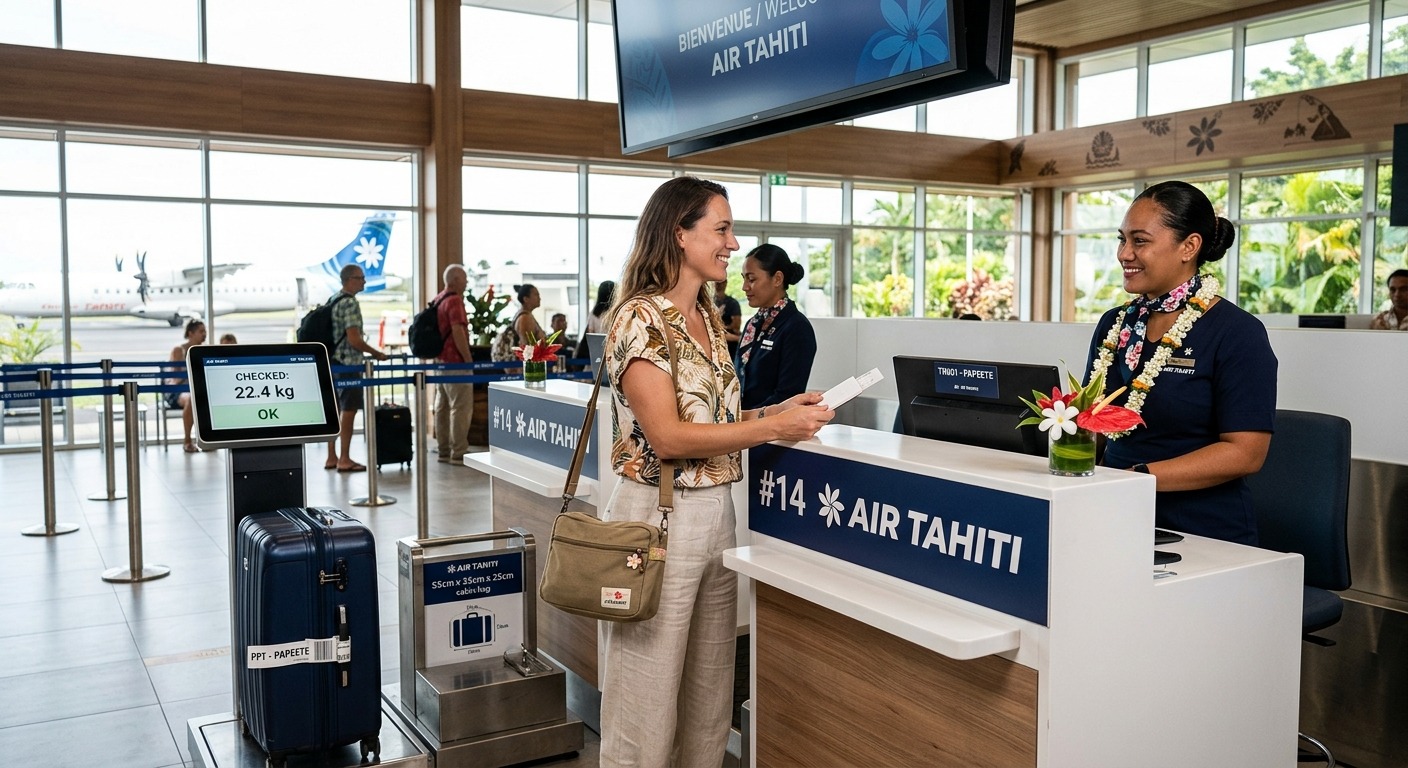
Air Tahiti’s carry-on size limit is 55 x 35 x 25 cm (21.7 x 13.8 x 9.9 in), including wheels and handles, for all destinations. This applies uniformly across Economy and Premium cabins. The limit exists because ATR and Twin Otter aircraft used on inter-island routes have significantly smaller overhead bins than wide-body jets.
That last point matters more than most travelers expect. Multiple TripAdvisor travelers report that anything resembling a wheeled roller bag even one that meets standard airline carry-on sizing elsewhere gets gate-checked on Air Tahiti flights simply because it won’t fit the compartment. A soft-sided duffel or small backpack has a much better chance of staying with you in the cabin.
Practical tip: Pack your camera, tablet, and other electronics in a smaller personal bag (like a purse or slim satchel) rather than your main carry-on. Several frequent Bora Bora and Moorea travelers use this trick specifically to keep valuables in the cabin even when their main carry-on gets checked.
Air Tahiti Carry-On Weight: How Strict Is Enforcement?
Air Tahiti enforces an 5 kg (11 lb) carry-on weight limit, and enforcement is inconsistent but real travelers report bags being weighed at Papeete and Moorea airports more often than at outer-island stops. When a carry-on exceeds the limit, it’s checked into the hold under “limited release” terms, and an excess fee applies if it also exceeds your checked allowance.
This is where Air Tahiti differs sharply from Air Tahiti Nui. On the international carrier, “they do not weigh carry-ons,” according to long-time French Polynesia travel forum contributors. On inter-island Air Tahiti flights, it’s a different story: gate agents have been known to have passengers unpack items from their carry-on into checked luggage on the spot, with charges applied to whoever’s still over.
Real-world scenario: A traveler carrying a packed roller bag weighing 8 kg (nearly double the limit) on a Moorea–Bora Bora flight would likely be asked to shift roughly 3 kg into checked luggage or pay an excess fee on the spot. Because enforcement varies flight to flight, the safest strategy is to pack every carry-on as if it will be weighed, every time.
Air Tahiti Extra Baggage Fee: What Does Excess Baggage Cost?
Air Tahiti calculates excess baggage fees based on the specific route and the amount of extra weight, using an online fare calculator available on their website. Payment is accepted in Pacific Francs (XPF) cash, local cheques, or payment card at check-in. Bags exceeding 25 kg (55 lb) must be shipped as cargo instead.
Unlike many international carriers that publish a flat per-kilo rate, Air Tahiti’s excess baggage cost is route-dependent a few extra kilos from Papeete to Bora Bora won’t cost the same as the same excess weight to a more remote outer island. To get an exact figure, use Air Tahiti’s official excess baggage calculator before you travel, entering your departure island, arrival island, and extra weight.
A few operational details worth knowing:
- Air Tahiti will try to fly your excess baggage on your original flight, but on full flights, it may be sent on a later one useful to know if you need everything to arrive with you.
- Bags over 25 kg (55 lb) aren’t accepted as standard excess baggage at all; they need to go through Air Tahiti’s cargo service instead.
- Excess fees are charged at check-in, not in advance, so budget for the possibility rather than assuming you’ll catch it during booking.
Cost scenario: Say you’re traveling Papeete to Rangiroa with a 30 kg checked bag on a standard economy ticket (23 kg allowance). That’s 7 kg of excess weight. Rather than guessing, run those exact numbers through Air Tahiti’s calculator tool before departure rates differ enough by route that estimating from a different itinerary could leave you under-prepared at the counter.
Air Tahiti Nui vs. Air Tahiti: What’s the Difference?
Air Tahiti Nui operates international long-haul flights with generous 10-12 kg carry-on and 23-32 kg checked allowances, while Air Tahiti operates inter-island hops with much stricter 5 kg carry-on limits. If you book a connecting itinerary entirely through Air Tahiti Nui, Air Tahiti will honor Air Tahiti Nui’s more generous baggage allowance on the connecting leg.
Here’s the side-by-side comparison:
|
Feature |
Air Tahiti Nui (International) |
Air Tahiti (Inter-Island) |
|
Carry-on weight |
10 kg (Economy/Premium), 12 kg (Business) |
5 kg (7 kg for Rarotonga) |
|
Carry-on size |
55 x 35 x 25 cm + personal item |
55 x 35 x 25 cm, no separate personal item |
|
Checked baggage |
23 kg (Economy) up to 2 x 32 kg (Business) |
23 kg standard, up to 46 kg on Z class |
|
Carry-on enforcement |
Rarely weighed |
Frequently weighed, especially at Papeete/Moorea |
|
Aircraft type |
Wide-body (Boeing 787 Dreamliner) |
ATR / Twin Otter (small overhead bins) |
This is the single biggest content gap in most existing guides: they list allowances side by side without explaining why they differ so much, or what happens at the connection point. If your entire journey say, Los Angeles to Bora Bora is booked on one Air Tahiti Nui ticket, your checked bags are typically transferred through and Air Tahiti will apply Air Tahiti Nui’s allowance on the domestic leg. But if you booked the inter-island segment separately, you’re subject to Air Tahiti’s standalone (and stricter) rules, and you’ll need to reclaim and recheck your bags between flights.
Air Tahiti Nui Baggage Allowance: International Flight Details
Air Tahiti Nui’s checked baggage allowance ranges from one 23 kg bag in Moana Economy to two 32 kg bags in Poerava Business class. Carry-on allowance is 10 kg (Economy/Premium) or 12 kg (Business), plus a separate 3 kg personal item on all classes. Maximum checked bag weight for any single piece is 32 kg heavier items must ship as cargo.
|
Travel Class |
Carry-On |
Personal Item |
Checked Baggage |
|
Moana Economy |
10 kg (22 lb) |
3 kg (6.6 lb) |
1 × 23 kg (50.7 lb) |
|
Mānava Premium |
10 kg (22 lb) |
3 kg (6.6 lb) |
2 × 23 kg (50.7 lb) |
|
Poerava Business |
12 kg (26.6 lb) |
3 kg (6.6 lb) |
2 × 32 kg (70.5 lb) |
Infants (0-23 months) without a seat reservation get a separate allowance: one personal item of 3 kg in the cabin, plus one 10 kg checked bag along with either a foldable stroller, car seat, or bassinet, free of charge.
What Special Items Can You Bring?
Air Tahiti Nui allows acoustic guitars and ukuleles up to 115 cm as carry-on within your existing allowance, plus mobility devices like canes, crutches, and foldable wheelchairs free of charge in addition to your standard baggage. Air Tahiti permits sports equipment such as surfboards up to 1.80 m in the hold, subject to availability.
A few specifics worth flagging that rarely make it into other guides:
- Surfboards on Air Tahiti: Boards up to 1.80 m (70 in) travel as regular checked baggage, space permitting. Boards between 1.80 m and 2 m must go through cargo. Anything longer than 2 m isn’t accepted at all.
- Mobility devices: Both airlines carry wheelchairs, crutches, and similar equipment free of charge, separate from your standard allowance this is a genuine accommodation, not a workaround.
- Duty-free liquids: Bottles must be under 100 ml, sealed in a transparent resealable bag no larger than one liter, and not opened before security. If your duty-free purchase doesn’t meet this, it needs to go in checked baggage instead.
- Respiratory and medical equipment: Portable oxygen concentrators and similar devices are permitted in the cabin at no charge, in addition to your standard bag.
How to Avoid Baggage Fees and Delays
A few practical habits make the difference between a smooth check-in and a stressful one:
- Weigh your bags at home before you leave, using the stricter Air Tahiti limits (not Air Tahiti Nui’s) as your benchmark if your trip includes both airlines.
- Choose a soft-sided or backpack-style carry-on over a wheeled roller bag for inter-island legs it’s far less likely to be flagged for gate-checking.
- Padlock checked bags to prevent tampering, and remove old baggage tags from previous trips to avoid routing confusion.
- Label every bag inside and out with your name and destination address.
- Keep your baggage claim receipt until you’ve collected your bags at your final stop.
- If you’re carrying dive gear, bring your certification card or a dated club declaration to claim the 5 kg diver allowance.
- Consider a Z class upgrade on Air Tahiti if you’re traveling with heavier gear it may cost less than repeated excess fees.
Frequently Asked Questions
Is Air Tahiti the same airline as Air Tahiti Nui?
No. Air Tahiti Nui operates international long-haul flights (such as Los Angeles to Papeete), while Air Tahiti operates smaller inter-island flights within French Polynesia. They have separate baggage policies, and Air Tahiti’s inter-island rules are notably stricter.
How much does Air Tahiti charge for extra baggage?
The fee depends on the specific route and excess weight, calculated through Air Tahiti’s official online fare tool. There’s no flat universal rate, so travelers should check their exact itinerary before flying rather than relying on a general estimate.
Can I pay Air Tahiti excess baggage fees in US dollars?
Air Tahiti accepts payment cards, local cheques, and cash in Pacific Francs (XPF) at check-in. Carrying a card is the simplest option if you don’t have XPF on hand.
What happens if my Air Tahiti carry-on is too heavy?
It will be moved to the hold under “limited release” terms, meaning Air Tahiti carries reduced liability for it. If the reclassified bag pushes you over your total checked allowance, an excess fee applies.
Does Air Tahiti weigh carry-on bags at every airport?
Not consistently. Travelers report more frequent carry-on weighing at Papeete and Moorea, the two hub airports for outer-island connections, while enforcement at smaller island airports tends to be visual rather than on a scale.
What is Z class on Air Tahiti?
Z class is a special fare type that raises your checked baggage allowance to 46 kg (100 lb), roughly double the standard 23 kg limit, without changing your cabin seating. It’s a useful option for travelers packing dive gear or extra equipment.
Does my Air Tahiti Nui baggage allowance carry over to my Air Tahiti connecting flight?
Yes, if your entire itinerary is booked on a single Air Tahiti Nui ticket, Air Tahiti will honor the Air Tahiti Nui allowance on the connecting inter-island leg. Separately booked tickets are subject to Air Tahiti’s standalone, stricter rules.
What’s the maximum weight for a single checked bag on Air Tahiti Nui?
32 kg (70.5 lb) is the maximum for any single checked bag. Anything heavier must be shipped as cargo rather than checked as standard luggage.
Do children get a smaller baggage allowance on Air Tahiti?
No. Children under 12 receive the same 23 kg checked and 5 kg carry-on allowance as adults on Air Tahiti flights. Infants without a seat have separate, reduced allowances.
Can I bring a guitar as carry-on with Air Tahiti Nui?
Yes. Acoustic guitars and ukuleles up to 115 cm are permitted as carry-on within your existing baggage allowance, ideally in a rigid case with rounded corners.

Azeem breaks down airline baggage policies, fare-class benefits, and peak pricing rules into practical guidance for smooth trip planning. He verifies every fee and dimension against official airline sources so travelers can pack with confidence.