Air Premia Baggage Policy: Fees, Allowance, Carry-On & Checked Bag Rules (2026)
Air Premia’s baggage allowance ranges from 15 kg (Economy Lite) to 32 kg (Wide Premium) for checked bags, with 1 carry-on up to 10 kg for Economy and 2 carry-ons for Wide Premium passengers. Americas routes include 2 checked pieces; all other international routes include 1. Prepaying for extra bags saves up to 15% versus airport rates.
Baggage surprises at the check-in counter are one of the fastest ways to derail a trip. A fee you didn’t budget for, a bag that’s two kilograms over, or a piece of sports gear that doesn’t qualify under standard rules these are the moments that turn excitement into frustration. Air Premia, South Korea’s hybrid long-haul airline, operates a structured but nuanced baggage policy that rewards passengers who plan ahead.
What Is the Air Premia Baggage Allowance?
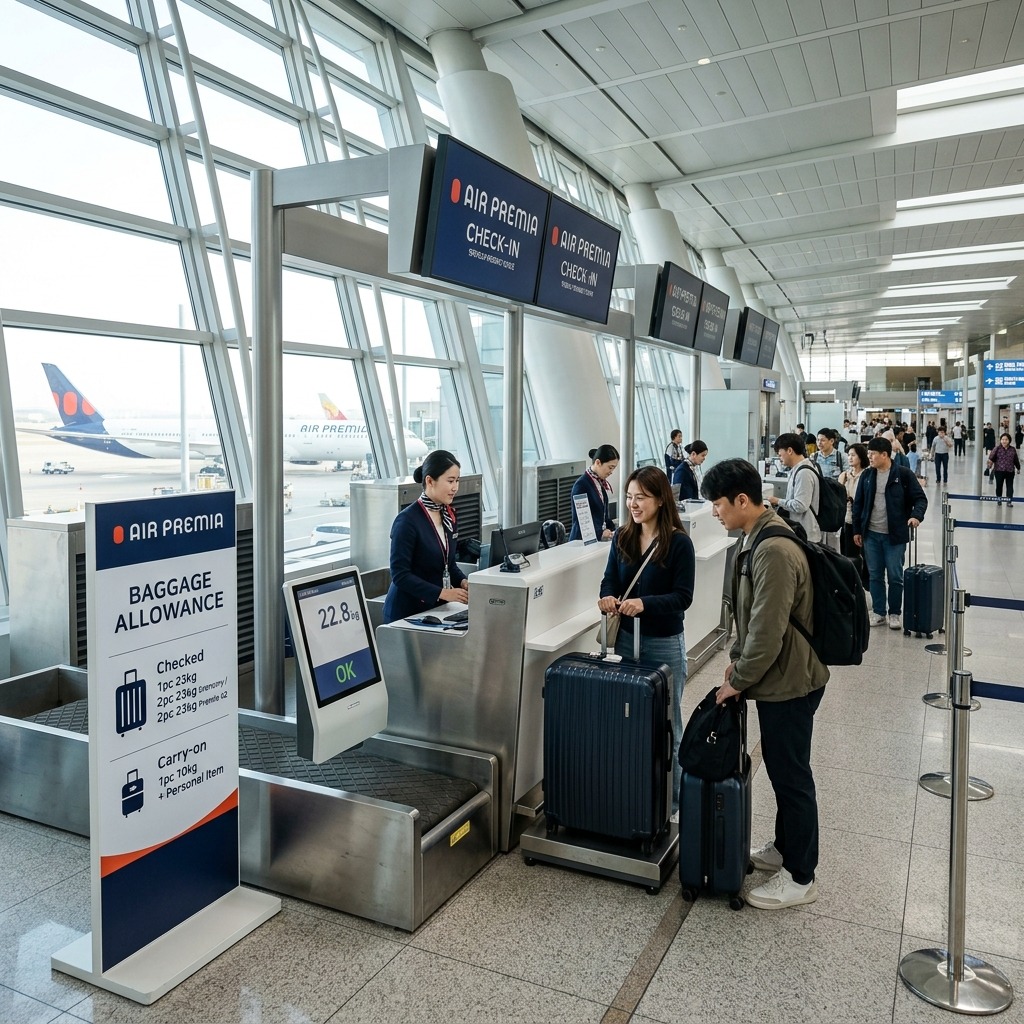
Air Premia’s baggage allowance is determined by your cabin class and fare tier. Economy passengers receive a checked bag allowance of either 15 kg or 23 kg depending on their fare type, while Wide Premium passengers receive 32 kg. All passengers may bring 1 personal item in addition to their carry-on, with the personal item’s weight counted within the carry-on limit.
The table below summarizes free checked baggage by class and route:
|
Cabin / Fare |
Non-Americas Routes |
Americas Routes |
|
Economy Lite |
1 piece × 15 kg |
1 piece × 23 kg |
|
Economy Standard |
1 piece × 23 kg |
2 pieces × 23 kg |
|
Economy Flex |
1 piece × 23 kg |
2 pieces × 23 kg |
|
Wide Premium Standard |
1 piece × 32 kg |
2 pieces × 32 kg |
|
Wide Premium Flex |
1 piece × 32 kg |
2 pieces × 32 kg |
Key takeaway: Economy Lite passengers heading to Japan, Hong Kong, or Southeast Asia only get 15 kg not the 23 kg that many travelers assume is standard. If you tend to pack heavily, upgrading to Economy Standard is often cheaper than paying the overweight surcharge at the airport.
What Is Air Premia’s Baggage Allowance on International Routes?
On international routes, Air Premia applies a piece-based system where Americas-bound passengers (including flights to Los Angeles and Newark) receive an additional checked bag compared to all other international destinations. The distinction matters: a passenger flying Seoul (ICN) to Los Angeles (LAX) in Economy Standard gets 2 × 23 kg free, while the same fare on a Seoul–Tokyo route includes only 1 × 23 kg.
All checked bags on all routes must stay within these hard limits:
- Maximum weight per bag: 32 kg (71 lbs) bags exceeding this may be refused outright
- Maximum size per bag: 158 cm (62.2 inches) total of three dimensions for standard checked items
- Oversized range: 159–292 cm (fees apply; see excess baggage section)
What Is Air Premia’s Economy Baggage Allowance?
Air Premia Economy is split into three fare tiers Lite, Standard, and Flex each with a different baggage entitlement. Economy Standard and Flex are identical in baggage terms; Lite is the restrictive option.
Economy carry-on allowance (all three tiers):
- 1 carry-on bag: up to 10 kg, max dimensions 55 × 40 × 20 cm (total 115 cm)
- 1 personal item: dimensions up to 50 × 30 × 20 cm (total 100 cm)
- Important: The personal item’s weight is not separate it is included within your 10 kg carry-on limit
This is a common point of confusion. If your carry-on bag weighs 7 kg and your laptop bag weighs 4 kg, you are already over the 10 kg threshold combined, even though you’re carrying what appears to be a standard setup. Air Premia may apply gate-checked baggage fees if the combined weight is exceeded.
Is Air Premia Strict With Carry-On Baggage?
Yes. Air Premia enforces a 10 kg carry-on limit for Economy passengers and gates excess carry-on as checked baggage at additional cost. If your carry-on or personal item exceeds the allowance at the boarding gate, gate-checked baggage fees apply per kilogram charged at a rate based on your route.
Gate-checked baggage fee rates:
|
Route Region |
Fee Per kg (Korea departure) |
Fee Per kg (Overseas departure) |
|
Northeast Asia |
KRW 10,000 |
USD 10 / JPY 1,000 / HKD 80 |
|
Southeast Asia |
KRW 15,000 |
USD 15 / THB 500 |
|
Americas / Europe |
KRW 20,000 |
USD 20 / EUR 20 |
Gate-checked bags must not exceed 23 kg or 158 cm total dimensions. If they do, the bag must be repacked before it can be accepted.
Prohibited carry-on items include:
- Firearms, tasers, and pepper/acid sprays
- Scissors and bladed objects
- Baseball bats, dumbbells, and similar blunt objects
- Explosives, flammable substances, and chemical agents
Does Air Premia Allow Both a Carry-On and a Personal Item?
Yes. Air Premia permits 1 carry-on bag plus 1 personal item in Economy, and 2 carry-on bags plus 1 personal item in Wide Premium. However, the personal item’s weight is included in the cabin baggage allowance it is not a separately weighted entitlement.
Accepted personal items include briefcases, laptop bags, handbags, small backpacks, and small duty-free purchases. Baby food, strollers (under 115 cm combined dimensions), and mobility aids may be brought into the cabin in addition to the standard allowance, at no extra charge.
Wide Premium passengers receive:
- 2 carry-on pieces, each up to 10 kg (20 kg combined)
- Priority boarding and dedicated check-in
What Are the Air Premia Checked Baggage Weight Limits?
The standard checked baggage weight limits at Air Premia are 23 kg for Economy and 32 kg for Wide Premium per bag. The absolute maximum any single bag may weigh is 32 kg (71 lbs) regardless of class. Bags heavier than 32 kg will be refused at check-in.
What is too heavy for Air Premia bags? Any bag exceeding 32 kg is “too heavy” and cannot be transported. Bags between 23 kg and 32 kg (for Economy passengers) are considered overweight and incur a surcharge. Economy Lite passengers face overweight charges starting at 15 kg on non-Americas routes.
Weight thresholds that trigger fees:
|
Scenario |
Who It Affects |
Fee Trigger |
|
Over 15 kg |
Economy Lite (non-Americas) |
Overweight charge per kg |
|
23–28 kg |
Economy Standard/Flex |
Overweight surcharge (prepaid available) |
|
24–28 kg |
Any Economy |
Tier 1 overweight surcharge |
|
29–32 kg |
Any Economy |
Tier 2 overweight surcharge |
|
Over 32 kg |
All passengers |
Bag refused for transport |
How Much Does Air Premia Charge for Extra Baggage?
Air Premia charges for excess baggage in two ways: at the airport (on-site rate) or in advance online (prepaid rate). Prepaying before departure saves you money. The prepaid window closes 48 hours before your flight.
Prepaid excess baggage fees (purchased online, up to 48 hrs before departure):
- Extra piece (up to 23 kg): KRW 60,000 / USD 60
- Overweight 24–28 kg: KRW 25,000 / USD 25
- Overweight 29–32 kg: KRW 50,000 / USD 50
On-site (airport) excess baggage fees:
- Extra piece (up to 23 kg): KRW 70,000 / USD 70
- Overweight per 1 kg above 23 kg: KRW 10,000 / USD 10
- Oversized bag (159–203 cm): KRW 80,000 / USD 80
- Oversized bag (204–292 cm): KRW 160,000 / USD 160
Real-world cost example: An Economy Standard passenger flying Seoul to Tokyo checks a bag weighing 26 kg. At the airport, they’d pay KRW 70,000 (over count) + KRW 30,000 (3 kg overweight × KRW 10,000) = KRW 100,000 total. If they had prepaid, the same bag would cost KRW 60,000 (extra piece) + KRW 25,000 (overweight tier 1) = KRW 85,000 a KRW 15,000 saving.
If the same bag were also 175 cm in combined dimensions, add another KRW 80,000 in oversize fees. Charges stack.
Currency note: Fees are charged in KRW for itineraries with Korea as the first departure point, and in local currency (USD, JPY, HKD, EUR, etc.) for itineraries originating abroad. Vietnam departures are billed in USD, not the local Vietnamese dong.
Limits on extra baggage purchases:
- Maximum 2 extra pieces per person per booking
- Overweight surcharge can only be selected once (either 24–28 kg or 29–32 kg)
- Economy Lite fare type cannot purchase prepaid overweight bags only extra pieces
- Prepaid baggage is non-transferable and applies only to the purchasing passenger
US DOT refund rule (content gap competitors often miss): On Air Premia flights to and from the United States, if checked baggage with paid excess fees is delayed by 15 hours or more (on flights of 12 hours or less) or 30 hours or more (on flights over 12 hours), Air Premia must refund those excess baggage charges under US Department of Transportation regulations.
How Does Air Premia Handle Sports Equipment and Special Items?
Special baggage follows specific combination rules that determine whether items count as one checked piece or two. The maximum weight for any special item is 32 kg, and total combined dimensions must not exceed 292 cm.
Sports equipment counting rules:
- Golf: 1 golf bag + 1 regular bag = 1 checked piece (combined weight must be under 32 kg; if 23–32 kg, overweight fees apply)
- Scuba diving: 1 air tank + 1 gear bag = 1 checked piece (tank must be fully empty and open for inspection)
- Fishing: 1 rod case + 1 tackle box = 1 checked piece
- Hockey/Lacrosse: 1 equipment bag + 1 stick = 1 checked piece
- Bicycles: 1 piece; must be in a hard case or cardboard box with handlebars fixed and pedals removed
An additional handling fee of KRW 10,000 / USD 10 applies to all special sports equipment, except golf bags, snowboards, and snow skis, which are exempt from the handling surcharge.
Prohibited special items: Motorized bicycles, motorcycles, and jet skis cannot be checked. All lithium battery-powered personal mobility devices electric bicycles, hoverboards, electric scooters, electric kickboards, electric skateboards are banned from both cabin and hold, regardless of battery size.
Musical instruments: Instruments exceeding 115 cm in combined dimensions (such as cellos, guitars, and gayageums) require the purchase of an adjacent seat to travel in the cabin. Smaller instruments meeting carry-on size requirements may be brought aboard within the standard allowance.
Air Premia’s published policy does not include a standard in-cabin or in-hold pet travel option. Passengers with specific medical equipment or mobility aids should contact Air Premia directly before booking, as these items are generally transported at no additional charge.
How to Save Money on Air Premia Baggage Fees
Planning ahead is the single most effective way to reduce baggage costs on Air Premia. Here are the strategies that make the biggest difference:
- Prepay online, not at the airport. Buying an extra bag online (up to 48 hours before departure) costs USD 60 versus USD 70 at the airport a 15% saving per piece.
- Choose Economy Standard over Lite if you pack 16–23 kg. Economy Lite passengers on non-Americas routes only get 15 kg free. Upgrading to Standard often costs less than paying overweight fees for multiple kilograms.
- Book Americas routes for the two-bag benefit. ICN–LAX and ICN–EWR routes include 2 × 23 kg free in Economy Standard/Flex.
- Distribute weight across bags rather than packing one heavy bag. At KRW 10,000 per kilogram overweight, a 5 kg excess costs KRW 50,000. Moving that weight to a second bag may only cost KRW 60,000 at prepaid rates roughly the same cost with significantly more total baggage.
- Weigh your bag and personal item together. Since your personal item’s weight counts toward the 10 kg carry-on limit, a 6 kg cabin bag and a 5 kg laptop bag already puts you over the threshold. Distribute carefully.
- Cancel prepaid bags up to 48 hours before. If your plans change, Air Premia allows full refunds on prepaid baggage up to 48 hours before departure. Within 48 hours, no refund is issued (except in the case of airline-initiated cancellations).
How Good Is Air Premia as an Airline?
Air Premia positions itself as a hybrid carrier premium economy quality at a price point closer to budget airlines. The airline operates exclusively on the Boeing 787-9 Dreamliner, which offers wider windows with five-level brightness control, lower cabin altitude, and better humidity retention than older aircraft types. Economy seats feature a 33-inch pitch (versus 29–32 inches on competing Korean carriers), a 12-inch Full HD touchscreen, and USB/adapter outlets at every seat.
Wide Premium takes the proposition further: a minimum 42-inch seat pitch (1.5 times standard economy width), a 13-inch screen, a dedicated remote, premium amenity kits on long-haul routes, complimentary alcohol, priority boarding, a dedicated check-in counter, and priority baggage handling. For travelers comparing a budget carrier with basic economy to Air Premia’s Wide Premium, the baggage allowance alone 2 × 32 kg on Americas routes eliminates nearly every additional fee.
The airline serves routes across Northeast Asia, Southeast Asia, and the Americas, including the US cities of Los Angeles and Newark. For travelers choosing between a full-service carrier and a low-cost option on long-haul Pacific routes, Air Premia occupies a strong middle ground particularly for those who value seat comfort, included baggage, and a modern aircraft.
Frequently Asked Questions
What is the standard Air Premia baggage allowance for Economy passengers?
Economy Standard and Flex passengers receive 1 piece × 23 kg for non-Americas routes and 2 pieces × 23 kg for Americas routes. Economy Lite passengers get 1 piece × 15 kg on non-Americas routes and 1 piece × 23 kg on Americas routes. All Economy passengers also receive 1 carry-on up to 10 kg and 1 personal item (weight included in carry-on limit).
How much does Air Premia charge for an extra checked bag at the airport?
KRW 70,000 / USD 70 per extra piece (up to 23 kg) when paid at the airport. Purchasing the same extra piece online before departure costs KRW 60,000 / USD 60 a direct saving of KRW 10,000 / USD 10.
Can Economy Lite passengers pay in advance to bring an overweight bag?
No. Economy Lite fare holders cannot purchase prepaid overweight baggage online. They can only purchase additional pieces (up to 23 kg each). Overweight fees on existing bags can only be paid at the airport, at the per-kilogram on-site rate.
What is the absolute maximum weight for any single bag on Air Premia?
32 kg (71 lbs) per bag. Air Premia may refuse to transport any bag weighing more than 32 kg. This limit applies across all cabin classes and all routes.
Does the personal item weigh separately from the carry-on on Air Premia?
No. Air Premia’s carry-on limit is 10 kg total, and the personal item’s weight is included within that allowance. A 7 kg carry-on bag and a 4 kg laptop bag combined exceed the 10 kg limit, even though you are technically carrying two items.
Is there an oversize fee, and at what bag dimensions does it apply?
Yes. Bags where the sum of all three dimensions measures 159–203 cm incur a KRW 80,000 / USD 80 fee. Bags measuring 204–292 cm incur KRW 160,000 / USD 160. Bags exceeding 292 cm cannot be transported.
Does Air Premia apply a baggage refund policy for US flight delays?
Yes. Under US Department of Transportation regulations, if a bag with paid excess baggage fees is delayed 15+ hours on flights of 12 hours or less, or 30+ hours on flights over 12 hours, Air Premia must refund the excess baggage charges.
How are golf clubs counted against the baggage allowance?
One golf bag and one regular bag together count as a single checked piece. If the combined weight is 23 kg or under, no extra fee applies. If the combined weight is 23–32 kg, overweight surcharges apply. If the combined weight exceeds 32 kg but is under 45 kg, the items are counted as two separate checked pieces.
Can I bring a hoverboard or e-scooter in my checked luggage on Air Premia?
No. All lithium battery-powered personal mobility devices including electric scooters, e-bikes, hoverboards, electric kickboards, and electric skateboards are banned from both carry-on and checked baggage, regardless of battery capacity or watt-hours.
How far in advance can I cancel a prepaid baggage purchase on Air Premia?
Prepaid baggage purchases can be canceled and fully refunded up to 48 hours before departure. No refund is issued for cancellations made within 48 hours of the flight, except when the airline itself cancels or disrupts the flight due to weather or operational reasons.

Muhammad Naeem is a travel researcher with 5+ years of experience analyzing airline rules and global travel regulations. He specializes in simplifying complex airline policies to help travelers avoid extra fees and fly with confidence. His work focuses on accuracy, clarity, and up to date information across international carriers.