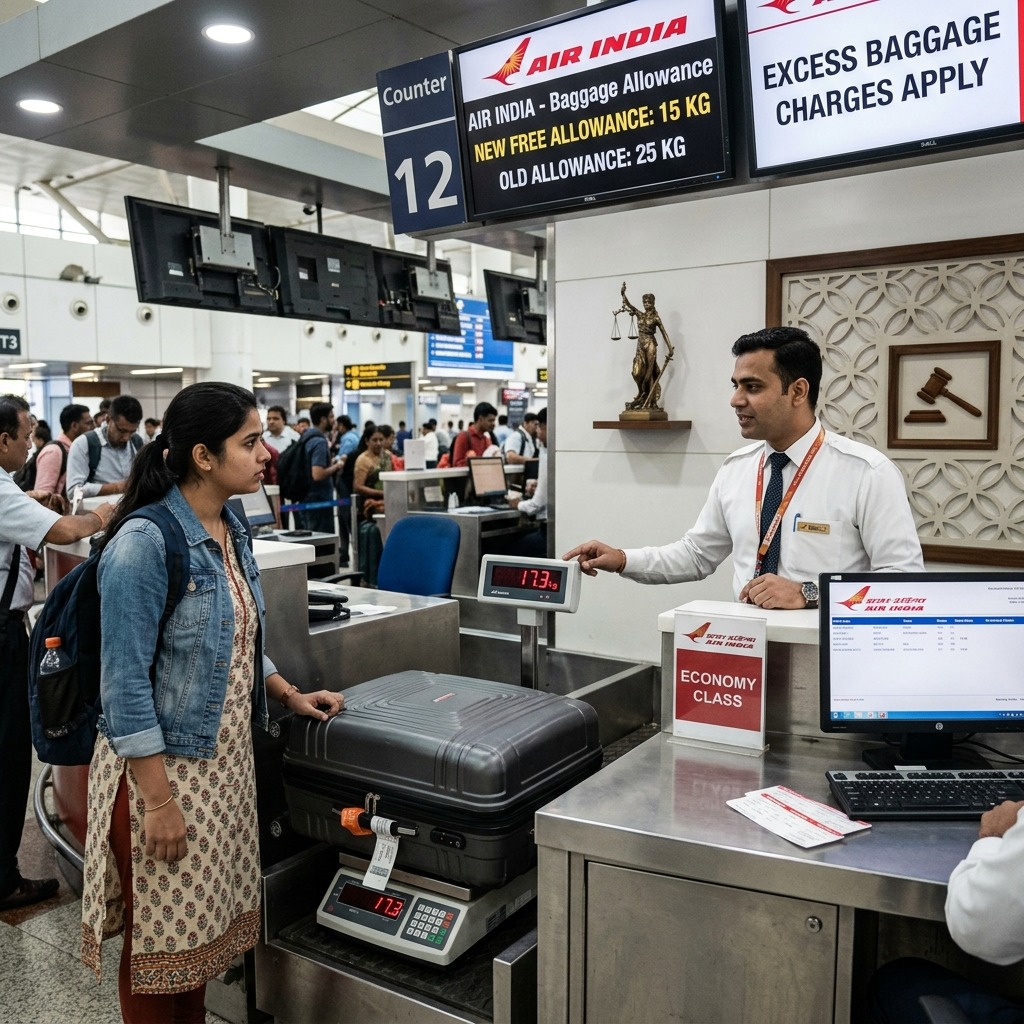
Why Indian Airlines Reduced Free Baggage from 25kg to 15kg
Indian airlines reduced domestic free checked baggage from 25kg to 15kg primarily to adopt the low-cost carrier (LCC) unbundling model separating base fares from add-on services like baggage. This allows airlines to advertise cheaper ticket prices while recovering revenue through ancillary fees. Baggage charges now account for 34% of India’s airline ancillary revenue (Credence Research, 2024).
Not long ago, checking in a 25kg bag on an Indian domestic flight was completely free. No surcharges. No pre-booking required. That era is largely over and millions of passengers are feeling the pinch.
IndiGo made the shift to 15kg domestic checked baggage as far back as October 2020. Air India followed in May 2024, cutting allowances for its Comfort and Comfort Plus economy fare families from 25kg down to 15kg. SpiceJet and Akasa Air have operated on 15kg standards for years. The result? A near-industry-wide cap that has angered travelers, drawn court challenges, and reshaped how Indians think about flying.
Why Did Indian Airlines Reduce Baggage Allowance from 25kg to 15kg?
Indian airlines cut baggage allowances from 25kg to 15kg to “unbundle” their pricing model separating base ticket fares from supplementary services. By offering lower headline ticket prices, airlines remain competitive, while recovering margins through add-on charges for baggage, seat selection, and meals.
This isn’t an India-specific phenomenon. The unbundling playbook was pioneered by global budget carriers like Ryanair and Spirit Airlines. India’s aviation market where IndiGo controls over 57% of domestic market share adopted the same logic as low-cost carriers became dominant.
Three core drivers explain the shift:
- Ancillary revenue growth: Baggage fees represent 34% of all airline ancillary revenue in India (Credence Research, 2024). IndiGo’s ancillary revenue per passenger grew approximately 18% in fiscal year 2025, driven by baggage, seat selection, and priority boarding fees (Dataintelo, 2025).
- Fuel efficiency: Lighter aircraft burn less fuel. A 10kg reduction per passenger across a full 180-seat aircraft saves meaningful fuel on each sector.
- Price perception: A ₹3,500 base fare looks more attractive than a ₹4,500 fare that includes 25kg baggage even if the total cost ends up higher when baggage is added.
|
Factor |
25kg Model |
15kg Model |
|
Base ticket price |
Higher |
Lower |
|
Baggage included |
Yes |
Only 15kg |
|
Extra baggage cost |
Not applicable |
₹650–₹700/kg |
|
Revenue flexibility |
Low |
High (ancillary) |
How Many kg Baggage Is Allowed on Indian Flights?
Free checked baggage on Indian domestic flights currently ranges from 15kg to 25kg depending on the airline and fare class. International allowances differ significantly economy passengers on Air India international routes receive 1–2 checked pieces of 23kg each, depending on destination.
Here is a breakdown of current allowances by major airline (2026):
Domestic Checked Baggage Allowance (Economy Class)
|
Airline |
Free Baggage Allowance |
Cabin Baggage |
|
IndiGo |
15 kg |
7 kg |
|
Air India (Comfort/Comfort Plus) |
15 kg (flights ≤2 hrs), 20 kg (flights >2 hrs) |
8 kg + 2 kg personal item |
|
Air India (Flex) |
25 kg |
8 kg + 2 kg personal item |
|
SpiceJet (Economy) |
15 kg |
7 kg |
|
Akasa Air |
15 kg |
7 kg |
Air India Business Class allows 35kg domestically; First Class gets 40kg. Premium Economy passengers receive 25kg.
What Happens If My Luggage Is Over 15kg?
If your checked baggage exceeds the free 15kg allowance, airlines charge excess baggage fees which can range from ₹650 to ₹700 per kg if pre-booked, or ₹700 to ₹750 per kg at the airport. These fees apply to every kilogram above the limit.
Practical example: Say you pack a 20kg bag for a Mumbai–Delhi IndiGo flight. Your 5kg overage will cost:
- Pre-booked (5kg slab online): ₹3,250
- At the airport: ₹3,500 (₹700 × 5kg)
That excess fee can easily exceed the cost of a budget fare itself. The lesson: pre-book excess baggage online always.
What actually happens at the check-in counter:
- Staff weigh your bag at the check-in desk
- If over 15kg, you’re directed to pay excess baggage (online or at a payment kiosk)
- If you refuse, the bag may not be accepted
- Some airlines allow you to redistribute weight into a second piece but there’s a ₹900–₹1,000 per piece fee for an additional bag
How Much Baggage Is 25kg and What Did Passengers Lose?
25kg is roughly equivalent to one large fully-packed suitcase (typically 68–75cm tall). At this weight, you can fit 10–15 outfits, shoes, toiletries, and personal items comfortably. Dropping to 15kg means fitting only the essentials into a medium-sized bag.
To put it concretely:
|
Item |
Approximate Weight |
|
Large hardshell suitcase (empty) |
4–5 kg |
|
7–8 outfits + undergarments |
4–5 kg |
|
Shoes (2–3 pairs) |
2–3 kg |
|
Toiletries + miscellaneous |
2–3 kg |
|
Total at 15kg limit |
~13–16 kg |
This means there is virtually no margin for gifts, specialty food items, or extra clothing a real problem for NRIs visiting family, business travelers carrying equipment, or families traveling with children.
What Is the Carry-On Luggage Weight Limit for International Flights?
For international flights on Indian carriers, cabin baggage (carry-on) is typically limited to 7–8kg. Air India allows 8kg plus a 2kg personal item (laptop bag or handbag) on international routes. IndiGo permits one cabin bag up to 7kg with total dimensions not exceeding 115cm (L+W+H).
Maximum cabin bag dimensions across major carriers:
- Air India: 55cm × 35cm × 25cm
- IndiGo: 55cm × 35cm × 25cm (total linear: 115cm)
- SpiceJet: 55cm × 35cm × 25cm
Liquids must be under 100ml per item and fit in one resealable 1-litre bag, per standard aviation security rules.
Why Airline Baggage Fees? Does Every Airline Charge for Baggage?
Airlines charge for baggage beyond the free allowance because it generates direct ancillary revenue and allows them to price base fares more competitively. Not every airline charges for checked baggage full-service carriers like Air India’s Flex fare and Vistara (now merged with Air India) historically included higher allowances in their base fares.
The short answer: budget carriers almost always charge extra for baggage beyond their minimum free allowance. Full-service fares, business class tickets, and frequent flyer elite status often include enhanced free allowances.
Who is exempt from excess charges in some cases:
- Air India Flying Returns elite-tier members (Gold tier gets 20kg extra on weight-concept flights)
- Passengers with medical documentation (certain conditions)
- Infants on Air India (10kg free domestically; 1 piece up to 23kg internationally)
- Students on Air India international routes (additional 10kg with valid student documentation)
How Much Is Extra Baggage on International Flights?
Extra baggage on international flights out of India costs between ₹1,000 and ₹2,500 per kg when pre-paid, and up to ₹2,500 per kg at the airport. Air India charges USD 15–40/kg internationally depending on destination; IndiGo charges ₹1,200–₹2,500/kg for international routes.
IndiGo international excess baggage fees (pre-paid, 10kg slab):
|
Route |
Pre-paid (10kg) |
At Airport (per kg) |
|
India to Dubai/Abu Dhabi |
₹11,000 |
₹1,200/kg |
|
India to Singapore |
₹11,000 |
₹1,500/kg |
|
India to London/Manchester |
₹20,000–₹22,000 |
₹2,500/kg |
|
India to Bangkok |
₹11,000 |
₹1,500/kg |
Air India international excess baggage (per kg):
- India USA, Canada, Europe, Australia: USD 40/kg (airport rate), USD 15–25/kg (pre-paid online)
- India other international destinations: USD 15/kg pre-paid, USD 25/kg at airport
The savings from pre-booking are significant. On a London-bound IndiGo flight, pre-booking 10kg saves you ₹3,000–₹5,000 versus paying at the airport.
Can You Carry 2 Bags for 25kg on Air India?
On Air India domestic routes under the Flex fare, 25kg of free checked baggage is permitted, but it must fit within standard piece and weight limits. The total weight may be split across multiple bags, provided each individual bag does not exceed 32kg and meets size requirements.
On international routes to the USA and Canada, Air India’s economy fare allows 2 checked pieces, each up to 23kg totaling 46kg free. This is the piece-concept system, used for long-haul international routes.
On domestic routes, Air India uses a weight concept meaning total weight across all pieces cannot exceed the stated limit, regardless of how many bags you use. So yes, you can split 25kg (Flex fare) into two bags.
What Are Courts and Regulators Doing About Baggage Fee Hikes?
Indian courts and regulatory bodies have intervened in airline baggage fee disputes multiple times, though outcomes have largely favored airline pricing freedom. The Delhi High Court set aside a 2016 DGCA circular that capped excess baggage fees, ruling that airlines not regulators should determine pricing through market forces.
Timeline of key legal interventions:
- 2016: DGCA issued Circular allowing private airlines to charge only ₹100/kg for excess baggage in the 15–20kg range, down from the then-prevailing rates of ₹220–₹350/kg.
- 2017: The Delhi High Court set aside that DGCA circular after the Federation of Indian Airlines (FIA) challenged it, arguing DGCA had no jurisdiction to fix tariffs. The court agreed that market forces not regulators should determine baggage pricing.
- 2024: Delhi High Court dismissed a petition seeking guidelines to cap airfares signaling continued reluctance to regulate airline pricing.
- 2026: IndiGo, Air India, and SpiceJet filed strong objections to a government directive asking airlines not to levy charges for certain services (The Hindu, 2026). DGCA issued Air Transport Circular 04 of 2026, classifying ancillary baggage services as “unbundled, optional add-on services.”
- Ongoing consumer court cases: A Bengaluru resident won ₹17,000 compensation from Air India via consumer commission for baggage negligence. SpiceJet was ordered to compensate a passenger ₹55,000 for a 14-hour delay with mismanagement.
The regulatory picture is clear: airlines have successfully defended their right to price baggage freely. Consumer courts, however, remain an accessible avenue for passengers when airlines mishandle, lose, or damage checked bags.
Frequently Asked Questions
Why did Air India specifically cut baggage from 25kg to 15kg in 2024?
Air India reduced its Comfort and Comfort Plus domestic economy checked baggage allowance from 25kg to 15kg in May 2024 to align with competitor pricing on budget fares and generate ancillary revenue through paid baggage upgrades similar to IndiGo’s model since October 2020.
Is there any domestic Indian airline still offering 25kg for free?
Air India’s Flex economy fare still includes 25kg free domestically. No budget carrier currently offers 25kg for free on standard economy fares in India.
What is DGCA Air Transport Circular 04 of 2026?
DGCA’s Air Transport Circular 04 of 2026 classifies ancillary services including paid baggage as “unbundled, optional add-on services.” It legally reinforces airlines’ right to charge for baggage beyond the free minimum, while requiring transparency in displaying these fees during booking.
Can I avoid excess baggage fees by wearing heavy clothes at the airport?
Technically yes airlines weigh checked bags, not what you wear on your body. Wearing a heavy jacket or boots is a legal and common workaround. However, it doesn’t help if your entire bag exceeds 15kg after your clothing strategy.
Do IndiGo and SpiceJet charge for cabin baggage?
No. Both IndiGo and SpiceJet include one piece of cabin baggage (7kg) at no additional charge. Excess cabin baggage over 7kg will be treated as checked baggage and charged accordingly.
What is the cheapest way to add extra baggage on IndiGo domestic flights?
Pre-booking through IndiGo’s website in advance is the most cost-effective option. A 10kg pre-paid slab costs ₹6,500, equivalent to ₹650/kg compared to ₹700/kg at the airport. Booking slabs (e.g., 5kg, 10kg, 15kg) is always cheaper than paying per-kg at check-in.
Can Indian consumers sue airlines for arbitrary baggage fee hikes?
Consumers cannot typically sue airlines for legal fee increases courts have upheld airlines’ right to set market-driven prices. However, consumer courts actively award compensation for delayed, damaged, or lost baggage and for misrepresentation of services.
Are there different baggage rules for senior citizens on Indian airlines?
Neither IndiGo nor SpiceJet offer specific senior citizen baggage concessions. Air India provides enhanced allowances for students but not separately for senior citizens as of 2026. Senior passengers should check their frequent flyer tier status, which may include extra allowances.
What happens to baggage fees if a flight is cancelled?
If the airline cancels a flight, pre-paid baggage fees are generally refundable along with the ticket fare. If the passenger cancels, baggage fees may or may not be refundable depending on the airline’s specific fare conditions always check the cancellation policy before booking.
How long does it take to receive compensation from consumer courts for baggage issues in India?
Consumer court timelines vary. Simple cases (e.g., damaged bag with clear evidence) can resolve in 3–6 months at district-level consumer commissions. Complex disputes involving multiple hearings, as seen in cases like the Delhi NCR passenger who won ₹2.74 lakh after a six-year legal battle (Economic Times, 2025), can take significantly longer.

Muhammad Naeem is a travel researcher with 5+ years of experience analyzing airline rules and global travel regulations. He specializes in simplifying complex airline policies to help travelers avoid extra fees and fly with confidence. His work focuses on accuracy, clarity, and up to date information across international carriers.

One Comment