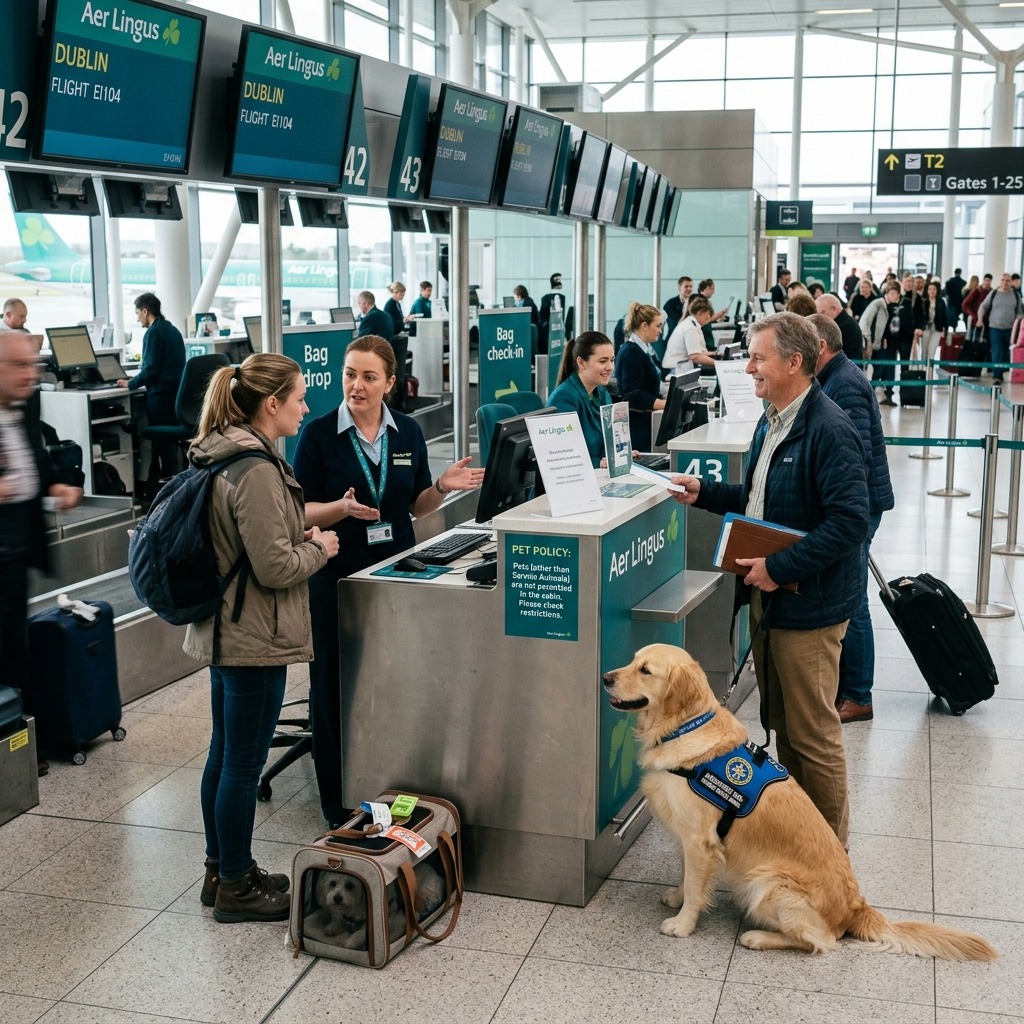
Aer Lingus Pet Policy: Rules, Fees & Tips for 2026
Aer Lingus does not allow household pets dogs, cats, or other animals in the cabin or as checked baggage on its own operated flights. The only animals accepted in the cabin are recognized service dogs that meet strict training and documentation standards. All other pet transport must go through cargo.
|
Travel type |
Allowed on Aer Lingus mainline? |
How it’s handled |
|
Pet in cabin |
No |
Not permitted |
|
Pet as checked baggage |
No |
Not permitted |
|
Pet as cargo |
Yes (indirectly) |
Via IAG Cargo or approved agent |
|
Recognized service dog |
Yes |
In cabin, free of charge |
|
Emotional support animal |
No |
Treated as a regular pet |
Note: Codeshare or partner-operated flights may follow different rules. Always confirm with the operating carrier.
Can I Take a Small Dog or Cat in the Cabin on Aer Lingus?
No. Aer Lingus does not permit small dogs or cats in the cabin, regardless of size or carrier type. Even a 2 kg toy breed in an airline-approved bag cannot travel in the cabin. The only exception is a trained, recognized assistance dog accompanying a passenger with a disability.
This sets Aer Lingus apart from carriers that allow small pets under 8 kg in the cabin. If in-cabin travel is essential for your cat or small dog, you may need to choose a different airline for that leg of your journey.
Aer Lingus cat in cabin: Cats fall under the same rule as dogs. They cannot fly in the cabin and must be transported as cargo through an approved agent.
Does Aer Lingus Transport Pets as Checked Baggage or Cargo?
Aer Lingus does not accept pets as checked baggage. Pets can only travel as manifest cargo, arranged through IAG Cargo (the group’s cargo division) or a professional pet relocation company. This means your pet travels separately from your luggage and is handled as a freight shipment.
How pet cargo works in practice:
- You book through IAG Cargo or a registered pet shipping agent, not the standard Aer Lingus booking system.
- Your pet must travel in an IATA-compliant travel crate.
- Routes are limited, and not every Aer Lingus destination accepts live animal cargo.
- Brachycephalic (snub-nosed) breeds face additional restrictions or outright refusal.
Because the process is freight-based, costs and lead times are significantly higher than a typical “pet in hold” fee on other airlines.
Aer Lingus Service Dog and Service Animal Policy
Aer Lingus accepts recognized service dogs (assistance dogs) in the cabin free of charge for passengers with a disability. The dog must be professionally trained, behave appropriately in public, and travel without a cage, resting on the floor at the passenger’s feet. Service animals other than dogs are generally not accepted.
What counts as a service animal on Aer Lingus?
A service animal on Aer Lingus is a dog trained to perform tasks for a person with a disability such as a guide dog, hearing dog, or medical alert dog. Pets, emotional support animals, and untrained companion animals do not qualify under this policy.
Key conditions for service dogs:
- The dog must be harnessed or leashed at all times.
- It must sit on the cabin floor, not on a seat or tray table.
- Advance notice is required typically at least 48 hours before departure.
- Documentation proving training and health may be requested.
Aer Lingus service dog form and U.S. flight requirements
For flights to and from the United States, Aer Lingus follows U.S. Department of Transportation rules, which require passengers to submit a DOT Service Animal Air Transportation Form before travel. This form confirms the dog’s health, training, and behavior. For larger dogs or long flights, a second DOT form covering the animal’s ability to relieve itself (or do so in a sanitary way) may also be required.
Practical tip: Download the DOT Service Animal Air Transportation Form ahead of time, complete it, and submit it through Aer Lingus’s special assistance team well before your travel date. Submitting late can lead to denied boarding for the animal.
Are Emotional Support Animals Allowed on Aer Lingus?
No. Aer Lingus does not recognize emotional support animals (ESAs) as service animals. Following the same regulatory shift adopted across the industry, ESAs are treated as regular pets which means they cannot travel in the cabin or as checked baggage and must go through cargo if accepted at all.
If your animal provides emotional support but isn’t a trained task-performing service dog, plan for cargo transport or consider an alternative carrier with an ESA-friendly policy.
How Much Does It Cost to Fly a Pet with Aer Lingus?
There is no standard “pet in cabin” fee on Aer Lingus because pets aren’t accepted in the cabin. The real costs come from cargo shipping, which is quoted individually based on weight, route, and crate size. Service dogs travel free of charge in the cabin.
Because Aer Lingus doesn’t publish a fixed pet fee, your true budget depends on the cargo and relocation route. Here’s a realistic cost breakdown to plan around:
|
Cost component |
Typical range (estimate) |
Notes |
|
Service dog (in cabin) |
Free |
For recognized assistance dogs |
|
IATA-compliant travel crate |
$80 – $300+ |
Depends on pet size |
|
IAG Cargo / pet shipping fee |
$500 – $2,500+ |
Varies by route and weight |
|
Veterinary certificates & microchip |
$100 – $400 |
Health checks and paperwork |
|
Pet relocation agent (optional) |
$1,000 – $4,000+ |
Door-to-door handling |
Worked example: Shipping a 15 kg medium dog from Dublin to a transatlantic destination as cargo could realistically total $1,800–$3,500 once you add the crate, vet paperwork, cargo fee, and agent handling. Compare that to a service dog, which flies in the cabin at no cost. These figures are estimates always request a live quote from IAG Cargo or your chosen agent, as rates change and depend on exact route and dates.
What Documents Does My Pet Need to Enter Ireland or the UK?
To enter Ireland or the UK, your pet generally needs a microchip, a valid rabies vaccination, an EU Pet Passport or an official health certificate, and for dogs tapeworm treatment given within a set window before arrival. Requirements vary by your departure country, so verify with official government sources.
Core documentation checklist:
- Microchip: Must be ISO-compliant and implanted before the rabies vaccine.
- Rabies vaccination: Valid and administered after microchipping, with a waiting period before travel.
- Pet passport or health certificate: EU Pet Passport for EU travel; an Animal Health Certificate or equivalent for other origins.
- Tapeworm treatment (dogs): Required for entry to Ireland and the UK, administered 24–120 hours before arrival.
- Approved route and carrier: Ireland and the UK only accept pets arriving via approved routes and operators.
Edge case to watch: Even with perfect paperwork, a pet arriving on a non-approved route can be refused entry or quarantined. This is a detail many guides skip confirm both the documents and the route.
Restrictions and Important Considerations
Before you book, keep these key limitations in mind:
| Consideration | What to know |
| In-cabin pets | Not allowed (service dogs only) |
| Checked baggage pets | Not allowed |
| Emotional support animals | Not recognized |
| Snub-nosed breeds | Restricted or refused as cargo |
| Booking channel | Cargo via IAG Cargo / agent, not standard booking |
| Advance notice for service dogs | Usually 48 hours minimum |
| Sedation | Generally discouraged |
Frequently Asked Questions
What service dog form does Aer Lingus require for U.S. flights?
For U.S. routes, Aer Lingus requires the U.S. DOT Service Animal Air Transportation Form, plus a relief-attestation form for longer flights with larger dogs.
How far in advance should I arrange pet travel?
Start at least 4–6 weeks ahead. Microchip, rabies vaccination timing, and cargo booking all need lead time. Service dogs need at least 48 hours’ notice.

Muhammad Naeem is a travel researcher with 5+ years of experience analyzing airline rules and global travel regulations. He specializes in simplifying complex airline policies to help travelers avoid extra fees and fly with confidence. His work focuses on accuracy, clarity, and up to date information across international carriers.
One Comment