Disney Cruise Baggage Policy 2026: Everything You Need to Know Before Sailing
Planning a Disney cruise is exciting until you start wondering whether your luggage will make it onboard without a hitch. Between navigating port security, understanding what’s prohibited, and figuring out when your bags will actually arrive at your stateroom, the baggage process can feel more complicated than it needs to be.
What Is the Disney Cruise Line Luggage Allowance?
Disney Cruise Line does not enforce a strict maximum bag count per guest, unlike airlines. Guests can bring as many bags as they can reasonably transport and store in their stateroom. However, most travel experts recommend 1–2 checked bags and one personal carry-on per person as a practical guideline, given stateroom storage limitations.
That said, there are real-world logistics to consider. Porters at the terminal handle checked bags at embarkation, and stateroom storage especially in standard inside cabins is limited. Overpacking creates a cabin management problem even if the cruise line doesn’t turn bags away at the door.
|
Bag Type |
Recommended Per Person |
Notes |
|
Checked luggage |
1–2 bags |
Handled by port porters; delivered to stateroom |
|
Carry-on bag |
1 bag |
Kept with you during boarding |
|
Personal item |
1 small bag/backpack |
Daypack, purse, or diaper bag |
What Are the Disney Cruise Luggage Size and Weight Rules?
Disney Cruise Line does not publish official size or weight restrictions for checked luggage, which is a notable difference from airlines. Guests are not charged excess baggage fees by Disney directly. However, practical limits apply: porters at the port are tipped per bag (typically $1–$2 per bag is customary), and standard staterooms have overhead storage and under-bed storage of approximately 7–8 inches of clearance.
Practical size guidance based on stateroom storage:
- Standard checked suitcase: Up to 28–30 inches works well for most staterooms
- Oversized bags (30+ inches): May be difficult to store under the bed or in closets
- Carry-on bags: Should fit in overhead storage or under your seat in common areas during embarkation
|
Luggage Category |
Recommended Max Size |
Weight Tip |
|
Checked bag |
28–30 inches |
Keep under 50 lbs for porter handling ease |
|
Carry-on |
22 x 14 x 9 inches |
Follow TSA guidelines if flying to port |
|
Personal item |
18 x 14 x 8 inches |
Backpack, tote, or diaper bag |
One important nuance competitors often overlook: if you’re flying to your embarkation port, your airline’s size and weight restrictions apply to your luggage before you even reach the cruise terminal. Budget airlines flying into ports like Orlando (MCO) or Miami (MIA) can charge $30–$80+ per checked bag each way. Factor this into your total trip cost.
What Are Disney Cruise Line Luggage Tags, and Do You Need Them?
Disney Cruise Line luggage tags are personalized tags mailed to guests before sailing (or available for printing at home via the Disney Cruise Line Navigator app or website). These tags identify your stateroom number so porters can deliver your bags to the correct cabin.
Key facts about Disney cruise luggage tags:
- Tags are typically available to print approximately 75 days before sailing for new guests and earlier for Castaway Club members
- Each tag includes your name, ship, sail date, stateroom number, and a barcode
- Attaching tags correctly before arriving at the port significantly reduces the chance of bag misdirection
- If you forget your tags or they’re damaged, port staff can print replacements at the terminal
Pro tip: Laminate or use a protective tag holder. Paper tags can tear during handling. Luggage tag holders are available on Amazon for $5–$10 and make a noticeable difference in tag durability.
What Can You Bring in Your Carry-On on a Disney Cruise?
Your carry-on bag on a Disney cruise should contain anything you’ll need during embarkation day before your stateroom is ready typically between 1:00 PM and 3:30 PM on boarding day.
Recommended carry-on essentials:
- Prescription medications and medical documentation
- Travel documents (passport, boarding passes, port adventure confirmations)
- Valuables (jewelry, electronics, cash)
- Swimwear and a change of clothes (the pools open on embarkation day)
- Sunscreen and a small first aid kit
- Snacks for children
- Phone charger and portable battery
What Are the Carry-On Liquid Rules on a Disney Cruise?
Disney Cruise Line follows TSA-style liquid rules at embarkation security. All liquids in carry-on bags must comply with the 3-1-1 rule: containers of 3.4 ounces (100ml) or less, placed in one clear quart-sized bag, one bag per person.
Exceptions include:
- Medically necessary liquids (insulin, prescription liquid medications) in reasonable quantities
- Baby formula, breast milk, and juice for infants (reasonable quantities)
- These exceptions must be declared at the security checkpoint
Can you bring a case of bottled water on a Disney Cruise?
Yes. Disney Cruise Line permits guests to bring a case of bottled water or other non-alcoholic beverages onboard, provided it’s in factory-sealed packaging. A standard 24-pack of water bottles is generally allowed. This can save money compared to purchasing bottled water onboard, where individual bottles typically cost $3–$5 each.
What Is Not Allowed in Luggage on a Disney Cruise?
Disney Cruise Line prohibits a specific list of items across both checked and carry-on luggage. Bringing prohibited items results in confiscation at the security checkpoint. In serious cases particularly with weapons or large quantities of controlled substances guests may be denied boarding.
Prohibited Items List
|
Category |
Examples |
|
Weapons |
Firearms, knives (blades over 4 inches), tasers, pepper spray |
|
Flammable/explosive |
Fireworks, lighter fluid, propane, flammable aerosols |
|
Restricted electronics |
Drones (prohibited on most sailings), hoverboards |
|
Alcohol beyond allowance |
More than 2 bottles of wine or 6 beers per stateroom at embarkation |
|
Illegal substances |
Controlled substances without valid prescription |
|
Irons and candles |
Open-flame items; irons are prohibited (laundry facilities and pressing services are available) |
Special note on medical equipment: CPAP machines, oxygen concentrators, walkers, and wheelchairs are permitted. Guests requiring medical oxygen should contact Disney Cruise Line’s special services team at least 60 days before sailing. There may be service fees depending on the equipment and arrangements required.
Disney Cruise Carry-On Liquids and Alcohol Policy: What’s the Limit?
Disney Cruise Line allows guests to bring a limited quantity of alcohol onboard at embarkation only not at ports of call.
Alcohol allowance per stateroom (not per person):
- 2 bottles of wine or champagne (750ml each)
- OR 6 beers (cans or bottles, 12 oz each)
Any alcohol purchased at ports of call will be collected by crew at the gangway and returned to guests on the final night of the cruise or on debarkation day. This is standard across most major cruise lines.
Spirits and liquor are not permitted to be brought onboard, regardless of quantity. Attempting to smuggle alcohol in shampoo bottles or other disguised containers a widely searched hack violates Disney Cruise Line’s guest conduct policy and can result in confiscation and a guest conduct warning.
Packing Tips to Make the Most of Your Stateroom Space
The single most effective packing strategy for a Disney cruise is using packing cubes and rolling clothes instead of folding them. This reduces the volume of clothes by 20–30% and keeps your stateroom organized throughout the sailing.
Practical packing tips:
- Roll, don’t fold: Rolling clothes reduces wrinkles and saves approximately 30% more space than flat folding
- Packing cubes: Color-code by family member or clothing type; $15–$40 for a set
- Compression bags: Useful for bulky items like jackets; can compress down to 50% of original size
- Under-bed storage: Disney cruise stateroom beds typically have 7–8 inches of clearance enough for one large soft-sided suitcase
- Over-the-door organizers: A hanging organizer ($8–$15) maximizes bathroom storage for toiletries
What About Themed Attire and Formal Nights?
Most Disney cruises include at least one “Pirates IN the Caribbean” deck party night and a formal or “semi-formal” evening depending on the itinerary. The 7-night and longer voyages typically include one formal night (Enchanted Evening) and one semi-formal night.
Packing for themed nights:
- Formal/semi-formal: One dress outfit per adult (blazer and dress pants for men; cocktail dress or gown for women)
- Pirate night: Pirate costumes, bandanas, or themed accessories are widely worn these are optional but fun
- Character costumes: Children can wear costumes onboard; adults may not wear full character costumes to avoid confusion with Disney cast members
What Do Most People Forget to Bring on a Disney Cruise?
Based on common traveler feedback and cruise forums, here are the most frequently forgotten items:
- Power strip (non-surge-protected): Disney staterooms typically have 2–3 outlets and 1–2 USB ports rarely enough for a family. Note: Surge-protected power strips are prohibited; a basic multi-outlet power strip is allowed
- Magnetic hooks and clips: Stateroom walls are magnetic hooks ($8–$12 per set) create extra hanging storage
- Laundry bag: Keeps dirty clothes separated from clean; a simple mesh bag costs $3–$5
- Insulated water bottle: Free water and beverages are available at certain areas; a reusable bottle reduces plastic waste and costs
- Seasickness medication: Even guests who’ve never experienced motion sickness should pack Dramamine or Sea-Bands as a precaution
- Highlighter and sticky notes: For marking the Navigator daily activity schedule
- Sunscreen (reef-safe): Required at some private island destinations; purchasing onboard costs significantly more ($18–$30+)
Do You Get Free Water on a Disney Cruise?
Yes. Disney Cruise Line provides complimentary water, lemonade, iced tea, and other non-alcoholic fountain beverages at quick-service dining locations like Cabanas (the main buffet) and pool deck beverage stations. Guests do not need to pay for these beverages.
What is not free:
- Bottled water (approximately $3–$5 per bottle)
- Specialty coffees and espresso drinks ($4–$7)
- Alcoholic beverages (cocktails range from $10–$18+; beer from $7–$12)
- Fresh-squeezed juices and smoothies at specialty locations ($6–$9)
To avoid paying for bottled water throughout the cruise, bring a reusable water bottle and refill it at beverage stations. Alternatively, as noted above, a sealed case of water from home is permitted at embarkation.
Special Baggage: Strollers, Sports Equipment, and Instruments
Strollers and Child-Related Gear
Strollers, car seats, and portable cribs are permitted on Disney cruises. Disney Cruise Line provides complimentary cribs upon request for staterooms; however, availability is not guaranteed request one at least 60 days before sailing.
Strollers are allowed on the ship and at ports. Foldable umbrella strollers are the most practical choice given hallway widths and storage in the stateroom. Full-size strollers can be checked at the port and delivered to your stateroom.
Sports Equipment
|
Equipment |
Policy |
Notes |
|
Golf clubs |
Permitted |
Check at port; delivered to stateroom |
|
Fishing gear |
Permitted |
Check local port regulations for bait/hooks |
|
Bicycles |
Not typically permitted |
Rent at ports instead |
|
Scuba gear (personal) |
Permitted (recreational) |
Tanks must be certified empty |
|
Surfboards |
Not permitted |
Size and safety restrictions |
Musical Instruments
Musical instruments are permitted on Disney cruises and should be carried on as a personal item if small (ukuleles, violins) or checked if larger (guitars in hard cases). Hard-sided instrument cases are handled carefully but are not guaranteed damage-free consider a travel insurance policy that covers musical equipment ($50–$150/year depending on instrument value).
How Does Disney Cruise Line Baggage Handling Work at the Port?
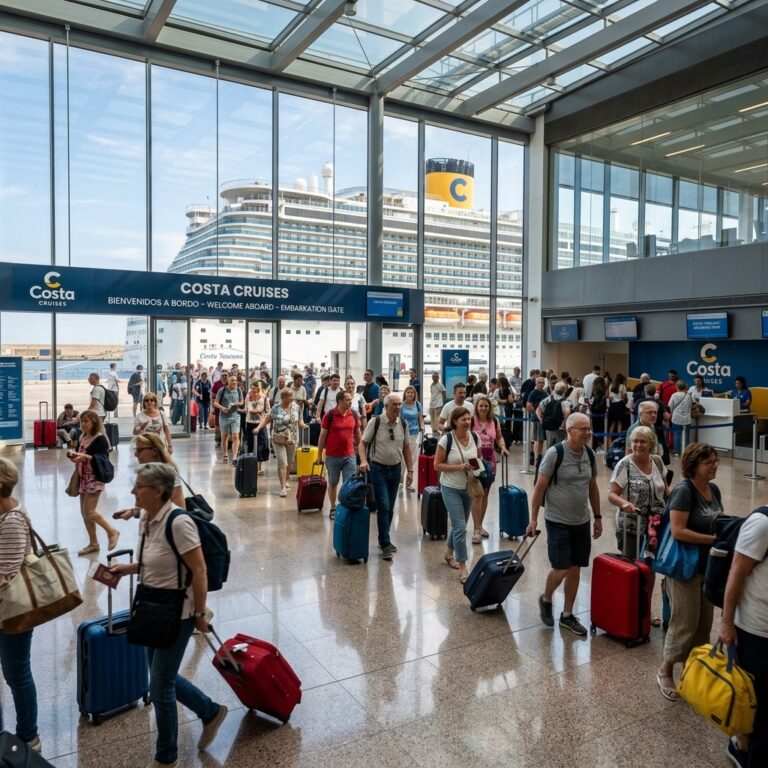
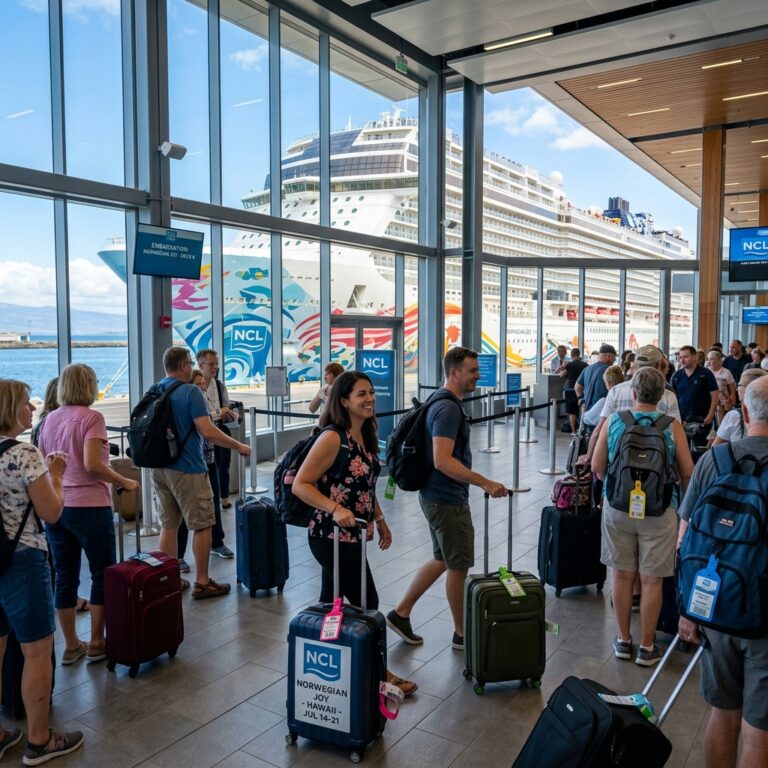
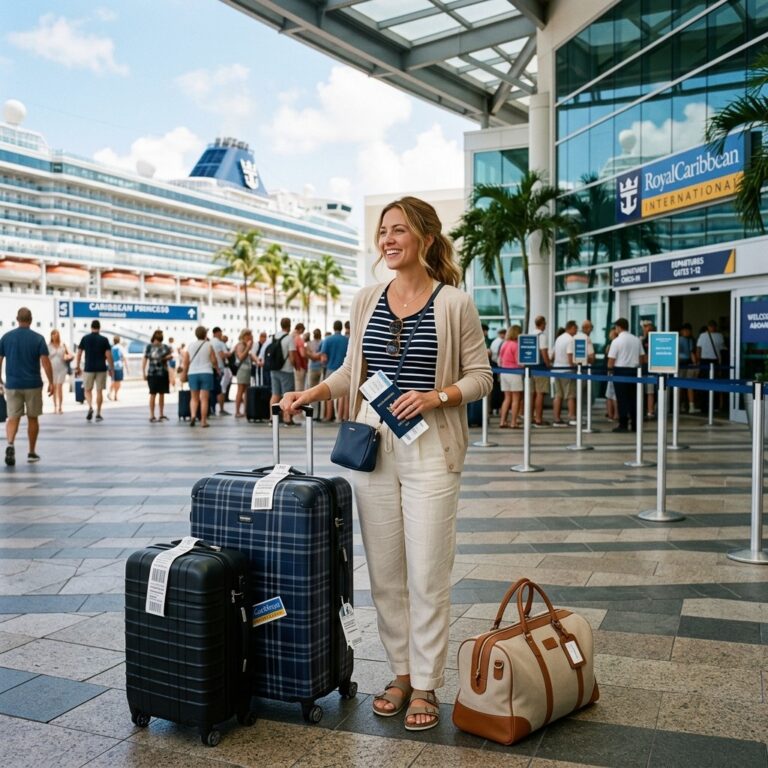
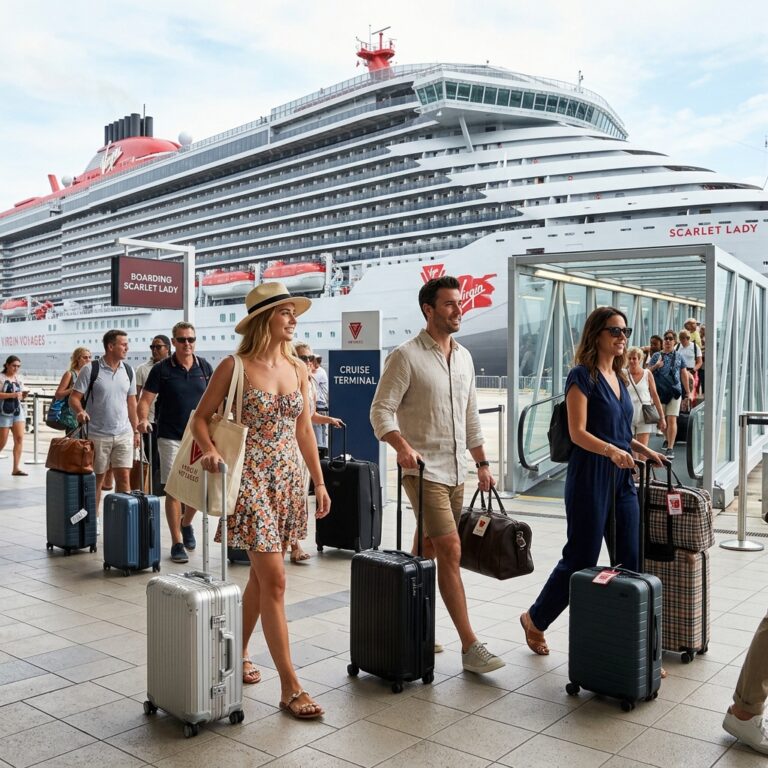
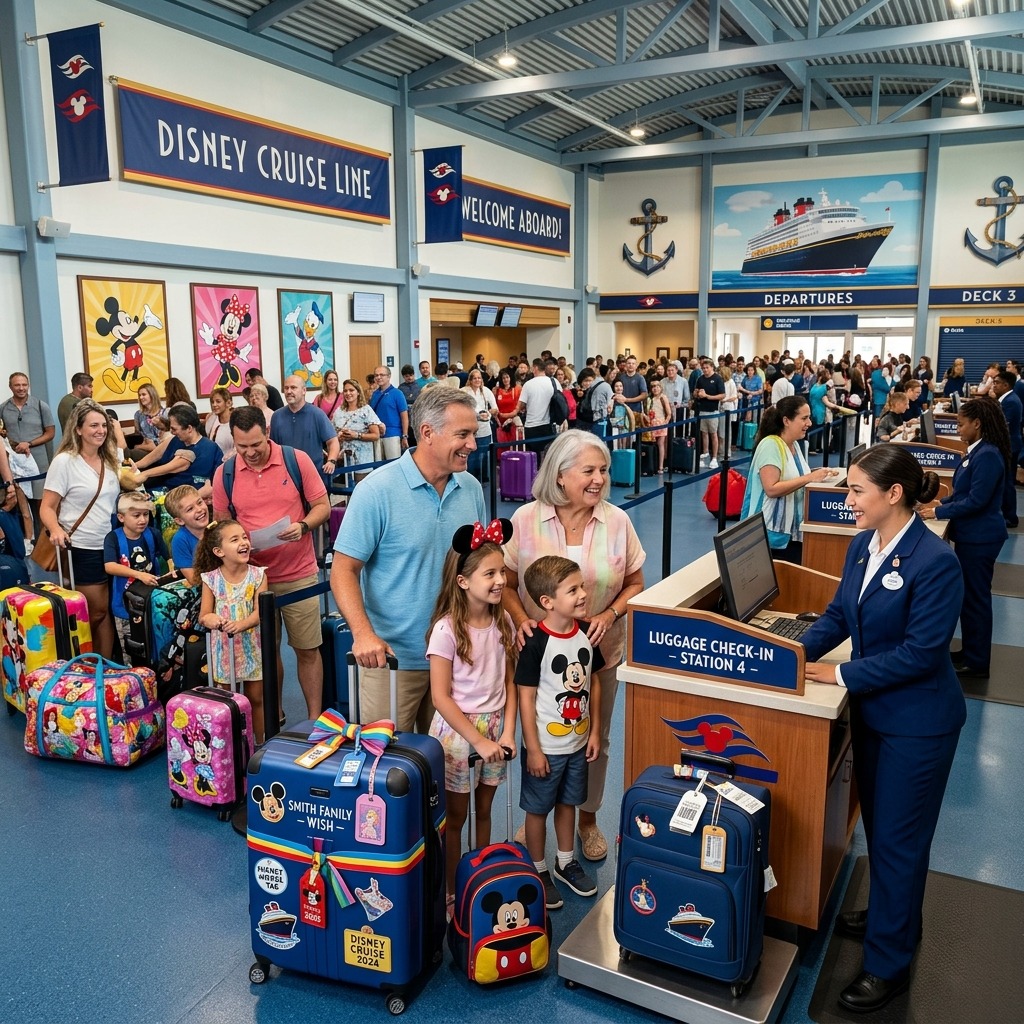
Upon arriving at the embarkation terminal, guests hand checked bags to uniformed porters outside the terminal building. Bags are screened and then delivered directly to your stateroom typically by 1:00–3:30 PM on boarding day.
Step-by-step embarkation baggage process:
- Arrive at the cruise terminal (check-in time based on your assigned Port Arrival Time)
- Hand checked bags to porters outside the terminal; tip $1–$2 per bag
- Retain your carry-on with you through security screening and check-in
- Board the ship; explore the ship or head to the pool while waiting for your stateroom
- Staterooms become available between 1:00–3:30 PM; bags are typically delivered by late afternoon
What should you do if luggage is delayed or lost?
If bags have not arrived by the time you’re ready to dress for dinner (usually around 5:30–6:30 PM on night one), contact Guest Services onboard immediately. Crew members will investigate the delivery status. Lost bags at the port are rare but do happen; always carry essential medications, documents, and valuables in your carry-on to avoid disruption if a delay occurs.
What Is the Debarkation Day Luggage Procedure?
On the final night of your cruise, guests place tagged checked bags outside their stateroom door before midnight (specific times are listed in your stateroom’s Navigator details). Bags are collected overnight and transported to the terminal’s baggage claim area.
Two debarkation options:
| Option | How It Works | Best For |
| Standard debarkation | Bags collected overnight; claim at terminal by assigned color/number group | Guests with flights later in the day |
| Express walk-off | Guests carry ALL their own bags off the ship | Early flights; guests who packed light |
For express walk-off, guests must be able to carry all bags themselves no porter assistance is available for this option. It typically begins around 7:00–7:30 AM and is the fastest way to exit the ship.
Important: If you have an early flight (before 11:00 AM), express walk-off is strongly recommended. Standard debarkation groups can exit between 7:30 AM–10:30 AM depending on assignment.
Frequently Asked Questions
Does Disney Cruise Line charge baggage fees?
No. Disney Cruise Line does not charge guests for checked baggage at the port. The only associated cost is the customary tip for port porters, typically $1–$2 per bag.
How many bags can one person bring on a Disney cruise?
Disney Cruise Line has no published maximum bag limit per guest. Practically, most guests bring 1–2 checked bags and one carry-on. Stateroom storage is the limiting factor, not a policy rule.
Can I bring a CPAP machine on a Disney cruise?
Yes. CPAP machines are permitted and classified as medical equipment, exempt from standard electronics restrictions. Contact Disney Cruise Line’s special services team in advance to arrange distilled water if needed.
Are drones allowed on Disney cruises?
No. Drones are prohibited on all Disney Cruise Line ships and at Castaway Cay (Disney’s private island). Confiscation occurs at embarkation security.
Can I bring my own snacks and food on a Disney cruise?
Yes, non-perishable, commercially packaged snacks are permitted. Open food items, homemade food, and perishables are generally not allowed onboard.
What happens to alcohol purchased at a port of call?
Crew members collect it at the gangway upon re-boarding and return it on the final night of the cruise or debarkation morning. This applies to all alcohol, regardless of quantity.
Can I bring an extension cord or power strip?
Basic multi-outlet power strips without surge protection are permitted. Surge-protected power strips are prohibited due to fire risk. Confirm this policy directly with Disney Cruise Line before sailing, as electrical policies can be updated.
Is there a fee for using laundry facilities onboard instead of packing extra clothes?
Disney cruise ships have self-service laundry rooms available for a fee approximately $3 per wash and $3 per dry cycle, with detergent sold separately for $1–$2. This can reduce the number of clothing items you need to pack.
What’s the best luggage tag holder for Disney cruise tags?
Waterproof, hard plastic luggage tag holders with a steel loop attachment ($5–$10 on Amazon) are the most durable option. Paper tags tear easily during port handling, especially in wet conditions.
Can children carry their own luggage through security?
Yes. There are no age restrictions on who carries bags through embarkation security. Children’s backpacks and bags pass through X-ray screening the same as adult luggage.

Muhammad Naeem is a travel researcher with 5+ years of experience analyzing airline rules and global travel regulations. He specializes in simplifying complex airline policies to help travelers avoid extra fees and fly with confidence. His work focuses on accuracy, clarity, and up to date information across international carriers.