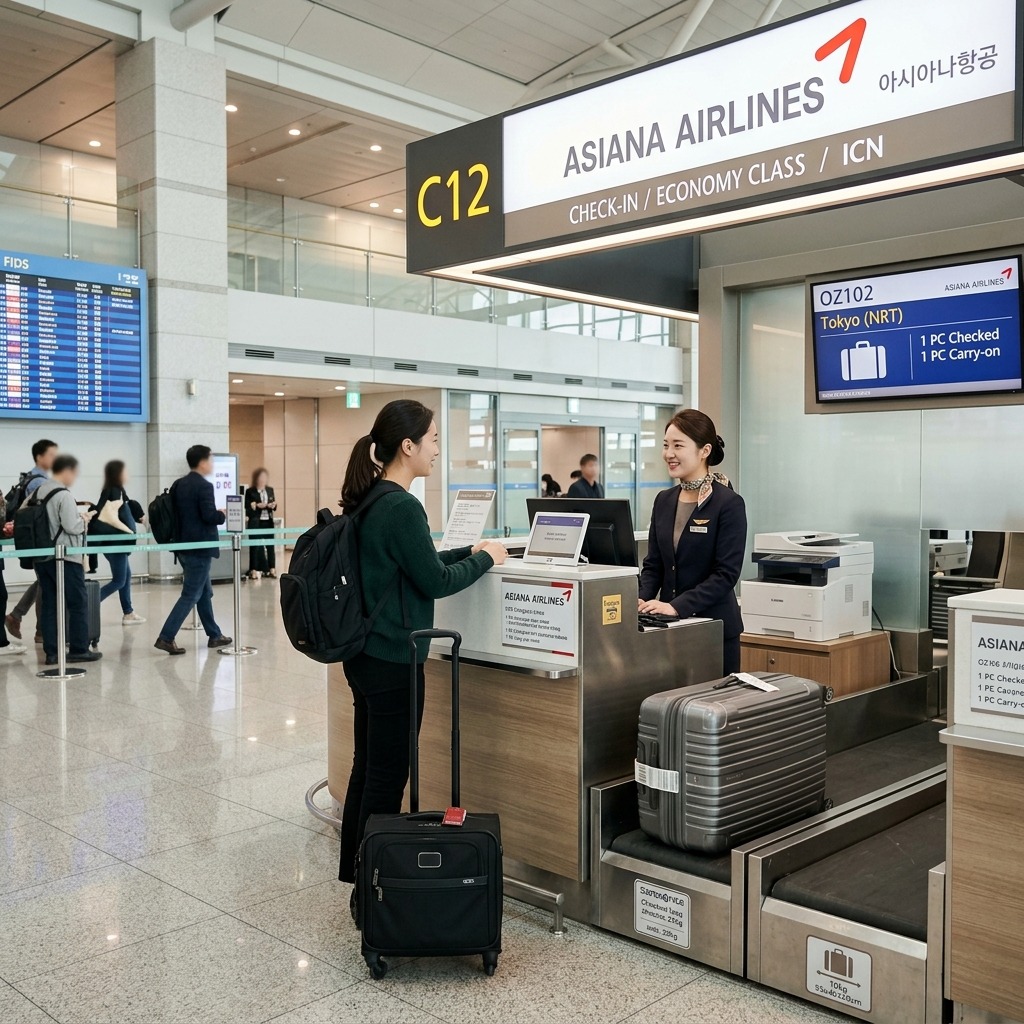
Asiana Airlines Baggage Policy 2026: Fees, Allowances & Rules
Asiana Airlines allows Economy Class passengers 1 checked bag (23 kg) on non-U.S. international routes and 2 checked bags (23 kg each) on U.S. routes. Business Class gets 2 bags (32 kg each) on all international routes. Carry-on is limited to 10 kg. Excess baggage fees range from USD 60 to USD 200+ depending on the route.
Packing for an Asiana Airlines flight without knowing the baggage rules is an easy way to face unexpected charges at the airport. Asiana Airlines South Korea’s second-largest carrier operates an extensive international network across Asia, the Americas, Europe, and Oceania, each with its own baggage rules. What applies on a Seoul-to-Los Angeles flight differs meaningfully from what applies on a Seoul-to-Tokyo route.
What Is the Asiana Airlines Baggage Allowance for International Flights?
Asiana Airlines uses a piece-concept system for international flights, meaning your allowance is determined by the number of bags you can check rather than a total weight limit. The weight limit applies per individual bag. Maximum dimensions per bag are 158 cm (62 inches) total length + width + height including handles and wheels, regardless of class.
Asiana Baggage Allowance: Economy Class vs. Business Class
|
Route |
Economy Class |
Business Class |
|
U.S. Routes |
2 bags × 23 kg (50 lbs) |
2 bags × 32 kg (70 lbs) |
|
Non-U.S. International |
1 bag × 23 kg (50 lbs) |
2 bags × 32 kg (70 lbs) |
|
Domestic (Korea) |
20 kg total |
30 kg total |
Key distinction: Economy Class passengers flying to or from the United States get twice the checked baggage allowance compared to those flying other international routes. A passenger flying Seoul to New York in Economy gets 2 bags; a passenger flying Seoul to London in Economy gets 1 bag. This is one of the most commonly misunderstood aspects of Asiana’s baggage policy.
Infant passengers traveling on U.S. routes may check 1 bag up to 23 kg (50 lbs). On non-U.S. international routes, the infant allowance drops to 10 kg (22 lbs). In both cases, infants may also bring one of the following: a folding stroller, baby walker, car seat, or bassinet.
Note for Saipan travelers: Although Saipan is a U.S. territory, Asiana applies non-U.S. route baggage regulations for that segment. Keep this in mind when planning your allowance.
How Much Baggage Is Allowed on Asiana Airlines Economy Class?
Asiana Airlines Economy Class passengers are allowed 1 checked bag weighing up to 23 kg (50 lbs) on non-U.S. international routes, and 2 checked bags weighing up to 23 kg each on U.S. routes. Domestically within Korea, Economy Class passengers may check baggage up to a combined weight of 20 kg (44 lbs).
Practical example: An Economy Class passenger flying Incheon (ICN) to Frankfurt (FRA) can check 1 bag up to 23 kg. If that same passenger then connects on a U.S.-bound flight operated by Asiana, the U.S. route allowance (2 bags) applies to that segment. On connecting flights operated by partner airlines, however, the partner’s own rules apply always confirm with your connecting carrier.
What Are the Asiana Airlines Carry-On Baggage Rules?
Asiana Airlines allows Economy Class passengers 1 carry-on bag and 1 personal item in the cabin. Business Class passengers may bring 2 carry-on bags and 1 personal item.
|
Item |
Economy |
Business |
|
Carry-on bags |
1 |
2 |
|
Weight per carry-on |
Max 10 kg (22 lbs) |
Max 10 kg (22 lbs) |
|
Max dimensions (carry-on) |
115 cm total (L+W+H) |
115 cm total (L+W+H) |
|
Personal item size |
40 × 30 × 20 cm |
40 × 30 × 20 cm |
|
Personal item storage |
Under the seat in front |
Under the seat in front |
The personal item category includes handbags, briefcases, and laptop bags. Standard backpacks and rolling carry-ons belong in the overhead bin and count as the carry-on bag.
A commonly missed rule: Duty-free items purchased at the airport count toward your carry-on allowance. A large duty-free bag cannot be treated as an extra free item. If your combined cabin baggage exceeds the limit, you will be asked to check it at the counter gate check-in is not available.
Small strollers may be brought into the cabin as an exception, but only if folded dimensions do not exceed 115 cm (width) × 25 cm (length) × 25 cm (height).
What Are the Asiana Airlines Baggage Fees for Excess Luggage?
Asiana Airlines charges excess baggage fees based on three potential violations: excess quantity (too many bags), excess weight (bag too heavy), and excess bulk (bag too large). If a bag triggers more than one violation say, it’s both an extra piece and oversized fees apply for each violation separately.
Asiana Airlines Excess Baggage Fee: U.S. Routes
|
Violation Type |
Weight / Size |
Fee (USD / KRW) |
|
Extra bag (1 piece) |
Up to 23 kg, ≤158 cm |
USD 200 / KRW 200,000 |
|
Overweight bag |
24–32 kg |
USD 100 / KRW 100,000 |
|
Overweight bag |
33–45 kg (advance notice required) |
USD 400 / KRW 400,000 |
|
Oversized bag |
159–203 cm total |
USD 200 / KRW 200,000 |
|
Oversized bag |
204–292 cm total (advance notice required) |
USD 400 / KRW 400,000 |
Brazil departures/arrivals have reduced rates. For example, 1 extra piece costs USD 75 / KRW 175,000. Overweight fees (24–32 kg) are waived entirely for Brazil routes.
Asiana Airlines Excess Baggage Fee: Non-U.S. International Routes
|
Route Type |
1st Extra Piece (23 kg) |
2+ Extra Pieces (each) |
|
Short-haul (≤1.5 hrs from Korea) |
USD 60 / KRW 60,000 |
USD 90 / KRW 90,000 |
|
Korea–Japan / China / HK / Taiwan |
USD 80 / KRW 80,000 |
USD 110 / KRW 110,000 |
|
Within Asia (other routes) |
USD 110 / KRW 110,000 |
USD 160 / KRW 160,000 |
|
Asia–Europe / Middle East / Africa / Oceania |
USD 140 / KRW 140,000 |
USD 210 / KRW 210,000 |
Short-haul routes (within 1.5 flight hours of Korea) include Fukuoka, Kumamoto, Weihai, Yantai, Dalian, and Qingdao.
Overweight fees on non-U.S. routes vary by route and bracket:
- 24–28 kg: USD 35–90 depending on route
- 29–32 kg: USD 50–110 depending on route
- 33–45 kg: USD 90–210 depending on route (advance notice required)
Domestic flights within Korea: Excess baggage is charged at KRW 2,000 per kilogram. A bag 10 kg over the limit costs KRW 20,000. Large items (total dimensions exceeding 158 cm) also incur a KRW 10,000 handling fee.
How Much Does Asiana Charge for Extra Baggage?
Asiana Airlines charges between USD 60 and USD 200 for one extra checked bag on international routes, depending on where you’re flying. On U.S. routes, one extra bag (up to 23 kg) costs USD 200. On short-haul Asian routes, that same bag costs USD 60. Weight and size surcharges apply on top of per-piece fees when applicable.
Real-world cost scenario: An Economy Class passenger flying Seoul to Paris (non-U.S. route) with 2 checked bags instead of the 1 included would pay USD 140 for the extra piece. If that second bag weighs 27 kg 4 kg over the 23 kg limit they’d pay an additional USD 60 overweight fee, bringing the total to USD 200. This is exactly the type of dual-fee situation that surprises many travelers.
Bags weighing more than 32 kg will be refused at check-in entirely. The maximum accepted weight on any Asiana flight is 45 kg, and bags between 33–45 kg require advance notice and incur the highest overweight fee tier.
What Happens If My Bag Exceeds Asiana’s Limit?
If your checked bag exceeds Asiana’s free allowance in quantity, weight, or size, you will be charged an excess baggage fee at the airport check-in counter. Fees must be paid before the bag is accepted. If a bag exceeds 32 kg, Asiana may refuse to transport it. Bags between 33–45 kg require advance notice to the airline and incur the highest fee tier.
Oversized bags (total dimensions between 204–292 cm) face double the applicable excess baggage fee and also require advance notice. For context, a standard bicycle or large surfboard could easily hit this threshold.
At the gate: Asiana does not permit baggage check-in at the boarding gate. If your carry-on is flagged as too heavy or large, it will need to be checked at the counter and if check-in counters are closed, you may face a more complex resolution.
U.S. DOT Refund Policy (effective October 28, 2024): For flights to and from the United States, if Asiana collects an excess baggage fee and your bag is subsequently delayed beyond the standard delivery window 15 hours for flights under 12 hours, 30 hours for flights over 12 hours Asiana is required to refund that fee under U.S. Department of Transportation regulations. Report any delayed baggage to the baggage agent at your destination immediately.
How to Add a Checked Bag on Asiana Airlines?
You can add checked baggage on Asiana Airlines by logging into your booking through the Asiana Airlines website and navigating to the baggage pre-purchase section before your flight. Pre-purchasing online is typically cheaper than paying at the airport on the day of travel.
Step-by-step process:
- Visit flyasiana.com and log into your booking using your reservation code
- Navigate to the “Manage Booking” section
- Select “Add Baggage” or “Pre-purchase Baggage Allowance”
- Choose the number of additional bags and complete payment
Important restriction: Pre-purchase baggage service is not available for passengers on codeshare flights operated by other airlines, or for itineraries that include transfer flights on partner carriers. In these cases, you must add baggage at the airport check-in counter.
Asiana also provides a Baggage Calculator tool at flyasiana.com to estimate your allowance based on route, class, and membership level before you book.
How Do Asiana Club Membership Tiers Affect Baggage Allowance?
Asiana Club elite members receive enhanced baggage allowances that go beyond standard class-based limits. The benefits scale with membership tier and vary by route.
Business Class – International Flights (U.S. and Non-U.S.):
- Platinum / Diamond Plus / Diamond: 3 bags, each up to 32 kg
- Gold: 3 bags (2 bags up to 32 kg + 1 bag up to 9 kg)
- Silver: 2 bags, each up to 32 kg (standard allowance)
Economy Class – U.S. Routes:
- Platinum / Diamond Plus / Diamond: 3 bags, each up to 23 kg
- Gold: 2 bags (1 up to 32 kg + 1 up to 23 kg)
- Silver: 2 bags, each up to 23 kg (standard allowance)
Economy Class – Non-U.S. Routes:
- Platinum / Diamond Plus / Diamond: 2 bags, each up to 23 kg
- Gold: 1 bag up to 32 kg
- Silver: 1 bag up to 23 kg (standard allowance)
Asiana Club Diamond, Diamond Plus, and Platinum members are also eligible for Star Alliance Gold benefits on Star Alliance member flights, though the specific allowance for that additional bag may vary by the operating airline.
What Is the Asiana Airlines Policy for Special and Oversized Items?
Asiana Airlines accepts sports equipment and musical instruments as checked baggage, provided they are packed inside a protective case. Items not properly packed may be refused or transported without compensation for damage.
Sports equipment accepted as checked baggage:
- Golf equipment
- Skiing and snowboarding gear
- Surfboards and wakeboards
- Scuba diving equipment
- Bicycles
- Fishing equipment
- Hockey and lacrosse equipment
A KRW 10,000 handling fee applies to large sports items (dimensions exceeding 158 cm). This fee was introduced in November 2020 alongside the removal of dedicated sports equipment benefits.
Musical instruments: Small instruments such as a violin (total dimensions under 115 cm) can travel as carry-on baggage. Larger instrumentscellos, guitars, and traditional Korean instruments like gayageum must be transported in the cabin only if an additional seat is purchased. The maximum height for an instrument transported with an additional seat is 155 cm. Instruments may also be checked, but must be properly cased.
How Do Baggage Allowances Differ Between Domestic and International Asiana Flights?
Domestic Asiana flights within Korea use a weight-based system rather than a piece-based system. Economy Class passengers may check up to 20 kg total; Business Class passengers may check up to 30 kg. International flights, by contrast, are piece-based each bag must individually stay within the weight limit.
Connecting domestic-to-international flights: If your domestic Asiana flight connects to an international Asiana flight, the international baggage allowance applies to the entire journey, including the domestic segment.
Air Busan codeshare domestic flights: If your domestic flight is operated by Air Busan on a codeshare basis, Air Busan’s own baggage rules apply not Asiana’s.
Tips to Avoid Excess Baggage Fees on Asiana Airlines
- Pre-purchase extra baggage online before arriving at the airport airport rates are higher and pre-purchase locks in the allowance
- Weigh your bags at home using a portable luggage scale; aim to stay at least 1–2 kg under the limit
- Use Asiana’s Baggage Calculator at flyasiana.com to confirm your exact allowance before packing
- Earn elite status through Asiana Club to unlock higher free allowances even Gold members on Economy non-U.S. routes get 1 bag up to 32 kg instead of 23 kg
- Ship ahead: For extended trips, consider shipping non-urgent items through a courier service rather than checking additional bags
- Know your route: Allowances differ between U.S. and non-U.S. routes in Economy, so confirm which rules apply before assuming you have 2 bags
Frequently Asked Questions
How many checked bags does Asiana Airlines Economy allow on non-U.S. flights?
Economy Class passengers on non-U.S. international routes are permitted 1 checked bag up to 23 kg (50 lbs). This is a common source of confusion for travelers who assume 2 bags are standard across all Asiana routes.
What is the maximum weight Asiana Airlines will accept for a single checked bag?
The absolute maximum weight for any single piece of checked baggage on Asiana Airlines is 45 kg. Bags between 33–45 kg require advance notice and are subject to the highest overweight fee tier. Bags exceeding 32 kg may be refused if advance notice was not given.
Does Asiana charge excess baggage fees if my bag is both overweight and oversized?
Yes. If a bag exceeds both weight and size limits simultaneously, Asiana charges separate fees for each violation. For example, on a U.S. route, an extra bag that is both oversized (159–203 cm) and overweight (24–32 kg) would cost USD 200 + USD 100 = USD 300 total.
Are excess baggage fees refundable if my bag is delayed on a U.S. flight?
Yes. Under U.S. Department of Transportation regulations effective October 28, 2024, Asiana must refund excess baggage fees if your bag is not delivered within the standard window: 15 hours for flights under 12 hours, and 30 hours for flights over 12 hours.
Can I pre-purchase extra baggage for a codeshare flight on Asiana?
No. Asiana’s pre-purchase baggage service is not available for codeshare flights operated by other airlines or for itineraries involving transfer flights on partner carriers. Additional baggage must be arranged at the airport check-in counter in these cases.
What is the carry-on weight limit on Asiana Airlines for Economy Class?
Economy Class passengers may bring 1 carry-on bag weighing no more than 10 kg (22 lbs), with total dimensions not exceeding 115 cm (length + width + height). A personal item up to 40 × 30 × 20 cm is permitted in addition to the carry-on.
Do Asiana Club Gold members get extra baggage on Economy non-U.S. routes?
Yes. Asiana Club Gold members flying Economy on non-U.S. routes receive 1 checked bag up to 32 kg, compared to the standard 23 kg limit for Silver members and non-members. This effectively gives Gold members a 9 kg bonus without adding a second bag.
How much does Asiana charge for excess baggage on a flight from Korea to Japan?
On Korea–Japan routes, Asiana charges KRW 80,000 (approximately USD 80) for the first extra piece (up to 23 kg, within 158 cm). Overweight fees for that same bag run from KRW 40,000 (USD 40) for 24–28 kg, up to KRW 110,000 (USD 110) for 33–45 kg.
Are duty-free purchases at the airport exempt from Asiana’s carry-on limit?
No. Duty-free items purchased at the airport are not exempt from Asiana’s carry-on rules. They count toward your carry-on allowance, and Asiana will not allow oversized duty-free bags to be treated as a free additional item in the cabin.
What excess baggage rate applies if I’m flying from Korea to Australia on Asiana?
Australia falls under the “Asia–Europe/Middle East/Africa/Oceania” route category. The first extra piece (up to 23 kg, within 158 cm) costs KRW 140,000 / USD 140. Overweight fees range from USD 90 (24–28 kg) to USD 210 (33–45 kg) depending on the weight bracket.

Muhammad Naeem is a travel researcher with 5+ years of experience analyzing airline rules and global travel regulations. He specializes in simplifying complex airline policies to help travelers avoid extra fees and fly with confidence. His work focuses on accuracy, clarity, and up to date information across international carriers.
One Comment