APSRTC Luggage Policy: Rules, Charges & Free Limit 2026
APSRTC allows every passenger 50 kg of free luggage, with no distinction between commercial and non-commercial items, according to official APSRTC data. There’s no separate “luggage booking” fee for standard baggage it travels in the bus dickey at the passenger’s own risk. Larger shipments go through APSRTC’s separate parcel and logistics service instead.
Millions of passengers travel across Andhra Pradesh on APSRTC buses every year, carrying everything from overnight bags to festival shopping hauls. Yet most travelers board without knowing exactly what they’re entitled to carry for free, what’s banned outright, or what happens when a bag doesn’t fit in the dickey.
What Are the APSRTC Luggage Rules for Passengers?
APSRTC’s core luggage rule is simple: every passenger gets 50 kg of free luggage per journey, and the corporation makes no distinction between commercial and non-commercial items within that limit. This allowance applies uniformly across all APSRTC routes and bus stations, regardless of bus type or distance traveled.
A few practical points flow from this rule:
- The 50 kg limit is per passenger, not per ticket or per family so a group of four traveling together effectively has 200 kg of combined free allowance.
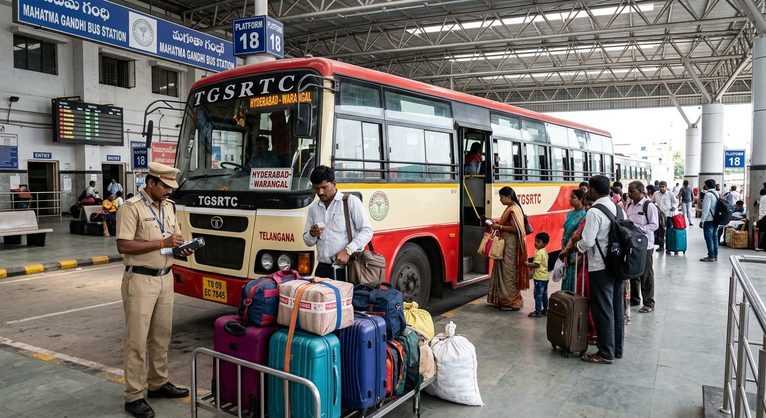
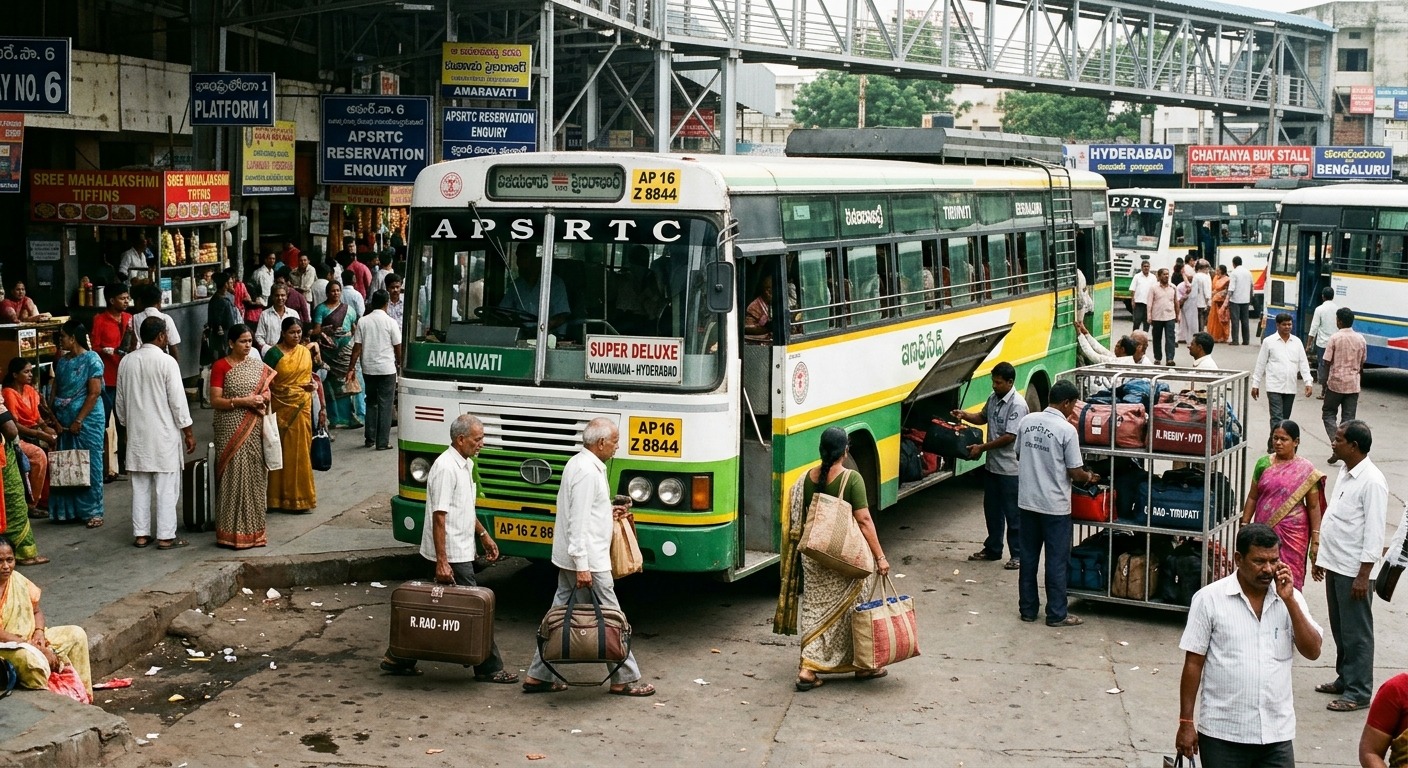
- Luggage is stored in the bus dickey (trunk) during travel, not inside the passenger cabin, except for small hand baggage.
- Baggage travels at the owner’s risk. Per APSRTC’s official terms and conditions, the corporation is a passenger transport service only and “shall not be liable to make good the loss of goods or property of passengers” for events beyond its control.
That last point matters more than most travelers realize. If a bag is damaged or misplaced due to circumstances outside APSRTC’s control, there’s no guaranteed compensation so avoid packing high-value items like electronics or jewelry in checked luggage.
Real-world edge case: When the dickey isn’t just for passengers
In recent years, some APSRTC long-distance buses have used dickey space to transport commercial cargo such as bulk vegetables or milk containers as part of the corporation’s separate cargo service, according to reporting by Deccan Chronicle (2022). This occasionally left passengers with less dickey space than expected, forcing them to keep luggage inside the cabin. If you’re traveling with bulky bags on a long-distance route, it’s worth arriving early and confirming dickey space availability with the conductor before boarding.
What Are APSRTC’s Luggage Charges for Excess Baggage?
Within the 50 kg free allowance, APSRTC does not charge anything extra for standard passenger baggage. However, APSRTC has not published a fixed per-kilogram tariff for baggage that exceeds this limit. In practice, any excess is handled at the conductor’s discretion, so heavy travelers should check with staff at booking or boarding.
This is a genuine content gap most guides skip over: there’s a difference between “free allowance” and “no charges ever.” Here’s how to think about it:
|
Luggage Scenario |
What Happens |
|
Up to 50 kg per passenger |
Free, no restrictions on item type (commercial or personal) |
|
Over 50 kg, personal use |
No published fixed rate confirm with conductor/counter before travel |
|
Bulk commercial goods (not tied to a passenger) |
Not permitted as regular luggage; must be booked via APSRTC Logistics (parcel/courier service) |
If you’re regularly moving heavier loads say, for a small business or bulk shopping using APSRTC’s dedicated logistics arm (covered below) is the compliant and predictable option, rather than hoping a conductor waves an overweight bag through.
How Do APSRTC Bus Luggage Charges Compare for Different Bus Types?
APSRTC applies the same 50 kg free luggage rule across all its bus categories Pallevelugu, Express, Super Luxury, and AC services with no separate baggage tariff tied to bus class. The policy is designed to apply uniformly, so an AC Super Luxury passenger and a Pallevelugu passenger have identical baggage entitlements.
Where bus type does affect your wallet is in reservation and service fees, not luggage:
- AC services carry a ₹30 advance reservation fee per seat, plus ₹15 for passenger amenities (seat cover, air freshener, wet napkin).
- Non-AC services carry a ₹20 advance reservation fee per seat.
None of these fees relate to luggage they’re ticketing charges. If a website or agent claims a bus-type-specific baggage fee, treat that with caution, since it isn’t part of APSRTC’s published passenger amenities policy.
What Is the APSRTC Luggage Booking Price for Sending Parcels or Cargo?
APSRTC doesn’t sell a separate “luggage booking” ticket for standard passenger baggage it’s included free with your bus ticket up to 50 kg. If you need to send items without traveling yourself, or ship bulk goods, that falls under APSRTC Logistics, which has its own parcel tariff, courier tariff, and bulk cargo rate cards.
it conflates “luggage” with “cargo booking,” but APSRTC treats them as entirely separate systems.
|
Service |
Who It’s For |
How Pricing Works |
|
Passenger luggage |
Ticketed bus passengers |
Free up to 50 kg; included in your fare |
|
APSRTC Parcel Service |
Sending goods without traveling |
Priced per APSRTC’s published parcel tariff |
|
APSRTC Courier Service |
Documents, smaller items |
Priced per courier tariff card |
|
Bulk/DGT cargo |
Businesses shipping large volumes |
Priced per Dedicated Goods Transport (DGT) rates |
|
Dickey space leasing |
Agents/vendors |
Leased separately, priced per leasing agreement |
If you’re a business owner or frequent shipper, booking through APSRTC Logistics counters (available across Andhra Pradesh and select interstate locations) gives you a fixed, transparent rate something the ad-hoc “extra baggage” route on a passenger bus simply can’t guarantee.
Where Is Luggage Stored, and What Bus Station Facilities Are Available?
Luggage is stored in the bus dickey during travel, and major APSRTC bus stations provide porter trolley facilities, weighing machines, and wheelchair assistance to help passengers manage baggage before boarding. These facilities are concentrated at the corporation’s principal stations.
APSRTC’s key bus stations with full passenger amenities include:
- Pandit Nehru Bus Station (Vijayawada)
- Dwaraka Bus Station (Visakhapatnam)
- Guntur Bus Station
- Ongole Bus Station
- Rajahmundry Bus Station
- Nellore Bus Station
- Kurnool Bus Station
- Srinivasa Bus Station (Tirupati)
- Kadapa Bus Station
At these locations, passengers typically have access to:
- Weighing machines for checking baggage weight
- Porter trolley facilities for moving heavy bags
- Wheelchair assistance for physically challenged passengers
- Dormitories and Deluxe Lounges for layovers between connecting services (charges for lounges vary by location and available facilities)
- Cloakroom-style storage, drinking water, and seating areas
Smaller depots may not offer the full range of amenities, so if you’re traveling with heavy luggage through a smaller town, it’s worth confirming facilities in advance.
What Items Are Prohibited on APSRTC Buses?
APSRTC prohibits flammable substances, explosives, weapons, illegal goods, and several types of raw or unpacked organic materials from being carried on its buses. Attempting to carry any of these items can result in your luggage or your ticket being refused at boarding.
The officially prohibited items include, among others:
- Flammable liquids and fuels: petrol, diesel, kerosene, turpentine, methylated spirits
- Explosives and weapons: gunpowder, crackers, loaded guns and cartridges, compressed gas cylinders
- Hazardous chemicals: acids, sulphur, coal tar
- Unprocessed organic goods: raw fish, dry fish, untanned leather/skins/hides, bones/horns, unpacked cotton bales, unpacked tea leaves, unpacked woolen goods
- Restricted substances: opium, narcotics, hemp, gutkha/pan masala containing tobacco or nicotine
- Other restricted items: dead bodies (human or animal), contraband, unauthorized forest produce, unpacked cinema films, human hair, blood worms, scooters/motorcycles, uncrated batteries
If you’re unsure whether an item qualifies, the safest move is to check with the conductor or a bus station official before travel rather than risk being denied boarding.
What Should You Know Before Traveling With Luggage on APSRTC?
Beyond weight limits, APSRTC requires a valid photo ID matching your e-ticket, treats baggage as travel at the owner’s risk, and reserves the right to adjust seating or cancel trips for operational reasons. None of these terms are luggage-specific, but they directly affect how a baggage-related dispute would be handled.
Key passenger terms worth knowing:
- E-tickets are non-transferable, and photo ID proof must match the ticket holder’s name.
- APSRTC is not liable for loss or damage to belongings from events beyond its control.
- Trips can be postponed or cancelled due to breakdowns or low passenger numbers; alternative service is offered subject to availability.
- APSRTC reserves the right to change seat assignments and may amend cancellation policy at its discretion.
- Passengers consent to receive SMS/call communications related to their booking.
None of this should discourage you from traveling it simply means valuable items are best kept as hand luggage rather than checked in the dickey.
Frequently Asked Questions
Is the 50 kg luggage allowance per ticket or per passenger?
It’s per passenger. Each ticketed traveler gets 50 kg of free luggage, so a family of four booked on one transaction has a combined 200 kg allowance across their individual entitlements.
Does APSRTC charge extra for AC buses carrying more luggage?
No. The 50 kg free allowance applies equally across AC and non-AC services. Any additional fees on AC tickets relate to reservation and amenity charges, not baggage.
Can I carry a motorcycle or scooter as luggage on an APSRTC bus?
No. Scooters and motorcycles are explicitly listed as prohibited items and cannot be transported as passenger luggage on APSRTC buses.
What happens if my luggage exceeds 50 kg?
APSRTC hasn’t published a fixed excess-baggage rate, so handling is left to conductor discretion. For predictable pricing on heavier loads, use APSRTC’s parcel or logistics service instead.
Is APSRTC responsible if my bag is lost or damaged?
Only in limited cases. Per its official terms, APSRTC is a passenger transport service and isn’t liable for loss or damage caused by events beyond its control, so baggage effectively travels at the owner’s risk.
Can I send a package on an APSRTC bus without traveling myself?
Yes, through APSRTC Logistics, which offers dedicated parcel, courier, and bulk cargo services with separate published tariffs, entirely apart from passenger baggage rules.
Are commercial goods allowed within the 50 kg free limit?
Yes. APSRTC’s policy makes no distinction between commercial and non-commercial items within the 50 kg allowance, as long as the goods aren’t on the prohibited items list.
Which APSRTC bus stations offer porter and wheelchair assistance?
Major stations including Pandit Nehru Bus Station (Vijayawada), Dwaraka Bus Station (Visakhapatnam), Guntur, Ongole, Rajahmundry, Nellore, Kurnool, Tirupati, and Kadapa offer porter trolleys and wheelchair facilities.
Can I keep my luggage inside the passenger cabin instead of the dickey?
Small hand baggage is generally fine in the cabin, but larger bags are meant for the dickey. Note that dickey space can occasionally be limited on long-distance routes carrying commercial cargo.
Do I need to pay anything extra for luggage at the time of online booking?
No. APSRTC’s online ticket booking system doesn’t include a separate luggage fee or booking step the 50 kg allowance is automatically included with your fare.

Azeem breaks down airline baggage policies, fare-class benefits, and peak pricing rules into practical guidance for smooth trip planning. He verifies every fee and dimension against official airline sources so travelers can pack with confidence.