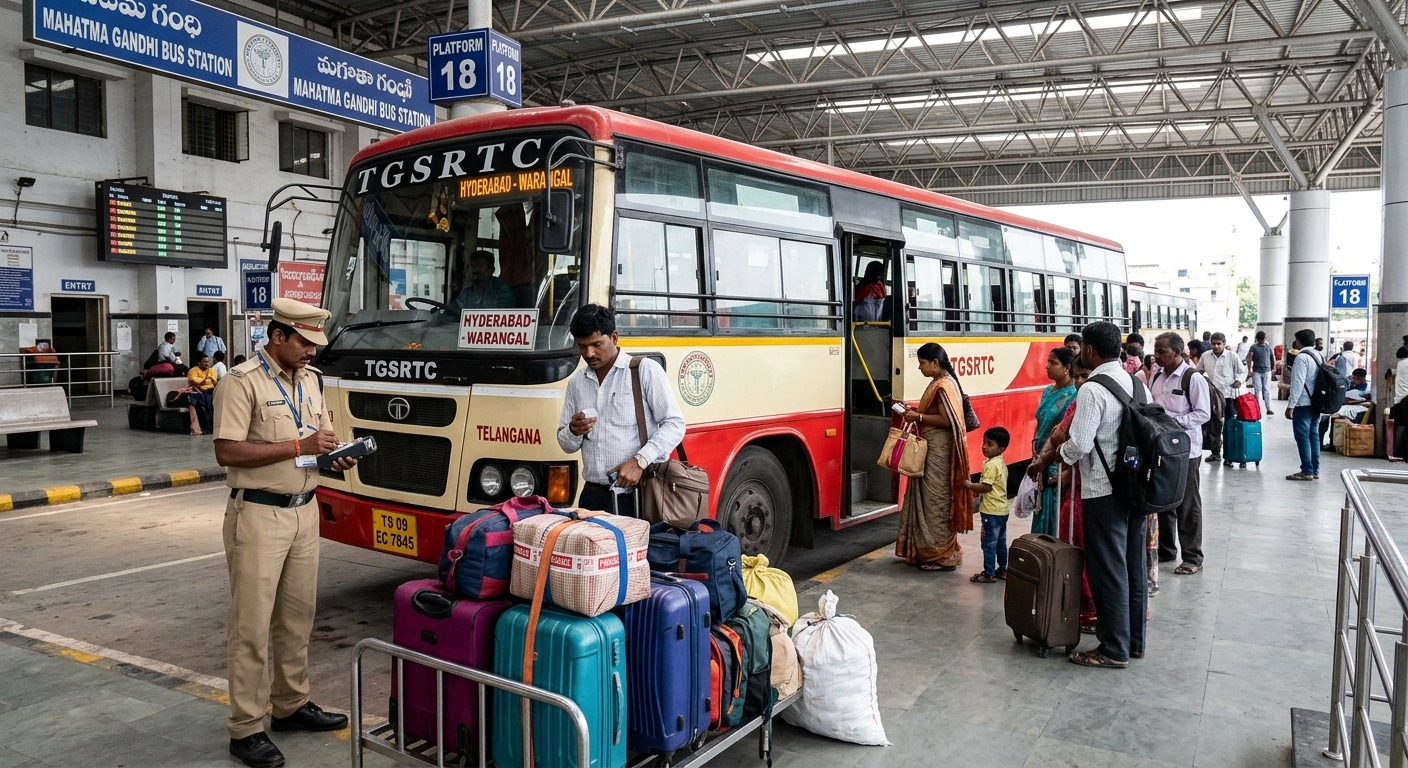
TGSRTC Luggage Policy: Rules, Charges & Cargo Services 2026
TGSRTC allows passengers to carry personal luggage in packets not exceeding 20 kg each, with excess luggage charged based on distance and bus type. Maximum bus luggage capacity is 750 kg for Palle Velugu, Express, and Deluxe services, and 1,000 kg for Super Luxury buses. TGSRTC also runs a separate Cargo and Parcel Service, launched in June 2020, for bulk shipments up to 50 kg per pack.
If you’ve ever hauled a suitcase, a sack of vegetables, or a box of festival gifts onto a Telangana State Road Transport Corporation (TGSRTC) bus, you’ve encountered its luggage policy whether you realized it or not. The rules cover everything from free baggage allowances to what happens when your bag is heavier than expected, and they were significantly revised in 2022 when TGSRTC aligned passenger luggage charges more closely with its cargo pricing.
What is TGSRTC’s luggage policy?
TGSRTC permits passengers to carry personal baggage in packets that must not exceed 20 kg each. Luggage beyond the free allowance is charged according to distance traveled and bus category. Total luggage load per bus is capped at 750 kg for Palle Velugu, Express, and Deluxe services, and 1,000 kg for Super Luxury buses.
Previously, TGSRTC allowed passengers to carry 50 kg of luggage free of charge, split across three packets (each capped at 20 kg), with an additional 50 kg allowed at a charge and no overall upper limit. In July 2022, TGSRTC revised this system, aligning passenger luggage tariffs with its cargo and parcel pricing structure to discourage passengers from using buses to move bulk goods cheaply.
Understanding TGSRTC luggage allowances
- Packet weight limit: Each individual luggage packet must not exceed 20 kg.
- Bus-wide capacity: 750 kg maximum for Palle Velugu, Express, and Deluxe buses; 1,000 kg for Super Luxury and above.
- Owner’s risk: Per TGSRTC’s official terms and conditions, baggage is booked entirely at the owner’s risk TGSRTC is a passenger transport service and is not liable for loss or damage to goods.
This distinction matters for farmers, small traders, and anyone transporting flowers, produce, or bulk items on regular passenger buses these journeys are now priced far closer to formal cargo rates than in the past.
How much do excess luggage charges cost on TGSRTC buses?
Excess luggage charges depend on both distance and bus type, and increased by more than 20 times in July 2022. For example, on Palle Velugu buses, a 50 kg luggage charge for a 0–25 km trip rose from Re 1 to Rs 20, while Express buses saw charges for the same weight rise from Rs 2 to Rs 50 for distances up to 50 km.
Here’s a snapshot of the revised charges compared to the older tariff:
|
Bus Type |
Distance |
Old Charge (50 kg) |
Revised Charge (50 kg) |
|
Palle Velugu |
0–25 km |
Rs 1 |
Rs 20 |
|
Palle Velugu |
26–50 km |
Rs 2 |
Rs 40 |
|
Palle Velugu |
125+ km |
Rs 6 |
Rs 90 |
|
Express |
0–50 km |
Rs 2 |
Rs 50 |
Why the hike? According to TGSRTC officials cited by The Hans India, many passengers were using ordinary buses to move goods at nominal luggage rates to avoid formal cargo charges, causing revenue losses. Aligning passenger luggage tariffs with cargo pricing was meant to close this gap.
Who’s most affected? Farmers and small traders carrying produce on Palle Velugu (village) buses feel this hike most acutely, since a charge that once cost Re 1 for 50 kg on short routes is now 20 times higher.
What items are prohibited on TGSRTC buses?
TGSRTC strictly prohibits inflammable goods, explosives, gas cylinders, and hazardous chemicals from being carried as luggage on any passenger bus, in line with standard safety regulations followed by state transport corporations across India.
Beyond the safety risk, carrying such items is also a way some passengers have historically tried to bypass cargo booking which is one more reason TGSRTC enforces this rule strictly at boarding points.
What is TGSRTC’s Cargo and Parcel Service?
TGSRTC launched its Cargo and Parcel Service in June 2020 to formally handle bulk goods transportation separately from passenger luggage. The service operates from counters at TGSRTC bus stations across Telangana and select neighboring states, with home delivery currently available only within Hyderabad City.
Key features of the service include:
- Weight limit: A single parcel pack cannot exceed 50 kg.
- Bulk cargo vehicles: Dedicated Cargo Transport Vehicles (4 MT and 10 MT capacity) handle larger consignments separately from buses.
- Dickey space booking: Businesses can book an exclusive compartment (the bus “Dickey”) on a monthly basis at Rs 5 per km, with an advance equivalent to one month’s charge.
- GST: 18% GST applies on parcels, parcel covers, and bulk bookings; 5% GST applies on perishable goods and Cargo Transport Vehicle bookings.
- Insurance: Optional insurance is available based on the shipment value declared in the consignment note.
To book a shipment, consignors visit the nearest bus station or counter, hand over the consignment, and the consignee collects it at the destination counter or receives home delivery if the destination is within Hyderabad.
Does TGSRTC have a separate luggage policy for students?
TGSRTC does not publish a distinct luggage allowance specifically for students. Student bus pass holders follow the same general luggage rules as other passengers a 20 kg packet limit and standard excess luggage charges based on distance and bus type.
Students commuting daily with backpacks well under 20 kg are unlikely to encounter any charges, since the rules primarily target bulkier consignments like trunks, sacks of produce, or festival luggage. If you’re a student planning to travel with heavier items say, moving hostel belongings at the start or end of a semester it’s worth budgeting for excess charges on Express or Deluxe routes, since student concessions apply to fares, not luggage tariffs.
TSRTC rules and regulations: what governs your journey?
TGSRTC’s rules and regulations extend well beyond luggage. Its official terms and conditions (available on tgsrtcbus.in) cover ticketing, cancellations, and passenger conduct:
- E-ticket requirement: Passengers must carry a copy of their e-ticket and valid photo ID at boarding; failure to do so means denial of boarding.
- Non-transferable tickets: E-tickets cannot be transferred to another traveler.
- Seat changes: TGSRTC reserves the right to change a passenger’s allotted seat.
- Service charge: A 2.5% service charge applies on top of the fare for online bookings.
- Cancellation slabs: Charges range from just the reservation fee (more than 48 hours before departure) up to 50% of the fare (within 1 hour of departure).
Where can I find the TSRTC rules and regulations PDF?
TGSRTC publishes tariff-specific documents, including the Bulk Cargo Tariffs PDF and the Parcel Tariff PDF, on its official logistics portal (tgsrtc.telangana.gov.in). General passenger terms and conditions are published as web pages on tgsrtcbus.in rather than as a single downloadable PDF.
If you need exact tariff figures for cargo or parcel bookings, TGSRTC’s official rate documents are the most reliable source, since these are updated directly by the corporation.
TSRTC guidelines for a smooth journey
- Keep individual luggage packets under 20 kg to avoid extra scrutiny at boarding.
- Carry a printed or digital copy of your e-ticket along with original photo ID.
- Avoid packing prohibited items like gas cylinders or flammable materials, even for short trips.
- For bulk goods, use the dedicated Cargo and Parcel Service instead of checking excess baggage on a passenger bus it’s the officially sanctioned, insured route for larger shipments.
- Confirm home delivery availability before booking a parcel if you’re outside Hyderabad City.
Frequently Asked Questions
How much free luggage was allowed on TGSRTC buses before the 2022 revision?
Passengers were previously allowed 50 kg of free luggage, split into three packets each capped at 20 kg, with an additional 50 kg permitted at a charge and no fixed upper limit.
What is the maximum luggage capacity on a TGSRTC Super Luxury bus?
Super Luxury and above buses are capped at 1,000 kg of total luggage load, which is 250 kg more than the 750 kg limit for Palle Velugu, Express, and Deluxe buses.
How much did TGSRTC increase luggage charges by in 2022?
TGSRTC increased passenger luggage charges by more than 20 times in July 2022, aligning them with cargo service tariffs to discourage bulk goods transport on passenger buses.
Can I carry gas cylinders on a TGSRTC bus?
No. Gas cylinders are strictly prohibited on all TGSRTC passenger buses, along with other inflammable goods, explosives, and hazardous chemicals.
Is TGSRTC liable if my luggage is lost or damaged during travel?
No. Per TGSRTC’s official terms and conditions, baggage is carried entirely at the owner’s risk, and TGSRTC is not liable for loss or damage to passenger goods.
When did TGSRTC launch its Cargo and Parcel Service?
TGSRTC launched its dedicated Cargo and Parcel Service in June 2020 to formally manage bulk goods transport separately from passenger luggage.
What is the maximum weight for a single parcel booked through TGSRTC Logistics?
A single parcel pack booked through TGSRTC’s Cargo and Parcel Service cannot exceed 50 kg.
Does TGSRTC offer home delivery for parcels?
Yes, but only within Hyderabad City. Outside Hyderabad, consignees must collect parcels from the destination bus station or counter.
What GST rate applies to TGSRTC parcel bookings?
Parcels, parcel covers, and bulk bookings are taxed at 18% GST, while perishable goods and Cargo Transport Vehicle bookings are taxed at 5% GST.
Does TGSRTC have a separate luggage rule for students?
No. Student pass holders follow the same general luggage rules as other passengers, since TGSRTC concessions apply to fares rather than luggage allowances.

Azeem breaks down airline baggage policies, fare-class benefits, and peak pricing rules into practical guidance for smooth trip planning. He verifies every fee and dimension against official airline sources so travelers can pack with confidence.
2 Comments