Solaseed Air Baggage Policy: Fees, Limits, Weight & Size
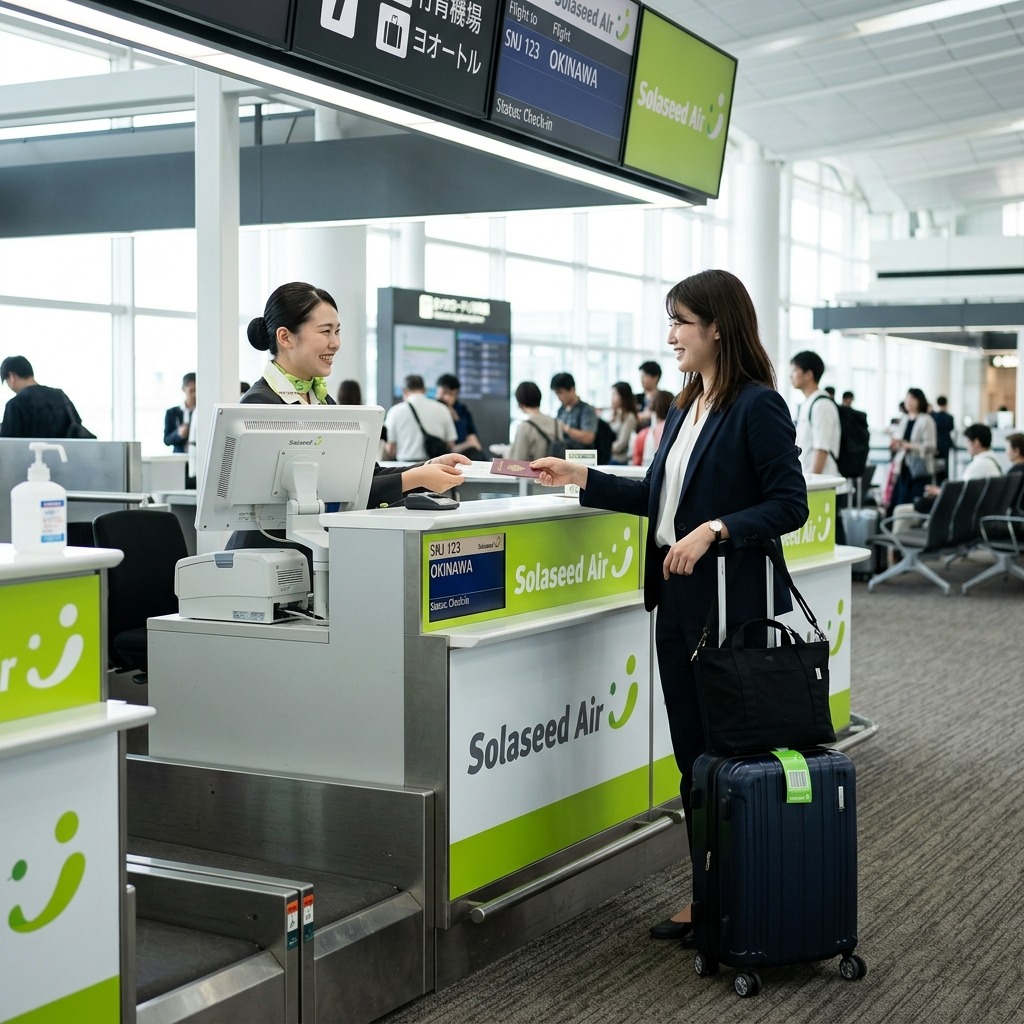
Solaseed Air allows one carry-on bag (up to 10 kg, 115 cm total) plus one personal belonging, and two free checked bags up to 23 kg each. Excess fees range from JPY 500 to JPY 5,500 depending on weight, size, or extra pieces. Major rule changes take effect May 19, July 1, and September 2026.
What Is Solaseed Air’s Baggage Allowance?
Solaseed Air’s standard baggage allowance includes one carry-on bag (10 kg max) plus one personal belonging in the cabin, and up to two checked bags weighing 23 kg each, free of charge. Allowances can vary by fare type Individual Inclusive Tour Fares only include one free checked bag.
Here’s the breakdown at a glance:
|
Baggage Type |
Free Allowance |
Weight Limit |
Size Limit |
|
Carry-on baggage |
1 piece |
10 kg (combined with personal item) |
55 x 40 x 25 cm (115 cm total) |
|
Personal belonging |
1 piece |
Included in 10 kg |
40 x 30 x 20 cm (from July 1, 2026) |
|
Checked baggage |
Up to 2 bags |
23 kg per bag |
158 cm total linear dimensions |
if you’re traveling on an Individual Inclusive Tour Fare or Inclusive Tour Discount Fare, only one checked bag is free not two. Always check your fare type on your e-ticket before assuming the standard allowance applies.
What Are Solaseed Air’s Carry-On Baggage Rules?
Solaseed Air permits one carry-on bag and one personal belonging per passenger, with a combined weight limit of 10 kg. Starting July 1, 2026, personal belongings must measure no more than 40 x 30 x 20 cm and fit completely under the seat in front of you.
What counts as a “personal belonging” versus carry-on baggage?
A personal belonging is a smaller item meant to fit under your seat think handbags or laptop bags. Carry-on baggage refers to your primary cabin bag, stored in the overhead bin. Solaseed Air’s Conditions of Carriage define “Carry-on Baggage” simply as any baggage that isn’t checked baggage, but in practice, the two categories have distinct size rules.
Items that don’t count toward your personal belonging allowance include:
- One coat
- One umbrella or walking stick
- Crutches or prosthetic limbs for personal use
- Guide, service, or hearing dogs assisting a passenger
- Other items specifically approved by Solaseed Air
Does bringing a stroller change your carry-on allowance?
Yes. If you bring a stroller or buggy onboard, you cannot bring any carry-on baggage beyond your one personal belonging. Families traveling with infants should factor this into their packing it’s a restriction competitor guides rarely mention, but it can catch parents off guard at the gate.
What if my carry-on doesn’t fit in the cabin?
Even if your bag falls within the size and weight limits, Solaseed Air may reclassify it as checked baggage if cabin crew determine it can’t be safely stowed. This typically happens on full flights where overhead space runs out quickly, so boarding early can reduce this risk.
What Is Solaseed Air’s Domestic Baggage Allowance?
For domestic Japan routes, Solaseed Air’s free checked baggage allowance is up to two bags at 23 kg each, with total linear dimensions not exceeding 158 cm. The Okinawa (Naha)–Ishigaki route has reduced excess fees compared to other domestic routes.
Domestic travelers should note a few route-specific quirks:
- Okinawa (Naha)–Ishigaki route: Overweight and oversize fees are discounted compared to standard routes, reflecting the shorter regional hop.
- Haneda Airport departures: Starting September 2026, checked baggage acceptance closes 30 minutes before departure earlier than many domestic carriers. Arrive with extra buffer time if you’re flying out of Haneda.
- Bulky items: From June 11, 2026, Solaseed Air will no longer accept more than 20 pieces of baggage per person, a new cap aimed at reducing cargo hold overloads.
What Is Solaseed Air’s Baggage Fee Structure?
Solaseed Air charges JPY 1,100–5,500 for overweight baggage (23–45 kg), JPY 5,500 per extra piece, and JPY 5,500 for oversize baggage between 158–292 cm. Fees stack if a bag exceeds multiple limits simultaneously.
Excess Baggage Charges Table
|
Violation Type |
Standard Routes |
Okinawa (Naha)–Ishigaki |
|
Overweight: 23–32 kg |
JPY 1,100 |
JPY 500 |
|
Overweight: 32–45 kg |
JPY 5,500 |
JPY 4,400 |
|
Extra piece (per bag) |
JPY 5,500 |
JPY 5,500 |
|
Oversize: 158–292 cm |
JPY 5,500 |
JPY 5,500 |
How do combined excess fees work? (A real cost scenario)
Here’s a scenario straight from Solaseed Air’s official fee documentation: a passenger flying Haneda to Miyazaki checks one extra bag weighing 30 kg. Because this exceeds both the piece allowance and the weight limit, both charges apply:
- Extra piece fee: JPY 5,500
- Overweight fee (23–32 kg bracket): JPY 1,100
- Total excess charge: JPY 6,600
This “stacking” rule is critical to understand. If your bag breaks three thresholds at once extra piece, overweight, and oversize you’ll pay all three fees combined, not just the highest one.
What other fees might apply beyond checked baggage?
- Cabin Baggage Fee: JPY 13,750 (standard routes) or JPY 8,580 (Okinawa–Ishigaki) per seat, required when oversized items like musical instruments or paintings need their own seat.
- Pet fee: JPY 6,600 per cage (standard routes) or JPY 4,400 (Okinawa–Ishigaki), including cage rental, payable at the airport counter.
- Extra seat purchase: Same pricing as Cabin Baggage Fees JPY 13,750 or JPY 8,580 per seat and includes a 23 kg baggage allowance.
- Excess Value Charge: If your baggage’s actual value exceeds the JPY 150,000 default liability limit, you can declare a higher value for a charge of JPY 10 per JPY 10,000 in excess.
What Items Are Restricted or Prohibited on Solaseed Air Flights?
Solaseed Air bans lithium-ion batteries over 160 Wh and cordless hair irons or straighteners with non-removable batteries, in both carry-on and checked baggage. These restrictions align with Japan’s Ministry of Land, Infrastructure, Transport and Tourism (MLIT) safety regulations.
Are power banks allowed on Solaseed Air?
Power banks are allowed only in carry-on baggage, never checked. Here’s how the limits break down:
|
Power Bank Capacity |
Carry-On |
Checked |
|
100 Wh or less |
Allowed (up to 2 total) |
Not permitted |
|
100–160 Wh |
Allowed (up to 2 total, combined with spare batteries) |
Not permitted |
|
Over 160 Wh |
Not permitted |
Not permitted |
New rules affecting power bank transport take effect for flights departing April 24, 2026, per MLIT guidance check Solaseed Air’s official restricted items page before your trip if you’re traveling with electronics-heavy gear.
Can I bring a cordless hair straightener or curling iron?
Only if the battery is removable and packed separately in your carry-on, or if the device has a “flight mode” disconnecting its heating element. Devices with non-removable batteries a common design in newer cordless hair tools are banned entirely, a restriction that has caused real confusion at security checkpoints according to Solaseed Air’s own advisory notices.
What other items are commonly misunderstood?
- Musical instruments: Free storage for items up to 203 cm total dimensions more generous than standard checked baggage.
- Sports equipment: Free storage up to 292 cm, covering items like skis or surfboards that would otherwise trigger oversize fees.
- Smart baggage: Bags with non-removable batteries (smart luggage with built-in chargers) are banned entirely; those with removable batteries are allowed if the battery travels in your carry-on.
- Plant restrictions: Sweet potatoes, morning glories, and untested citrus or camellia plants from Okinawa Prefecture and nearby islands cannot be transported to mainland Japan.
Frequently Asked Questions
How much does it cost to check an extra bag with Solaseed Air?
An extra piece of checked baggage costs JPY 5,500 on all routes. If that extra bag is also overweight or oversized, additional fees stack on top, potentially pushing the total above JPY 10,000 per bag.
Can I bring two carry-on bags on Solaseed Air?
No. Solaseed Air permits only one carry-on bag plus one personal belonging (like a handbag), with a combined weight cap of 10 kg. Bringing a stroller reduces this to just the personal belonging.
What happens if my checked bag weighs more than 45 kg?
Solaseed Air will not accept individual pieces exceeding 45 kg or dimensions over 292 cm as checked baggage under any circumstances, regardless of fee payment.
Is there a cheaper baggage fee for Okinawa routes?
Yes. The Okinawa (Naha)–Ishigaki route has reduced excess fees for example, JPY 500 versus JPY 1,100 for baggage 23–32 kg overweight, and JPY 4,400 versus JPY 5,500 for baggage 32–45 kg.
Can I bring a power bank in my checked luggage?
No. All power banks, regardless of capacity, are prohibited in checked baggage. They must travel in carry-on baggage, and units over 160 Wh are banned entirely from air travel.
How early does checked baggage close at Haneda Airport?
Starting September 2026, Haneda Airport will close checked baggage acceptance 30 minutes before departure for Solaseed Air domestic flights earlier than the airport’s previous cutoff.
Does Solaseed Air charge for pets in the cabin or cargo hold?
Yes. Pet transport costs JPY 6,600 per cage on most routes, or JPY 4,400 on the Okinawa (Naha)–Ishigaki route. This fee includes cage rental and is payable at the airport counter on the day of travel.
What’s the maximum liability if Solaseed Air damages my baggage?
Solaseed Air’s default liability limit is JPY 150,000 per passenger. Travelers with higher-value baggage can declare the actual value and pay an excess value charge of JPY 10 per JPY 10,000 above that limit.
Are musical instruments included in the free baggage allowance?
Musical instruments receive a special allowance: free storage as checked baggage up to 203 cm in total dimensions, which exceeds the standard 158 cm limit for regular checked bags.
Will my carry-on always fit in the cabin if it meets the size limit?
Not necessarily. Even bags within the 55 x 40 x 25 cm limit may be checked at the gate if cabin crew determine there isn’t safe stowage space, particularly on full flights.

Azeem breaks down airline baggage policies, fare-class benefits, and peak pricing rules into practical guidance for smooth trip planning. He verifies every fee and dimension against official airline sources so travelers can pack with confidence.