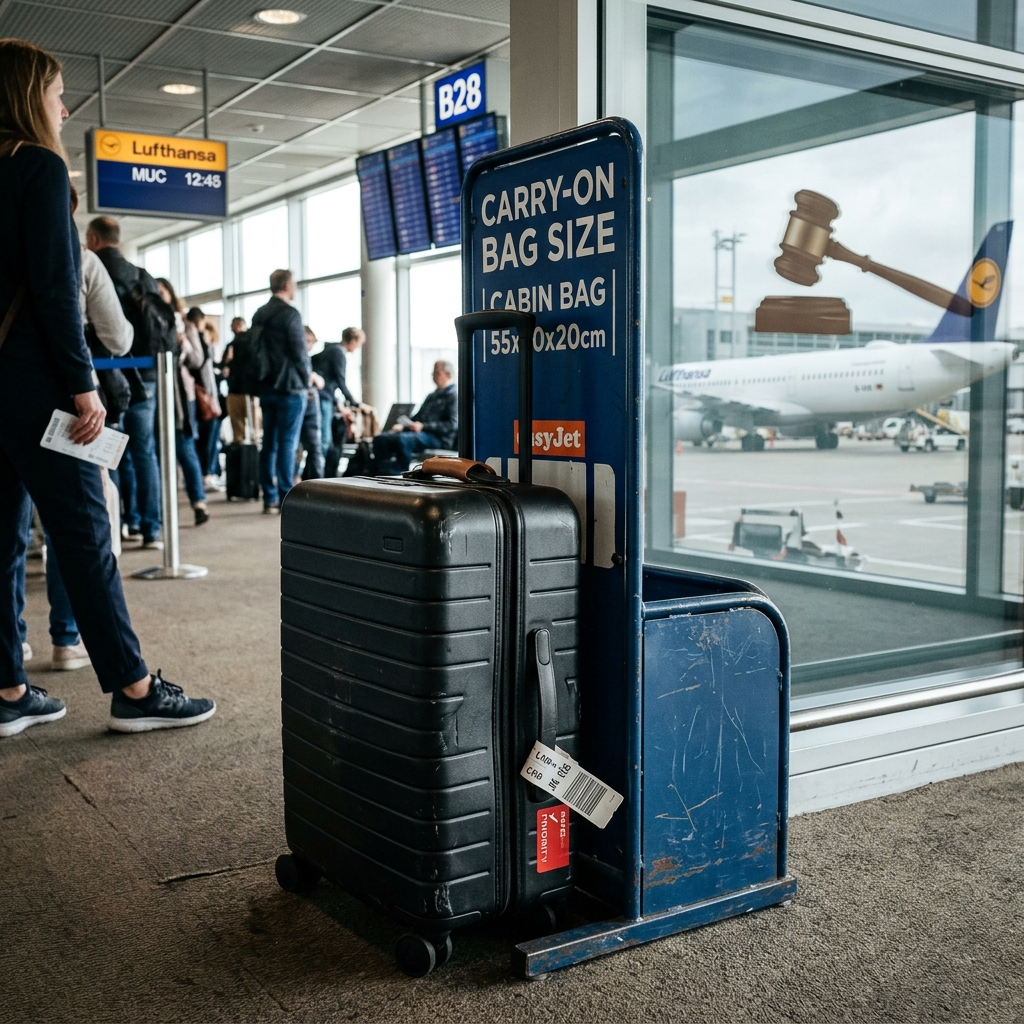
Vueling Carry-On Baggage Ruling Germany 2026: Fees & Passenger Rights
European courts and regulators have ruled that charging passengers for standard carry-on baggage violates EU consumer protection law. A German court upheld a ruling against Vueling in July 2026. Spain fined five budget airlines €179 million in 2024. A new EU law adopted on July 7, 2026 guarantees every passenger one free personal item (40×30×15 cm), with full enforcement expected by September 2027.
Budget airlines have built entire business models around one reliable revenue stream: charging you extra to bring your bag on the plane. For years, fees for a standard cabin trolley could quietly double the cost of a “cheap” ticket. That practice is now under serious legal fire across Europe from German courts to Spanish regulators to the European Parliament itself.
Here’s exactly what has been ruled, which airlines are affected, and what you can do about it right now.
What Did European Courts Actually Rule About Carry-On Bag Fees?
European courts have ruled that restricting passengers to one tiny free item while charging separately for a standard carry-on trolley violates EU law. The legal foundation is a 2014 Court of Justice of the EU (CJEU) ruling (C-487/12), which established that hand luggage is an “indispensable element of passenger transport” and cannot be treated as a chargeable add-on.
That 2014 ruling established the principle. The enforcement followed a decade later.
In November 2024, Spain’s Consumer Rights Ministry fined five airlines a combined €179 million for what it classified as abusive baggage practices:
|
Airline |
Fine Amount |
|
€107.8 million |
|
|
Vueling |
€39.3 million |
|
easyJet |
€29.1 million |
|
Norwegian |
€1.6 million |
|
Volotea |
€1.2 million |
Then, in May 2025, consumer watchdog group BEUC and 16 national member organizations filed formal complaints against seven airlines: easyJet, Norwegian Air, Ryanair, Transavia, Volotea, Vueling, and Wizz Air.
The legal pressure continued mounting throughout 2026.
What Is the Vueling Carry-On Baggage Court Ruling in Germany?
The Higher Regional Court of Hamm (OLG Hamm) ruled on January 20, 2026 (case ref. I-13 UKl 4/25) that Vueling’s “Fly Light” baggage policy is unlawful under EU law. The court confirmed this ruling on July 7, 2026, after Vueling filed a formal objection. This is the first German court decision under BEUC’s coordinated campaign against seven airlines’ carry-on fee practices.
The case was brought by Germany’s Federation of Consumer Organizations (vzbv). Under Vueling’s “Fly Light” fare, passengers were only permitted to bring one item measuring a maximum of 40×30×20 cm small enough to fit under the seat in front. Bringing a standard cabin trolley (up to 55×40×20 cm) required an additional fee ranging from €10 to €59 online and €45 to €79 at the gate.
The OLG Hamm found this arrangement unlawful on two grounds:
- Restricting passengers to a single free carry-on item violates EU law, even if a second small item (such as a laptop bag alongside a handbag) could be safely stowed under the seat
- Failing to display the cabin trolley surcharge on the “Fly Light” fare page constitutes misleading pricing
“EU law requires airlines to transport reasonable hand baggage at no extra cost,” said Ramona Pop, Executive Director of vzbv. “Many airlines violate this by allowing only ultra-small bags without a surcharge.”
Vueling has since lodged a formal objection, meaning proceedings continue through standard legal channels. The July 7, 2026 hearing upheld the original judgment.
The vzbv also filed separate lawsuits against easyJet, Wizz Air, and Eurowings as part of the same BEUC-coordinated initiative.
What Did the New EU Air Passenger Rights Reform Change?
The European Parliament adopted the revised EU Air Passenger Rights Regulation (EU261) on July 7, 2026, by 646 votes to 12. The reform guarantees every passenger one free personal item (40×30×15 cm, under-seat). It does NOT make the standard carry-on trolley universally free airlines can still charge for it, but must display trolley-inclusive fares from the first search page. Full enforcement begins September 2027 at the earliest.
|
What Changed |
What Did NOT Change |
|
Free under-seat personal item (40×30×15 cm) guaranteed |
Standard carry-on trolley can still be charged |
|
Fares must include cabin bag cost by default (price transparency) |
Cabin bag dimensions not standardized across EU |
|
9-month window to file compensation claims |
Compensation amounts unchanged since 2005 |
|
No-show clause abolished (return flight stays valid) |
No uniform weight limits across airlines |
|
Children under 14 seated next to guardian free |
Extraordinary circumstances still exempt airlines |
The reform is the result of a political compromise. Parliament initially sought a universally free cabin bag (100 cm combined dimensions, up to 7 kg). The Council, backed by lobbying from low-cost airlines, blocked this. The estimated cost of the final compromise: €1.80 per ticket, according to rapporteur MEP Andrey Novakov (EPP).
Which Airlines Are Affected and What Are Their Current Carry-On Rules?
Every EU-based airline is subject to both the CJEU 2014 precedent and the 2026 EU261 reform. Budget carriers such as Ryanair, Wizz Air, Vueling, easyJet, Norwegian, and Volotea are most directly affected, as carry-on fees form a significant portion of their ancillary revenue exceeding €10 billion across Europe’s seven largest low-cost carriers in 2024.
Ryanair alone generated approximately €3.5 billion from baggage fees in 2024 (according to KNEWS.MEDIA and Forbes).
|
Airline |
Free Personal Item |
Cabin Trolley Included? |
Trolley Surcharge |
|
Ryanair |
40×30×20 cm |
Priority fares only |
€6 – €36 |
|
Wizz Air |
40×30×20 cm |
WIZZ Priority only |
€5 – €40 |
|
Vueling |
40×30×20 cm |
Optima/TimeFlex fares only |
€10 – €59 (€45–€79 at gate) |
|
easyJet |
45×36×20 cm |
Up Front/Extra Legroom only |
£7 – £40 |
|
Norwegian |
25×33×20 cm |
LowFare+ / Flex only |
€8 – €20 |
|
Volotea |
40×30×20 cm |
Standard+ only |
€10 – €40 |
|
Transavia |
40×30×10 cm |
Included on all fares |
— |
What Do the Vueling Baggage Rules in Germany Mean for Passengers in 2026?
Under the OLG Hamm ruling, Vueling cannot lawfully restrict German-route passengers to a single tiny item while charging separately for a standard cabin bag. Even if two small bags together remain within size limits and can be safely stored under the seat, restricting passengers to one item without the option to include a second at no cost is unlawful.
Practically, this means:
- Passengers who paid Vueling’s carry-on surcharge on “Fly Light” fares may have grounds to reclaim that fee
- Vueling must not advertise the “Fly Light” fare without disclosing the trolley surcharge on the same page
- The ruling applies as legal precedent, though Vueling’s formal objection means it is not yet final
One critical note: the European Commission opened an infringement procedure (INFR(2025)4019) against Spain in October 2025, arguing that the €179 million in national fines violated airline pricing freedom under EU Regulation (EC) No 1008/2008. Consumer groups, including BEUC, sharply criticized this position. The legal tension between national enforcement and EU-level pricing freedom rules remains unresolved.
How Do You Claim a Refund for Carry-On Bag Fees Already Paid?
There is no automatic refund mechanism in place yet. The 2026 EU261 reform does not retroactively reimburse past fees. However, passengers who paid carry-on surcharges on routes now covered by court rulings particularly Vueling routes in Germany may pursue claims through these channels:
- Submit a written complaint directly to the airline, referencing the OLG Hamm ruling (I-13 UKl 4/25) or the 2014 CJEU precedent (C-487/12)
- File a complaint with your national enforcement body in Germany, this is the Luftfahrt-Bundesamt (LBA); in Spain, AESA; in the UK, the Civil Aviation Authority (CAA)
- Use an approved Alternative Dispute Resolution (ADR) body in the UK, AviationADR covers Ryanair, easyJet, and Wizz Air; CEDR covers British Airways
- Small claims court remains an option for individual cases below country-specific thresholds
Keep your booking confirmation, boarding pass, and payment receipt as supporting documentation.
When Will the New EU Carry-On Rules Actually Take Effect?
The new EU261 rules will not apply before September 2027 at the earliest. The timeline runs as follows:
- July 7, 2026 European Parliament adopts the regulation (646–12)
- August 2026 Expected EU Council ratification
- Autumn 2026 Publication in the EU Official Journal
- Entry into force 20 days after publication
- 12-month transition period Airlines have one year to comply
- Effective enforcement September 2027 at the earliest
Until then, Regulation (EC) No 261/2004 from 2004 remains in full force.
Frequently Asked Questions
Is it now illegal for Ryanair to charge for carry-on bags in Europe?
Not entirely. The 2014 CJEU ruling (C-487/12) established that airlines cannot charge for reasonable hand luggage. Ryanair received an €107.8 million fine from Spain in 2024. The 2026 EU reform requires price transparency but does not ban cabin bag surcharges outright.
What exactly did the OLG Hamm rule about Vueling’s “Fly Light” fare?
The German court ruled on January 20, 2026 that Vueling’s policy of offering only one item (40×30×20 cm) for free, while charging €10–€59 for a standard trolley, violates EU law. The ruling was upheld on July 7, 2026.
Can I get a refund on carry-on fees I’ve already paid to Vueling in Germany?
Potentially yes, for recent bookings. File a written complaint to Vueling referencing OLG Hamm case I-13 UKl 4/25, then escalate to Germany’s LBA or an ADR body if no response within 30 days.
Does the new EU261 reform mean carry-on bags are free on all European flights?
No. The reform guarantees one free under-seat personal item (40×30×15 cm). Standard cabin trolleys can still be charged. Airlines must, however, display trolley-inclusive fares by default.
How much revenue do budget airlines make from carry-on fees?
Europe’s seven largest low-cost airlines generated over €10 billion from cabin bag fees in 2024. Ryanair alone earned approximately €3.5 billion.
Which seven airlines did BEUC file complaints against in May 2025?
easyJet, Norwegian Air, Ryanair, Transavia, Volotea, Vueling Airlines, and Wizz Air.
Will Wizz Air’s cabin bag fees become illegal?
Wizz Air faces the same BEUC complaint and is subject to the EU261 reform. Its current fee structure (€5–€40 per segment) will need to comply with price transparency rules by September 2027. Separate court rulings may apply earlier.
Does the EU ruling apply to flights from the UK?
Partially. EU carriers (Ryanair, easyJet, Wizz Air) departing from UK airports are covered by EU rules. UK carriers (British Airways, Jet2) operating domestically fall under UK261, which has not adopted the 2026 reform.
How much can Vueling charge for a cabin bag at the gate in Germany?
Under its current “Fly Light” fare, Vueling charges €45–€79 at the gate for a 55×40×20 cm trolley. The OLG Hamm ruled this practice combined with restricting free items to one small bag is unlawful.
What is the estimated cost impact of the EU reform on ticket prices?
According to rapporteur MEP Andrey Novakov (EPP), the reform adds approximately €1.80 per ticket. easyJet has suggested prices could rise by up to 25%.

Azeem breaks down airline baggage policies, fare-class benefits, and peak pricing rules into practical guidance for smooth trip planning. He verifies every fee and dimension against official airline sources so travelers can pack with confidence.


3 Comments