T’way Air Baggage Policy: Carry-On and Checked Baggage Rules
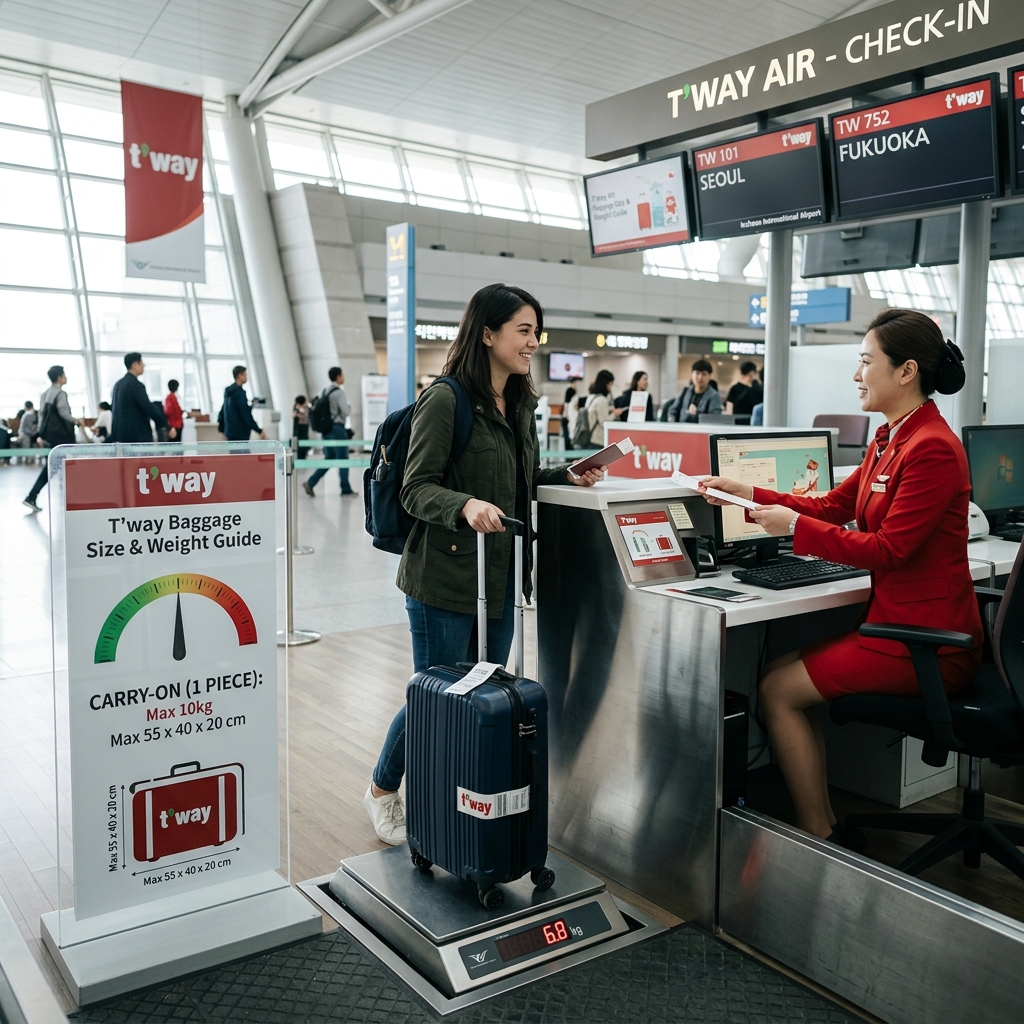
T’way Air allows one carry-on bag (max 10 kg, 40×20×55 cm) and one personal item per passenger, with a combined weight limit of 10 kg for both. Checked baggage allowances range from 0 kg (Event fare) to 30 kg (Business fare), with excess fees starting at 2,000 KRW/kg on domestic routes. Fees are based on fare type and route zone.
Booking a T’way Air flight without reading the baggage rules first is a gamble you don’t want to take especially when excess fees can reach 20,000 KRW per kilogram on Southeast Asian routes. T’way Air (IATA: TW), South Korea’s home-grown low-cost carrier founded in 2005, now serves over 10 million passengers annually. And like most budget airlines, its pricing model assumes you’ll pack light unless you’ve paid for more.
What Is T’way Air’s Carry-On Baggage Allowance?
T’way Air allows each passenger one carry-on bag and one personal item, with a total combined weight limit of 10 kg for both items together. The carry-on bag must not exceed 40 cm × 20 cm × 55 cm (including handles and wheels), and the personal item such as a handbag or laptop bag must fit under the seat in front of you.
This is a critical point that many travelers miss: the 10 kg limit covers both the carry-on and the personal item combined, not each item individually. Pack a 7 kg camera bag and a 5 kg backpack, and you’ll face a problem at the gate.
T’way Air Carry-On Quick Reference
|
Item |
Weight Limit |
Size Limit |
|
Carry-on bag |
Combined 10 kg total |
40 × 20 × 55 cm (L×W×H) |
|
Personal item (handbag, laptop bag) |
Included in 10 kg total |
Must fit under seat |
|
Business Class (select routes) |
10 kg per piece (2 pieces) |
Standard cabin dimensions |
Prohibited in carry-on:
- Liquids over 100 ml (international flights); all must fit in a single 1-liter clear resealable bag
- Sharp objects, scissors, and tools
- Power banks and spare lithium batteries are required in carry-on (prohibited in checked baggage)
- Lighters may be carried on the person but never in checked bags
Tip: Weigh your carry-on and personal item together at home. A portable luggage scale costs under $10 and can save you far more at the check-in counter.
What Is T’way Air’s Checked Baggage Allowance by Fare Type?
T’way Air’s checked baggage allowance is entirely determined by the fare type you purchase not by route length alone. Event fares include zero free baggage, while Business fares include up to 30 kg. No single piece of checked luggage may exceed 32 kg; anything heavier must be repacked into separate bags.
Checked Baggage Allowance by Fare Type
|
Fare Type |
Free Checked Baggage |
Max Per Piece |
|
Event Fare |
None (must purchase separately) |
32 kg |
|
Smart Fare |
15 kg |
32 kg |
|
Normal Fare |
20 kg |
32 kg |
|
Business Fare |
30 kg |
32 kg |
Real-world example: A traveler booking a Seoul–Tokyo Event fare with 18 kg of luggage owes the flat 60,000 KRW charge just to check any bag, plus 3,000 KRW extra for each kilogram over 15 kg (i.e., 3 kg × 15,000 KRW = 45,000 KRW additional). The smarter move? Add baggage online before flying always cheaper than paying at the airport.
What Are T’way Air’s Excess Baggage Fees for International Routes?
T’way Air charges excess baggage fees based on route zones, ranging from 15,000 KRW/kg (Japan, China short-haul) to 30,000 KRW/kg (Australia, Europe). Event fare passengers on international routes face an upfront flat-rate fee just for checking a bag, regardless of weight a detail most competitor summaries omit entirely.
Fees below reflect the updated schedule effective from March 30, 2026:
Excess Baggage Fees by Zone (from March 30, 2026)
|
Zone & Routes |
Event Fare Flat Rate |
Per-kg Excess Fee |
|
Zone 1 – Domestic |
No flat rate |
2,000 KRW/kg |
|
Zone 2 – Japan, China (short-haul) |
60,000 KRW (up to 15 kg) |
15,000 KRW/kg |
|
Zone 3 – China (long-haul), Taiwan, HK, Macau, Russia |
80,000 KRW (up to 15 kg) |
18,000 KRW/kg |
|
Zone 4 – Thailand, Vietnam, Philippines, Malaysia, Laos |
100,000 KRW (up to 15 kg) |
20,000 KRW/kg |
|
Zone 4 – Singapore |
No flat rate |
20,000 KRW/kg (over 30 kg) |
|
Zone 4 – Guam/Saipan |
60,000 KRW/piece over 23 kg |
|
|
Zone 5 – Australia |
No flat rate |
30,000 KRW/kg |
|
Zone 5 – Europe |
No flat rate (Smart/Normal: over 23 kg) |
30,000 KRW/kg |
|
Zone 5 – Canada |
165,000 KRW/165 CAD per piece over 23 kg |
Important edge case for Event fare travelers: On Zone 4 routes (e.g., Da Nang, Bangkok, Manila), even if you check in a single 10 kg bag, you’ll pay the 100,000 KRW flat rate upfront. There is no “pay only for what you use” option on Event fares internationally. This makes the Smart fare considerably better value for anyone planning to check luggage.
How Can You Buy Extra Baggage on T’way Air?
The cheapest way to add baggage on T’way Air is through the official website or app before departure always less expensive than paying at the airport or at the boarding gate. T’way Air allows online baggage additions up to 24 hours before departure.
To buy extra baggage:
- Visit twayair.com and log into “My Booking”
- Select your flight and choose the baggage add-on
- Pay online using a credit or debit card
- Receive confirmation no need to print
If you show up at the gate with oversized carry-on luggage, a gate baggage handling fee applies on top of any excess charges:
- Domestic: 10,000 KRW per piece
- International: 20,000 KRW (or 20 CAD) per piece
That gate handling fee is separate from and additional to any excess weight fee. It adds up fast.
What Are the Rules for Special and Sports Baggage?
T’way Air classifies items like skis, snowboards, surfboards, bicycles, and golf clubs as special baggage. These items carry a flat fee of 20,000 KRW (or 20 CAD) per item, charged in addition to any applicable excess baggage fees. The three combined dimensions (length + width + height) must not exceed 277 cm anything larger cannot be accepted.
Key special baggage rules:
- Sports equipment must be packed in dedicated hard cases no compensation is provided for damage to items packed otherwise
- Musical instruments small enough to fit in the overhead bin (under 115 cm total linear dimensions) can travel as carry-on
- Larger instruments (e.g., cellos) require an extra purchased seat for in-cabin travel, or must be checked in a secure hard case
- Combustion-engine items (motorcycles, gas-powered scooters, jet skis) are not accepted under any circumstances use an air cargo forwarder instead
Prohibited in checked baggage (safety):
- Spare lithium batteries and portable power banks
- Electronic cigarettes and vaping devices
- Items that could cause fire or explosion
How Does T’way Air’s Baggage Policy Compare to Other Korean Budget Airlines?
T’way Air’s carry-on limit of 10 kg combined (bag + personal item) sits at the lower end of Korean LCC standards. Jeju Air and Air Busan typically allow a similar 10 kg carry-on, while some routes on Eastar Jet allow 10 kg for the main bag alone without combining the personal item. T’way Air’s checked baggage structure with Event fares receiving zero free luggage is standard among Korean LCCs but punishing for travelers who don’t read the fine print.
The per-kg excess fees on Zone 4 international routes (20,000 KRW/kg on Southeast Asia) are competitive but not the lowest on the market. Where T’way Air stands out positively is on Singapore routes, where it applies a 30 kg threshold before Zone 4 excess fees apply more generous than its treatment of most other Southeast Asian routes.
Tips to Avoid Unexpected Baggage Fees on T’way Air
These practical steps can save you tens of thousands of KRW:
- Buy baggage online, not at the airport pre-purchase is always cheaper, and the gap widens closer to departure
- Weigh both carry-on items together before leaving home; the combined 10 kg limit is easy to exceed with electronics and a laptop
- Check your fare type first if you’re on an Event fare and need to check a bag internationally, factor the flat-rate fee into your total cost comparison
- Avoid gate check-ins the 10,000–20,000 KRW gate handling fee adds unnecessary cost for something you could resolve online
- Use the T’way Air app available on iOS and Android, it lets you add baggage, check in online, and manage bookings 24/7
- Pack valuables in your carry-on medications, documents, electronics, and money should never travel in checked luggage
What Is the New Name for T’way Air?
T’way Air is rebranding to Trinity Airways. The name change was announced in September 2025 following the airline’s acquisition by South Korea’s Daemyung Sono Group. The full rebrand including new aircraft livery and brand identity is scheduled for rollout in the first half of 2026. As of the time of writing, flights continue to operate under the T’way Air name, and existing bookings remain valid.
Frequently Asked Questions
Does T’way Air include carry-on baggage for free?
Yes. All T’way Air passengers regardless of fare type receive a free carry-on allowance. One bag (max 40×20×55 cm) and one personal item are permitted, with a combined weight limit of 10 kg for both items together.
What is the maximum weight for a single checked bag on T’way Air?
No single checked bag may exceed 32 kg. If a bag weighs more, it must be repacked into separate pieces before check-in.
How much does T’way Air charge for excess baggage on domestic flights?
T’way Air charges 2,000 KRW per kilogram over the free allowance on domestic routes the lowest rate across all zones.
Can you buy baggage on T’way Air at the airport?
Yes, but it costs more than buying online. Airport rates are higher, and gate-checked bags incur an additional 10,000 KRW (domestic) or 20,000 KRW (international) handling fee per piece on top of any weight charges.
What happens if an Event fare passenger checks a bag on a Zone 4 international route?
They pay a flat 100,000 KRW fee for up to 15 kg, plus 20,000 KRW for each kilogram above 15 kg. This applies even if the bag weighs just 5 kg the flat rate is charged regardless of weight.
Are power banks allowed in T’way Air checked baggage?
No. Power banks and spare lithium batteries are strictly prohibited in checked luggage. They must be carried in the cabin.
What is the excess baggage fee for a T’way Air flight to Japan?
For travel from March 30, 2026 onward: Event fare passengers pay 60,000 KRW for up to 15 kg, then 15,000 KRW per additional kilogram. Smart and Normal fare passengers pay 15,000 KRW per kg over their free allowance (15 kg and 20 kg respectively).
Is T’way Air a good airline?
T’way Air holds IOSA (IATA Operational Safety Audit) certification, serves over 10 million passengers annually, and is publicly listed on South Korea’s KOSPI exchange. It offers a competitive route network across Asia and has expanded into medium-haul markets using the Airbus A330-300. For budget-conscious travelers flying within Asia, it is a well-regarded option provided you understand the low-cost fare structure and plan baggage accordingly.
Does T’way Air charge for sports equipment separately from checked baggage?
Yes. A special baggage fee of 20,000 KRW (or 20 CAD) per item applies to sports equipment, independent of any excess baggage fees. Both charges apply if the item also exceeds your free baggage allowance.
What is the baggage allowance for T’way Air Business fare passengers on long-haul routes?
Business fare passengers receive 30 kg free on most routes, 40 kg on Australia and Europe routes. Excess charges on long-haul Zone 5 routes are 30,000 KRW per kilogram over the threshold.

Muhammad Naeem is a travel researcher with 5+ years of experience analyzing airline rules and global travel regulations. He specializes in simplifying complex airline policies to help travelers avoid extra fees and fly with confidence. His work focuses on accuracy, clarity, and up to date information across international carriers.
One Comment