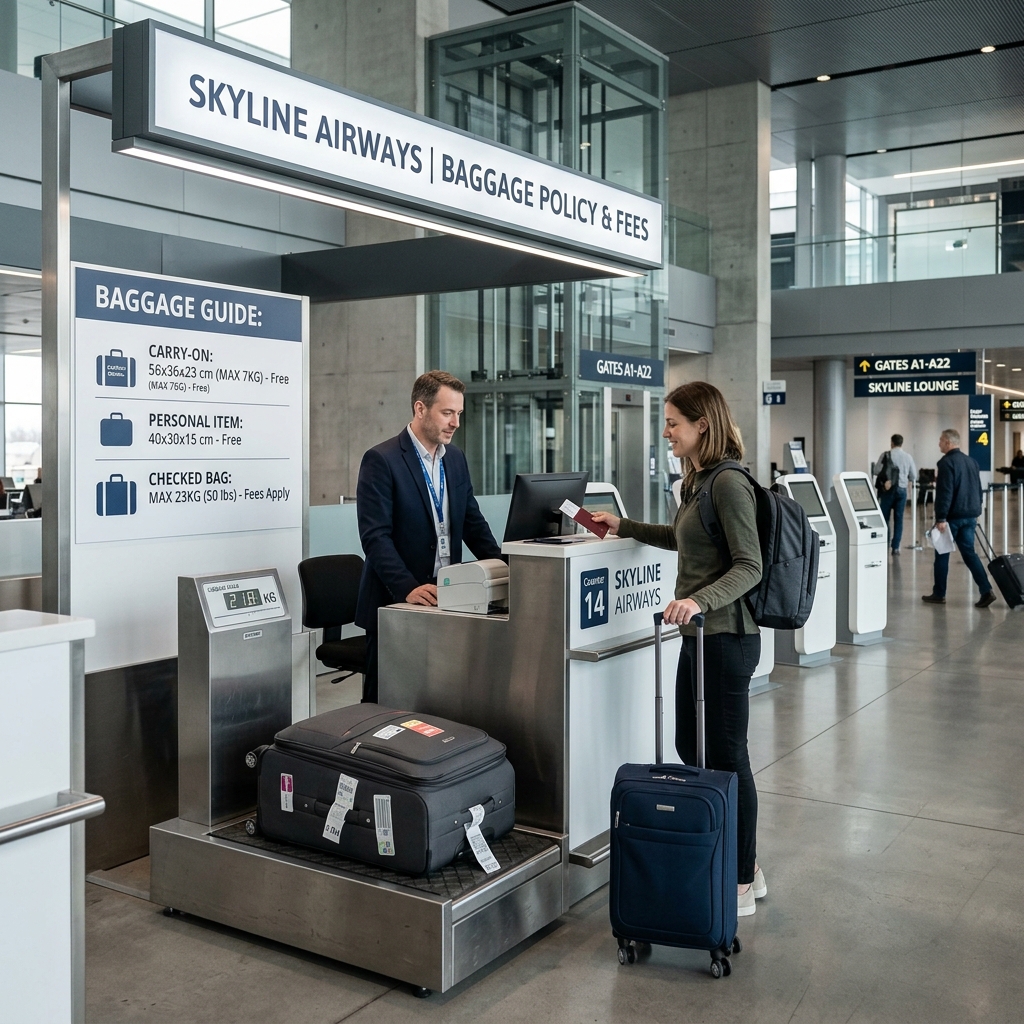
Air Canada Baggage Policy 2026: Fees, Sizes & Rules
Air Canada’s baggage policy in 2026 varies by fare type, cabin class, and route. Economy Basic passengers on key routes get only one personal item at no charge. Checked baggage fees start at CAD $45 for domestic flights. Business Class passengers receive two free checked bags weighing up to 32 kg (70 lb) each.
Few things derail a trip faster than an unexpected baggage fee at the check-in counter. Air Canada’s policy covers everything from carry-on dimensions and personal item size limits to overweight surcharges and sports equipment rules and the details shift depending on your fare class, destination, and when you bought your ticket.
What Is Air Canada’s Baggage Allowance in 2026?
Air Canada’s baggage allowance in 2026 is determined by your fare type, cabin class, and route. Economy Basic fares on domestic and short-haul international routes include only one personal item. Higher fares Flex, Comfort, Latitude, Premium Economy, and Business Class include one or two free checked bags, each up to 23 kg (50 lb) or 32 kg (70 lb) for Business.
The table below summarizes checked bag inclusions by cabin class for flights outside North America:
|
Cabin Class / Fare |
Checked Bags Included |
Max Weight per Bag |
Max Size per Bag |
|
Economy Basic |
0 (must purchase) |
23 kg (50 lb) |
158 cm (62 in) |
|
Economy Standard / Flex / Comfort |
1 bag |
23 kg (50 lb) |
158 cm (62 in) |
|
Economy Latitude |
2 bags |
23 kg (50 lb) |
158 cm (62 in) |
|
Premium Economy |
2 bags |
23 kg (50 lb) |
158 cm (62 in) |
|
Business Class |
2 bags |
32 kg (70 lb) |
158 cm (62 in) |
For flights within North America (Canada and the US, including Hawaii and Alaska):
|
Cabin Class / Fare |
Checked Bags Included |
|
Economy Basic & Standard |
0 (must purchase) |
|
Economy Flex & Comfort |
1 bag |
|
Economy Latitude |
2 bags |
|
Premium Economy |
2 bags |
|
Business Class |
2 bags |
The jump from Economy Standard to Economy Flex is significant Flex includes your first bag free on North American routes, saving you at least CAD $45 one way.
What Are Air Canada’s Baggage Fees in 2026?
Air Canada checked baggage fees in 2026 start at CAD $45 for the first bag on domestic and Canada–US routes for Basic and Standard Economy fares. International first-bag fees reach CAD $90–$108 for Economy Basic fares. Fees are lower when prepaid online versus paying at the airport.
Air Canada Checked Baggage Fees: Domestic & Canada–US Routes
Per one-way segment, in CAD (inclusive of taxes where applicable):
|
Fare Type |
1st Bag |
2nd Bag |
|
Basic & Standard |
$45–$54 |
$60–$72 |
|
Flex |
Free |
$60–$72 |
|
Comfort |
Free |
$50–$60 |
|
Latitude |
Free |
Free |
The lower end of each range typically reflects the prepaid online price. The higher end reflects fees paid at the airport. Prepaying online generally saves you around 20%.
Air Canada Checked Baggage Fees: Caribbean, Mexico & Central America
Fees per one-way segment match the domestic/US structure above:
|
Fare Type |
1st Bag |
2nd Bag |
|
Basic & Standard |
$45–$54 |
$60–$72 |
|
Flex |
Free |
$60–$72 |
|
Comfort |
Free |
$50–$60 |
|
Latitude |
Free |
Free |
Air Canada Checked Baggage Fees: International Routes
|
Fare Type |
1st Bag |
2nd Bag |
|
Economy Basic |
$90–$108 |
$120–$144 |
Real-world example: A round-trip to London in Economy Basic, with one checked bag each way, would cost you CAD $180–$216 in baggage fees alone nearly the price of upgrading to a higher fare class that includes a free bag.
What Is Air Canada’s Carry-On Policy?
Air Canada’s carry-on policy in 2026 allows most passengers one standard carry-on item and one personal item. Economy Basic passengers on domestic Canada, Canada–US, Mexico, Caribbean, and Central American routes are restricted to one personal item only (no standard carry-on bag).
This Economy Basic carry-on restriction applies to tickets purchased on or after January 3, 2025 a significant policy change that catches many travelers off guard.
What Is Air Canada’s Carry-On Size Limit?
Air Canada’s carry-on size limit for a standard item is 23 × 40 × 55 cm (9 × 15.5 × 21.5 in), measured depth × width × height, including wheels and handles. The personal item size limit is 33 × 43 × 16 cm (13 × 17 × 6 in). There is no published weight limit for carry-on bags, but items must be light enough to stow unaided.
| Item Type | Max Dimensions (D × W × H) |
| Standard carry-on | 23 × 40 × 55 cm / 9 × 15.5 × 21.5 in |
| Personal item | 33 × 43 × 16 cm / 13 × 17 × 6 in |
Acceptable personal items include handbags, laptop bags, small backpacks, and briefcases. Each must fit under the seat in front of you.
Is Carry-On Free on Air Canada?
Yes carry-on baggage is free on Air Canada for most passengers. All fare types except Economy Basic (on select routes) include one standard carry-on and one personal item at no charge. Economy Basic passengers on domestic, US, Mexico, Caribbean, and Central American routes may bring only one personal item.
In practical terms: if you’re booked on an Economy Basic fare from Toronto to Miami, your roller bag will need to be checked and paid for at the airport if you didn’t prepay.
What Are Air Canada’s Overweight and Oversized Baggage Fees?
Air Canada charges an overweight or oversized fee when a checked bag exceeds 23 kg (50 lb) in weight or 158 cm (62 in) in total linear dimensions. Bags between 23–32 kg (50–70 lb) or 160–292 cm (63–115 in) are accepted with a surcharge. Items beyond those limits must travel as cargo.
Overweight and Oversized Surcharges
|
Route |
Overweight or Oversized Fee |
Overweight AND Oversized |
|
Within Canada |
$100–$120 |
$100–$120 (single fee) |
|
Canada–US |
$100–$120 |
$100–$120 (single fee) |
|
Caribbean / Mexico / International |
$100–$120 |
$100–$120 (single fee) |
Additional Bag Fees (Over Your Standard Allowance)
|
Route |
Additional Bag Fee |
|
Within Canada |
$100–$120 |
|
Canada–US (incl. Hawaii & Alaska) |
$100–$120 |
|
Caribbean, Mexico, Central America |
$225–$270 |
|
All other international destinations |
$225–$270 |
Important edge case: When you pay the additional bag fee, no separate overweight or oversized surcharge applies to that same bag a useful detail if you’re traveling with something bulky.
What Are Air Canada’s Special Item Baggage Rules?
Sports Equipment
|
Item |
Fee |
|
Bicycle or sporting firearm |
$50–$60 per one way |
|
Surfboard, paddleboard, kiteboard, wakeboard, wave ski |
$100–$120 per one way |
Musical Instruments
When checked separately, a musical instrument counts as one checked bag toward your fare’s maximum allowance. Standard checked baggage fees and size/weight limits apply.
Pets
|
Situation |
Fee |
|
Pet in cabin within Canada / Canada–US (excl. Hawaii) |
$50–$60 per one way |
|
Pet in cabin all other routes |
$100–$120 per one way |
|
Pet in cargo hold within Canada / Canada–US |
$105–$126 per one way |
|
Pet in cargo hold all other routes |
$270–$324 per one way |
Hunting Equipment
|
Item |
Fee |
|
Antlers and horns |
$150–$180 |
|
Firearms |
$50–$60 |
Medical Equipment and Mobility Aids
Wheelchairs and mobility aids are transported free of charge as part of your checked baggage. Personal medical devices such as CPAP machines and portable oxygen concentrators may also be carried on board at no additional cost. Air Canada’s Medipak oxygen service applies to international and Canada–US routes, with fees ranging from CAD $220 to $1,070 depending on flow rate, flight duration, and the number of eligible segments.
Infant Baggage
Parents traveling with a lap infant may bring one additional standard carry-on item (up to 55 × 40 × 23 cm) at no charge. Small collapsible strollers are permitted through the gate at no additional cost.
How Can You Get a Free Checked Bag on Air Canada?
You can get a free checked bag on Air Canada by booking an Economy Flex fare or higher, holding Aeroplan Elite Status, or carrying an eligible Aeroplan co-branded credit card from TD, CIBC, or American Express. Elite members in the Aeroplan 25K–Super Elite tiers receive one to two free bags depending on their status level.
Here are the most effective strategies:
- Upgrade your fare: Flex fares include one free bag on domestic and short-haul routes. Latitude includes two free bags on all routes.
- Aeroplan co-branded credit cards: TD Aeroplan Visa cardholders and their travel companions (up to eight others on the same booking) receive the first checked bag free when travel originates on an Air Canada flight.
- Aeroplan Elite Status: As of February 2026, enhanced Elite benefits include up to two free checked bags for qualifying status members, applicable across most Air Canada routes.
- Prepay online: While not free, prepaying for a checked bag online versus at the airport saves roughly 20% per bag.
What Tips Can Help You Avoid Air Canada Baggage Fees?
Paying baggage fees is optional for travelers who plan ahead. Consider these strategies:
- Weigh your bag at home. A standard kitchen scale is accurate enough to confirm you’re under 23 kg (50 lb). Going over even by a few hundred grams triggers the overweight surcharge.
- Know your carry-on dimensions. Most standard 21-inch carry-on suitcases fit within Air Canada’s 55 × 40 × 23 cm limit. Measure with the wheels and handle retracted.
- Use packing cubes. Compressing clothing saves space and allows you to consolidate items into fewer bags.
- Review your fare class. On a short domestic flight, the price difference between Economy Basic and Economy Flex may be less than the cost of checking a bag.
- Check codeshare partners’ policies separately. If your itinerary includes a connecting flight operated by a partner airline (such as United Airlines or Lufthansa), that carrier’s baggage rules not Air Canada’s may apply to those segments.
What’s New With Air Canada’s Baggage Policy in 2026?
Two key updates have shaped Air Canada’s baggage policy in recent months:
- Economy Basic carry-on restriction (effective January 3, 2025): Economy Basic passengers on domestic, Canada–US, Mexico, Caribbean, and Central America routes may now bring only one personal item on board. Any additional carry-on bag must be checked and paid for at the airport.
- Aeroplan Elite Status baggage enhancements (effective February 2026): Air Canada’s September 2025 Aeroplan Elite update introduced expanded free checked bag benefits for 25K, 35K, and higher-tier members, allowing qualifying members to check up to two bags free on most routes.
These changes represent a push toward fare differentiation rewarding loyal, higher-spending passengers while extracting more revenue from budget-oriented Economy Basic bookings.
Frequently Asked Questions
How much does Air Canada charge for a first checked bag on a domestic flight?
Air Canada charges CAD $45–$54 for a first checked bag on domestic flights under Economy Basic and Standard fares. Economy Flex and Comfort fares include the first bag free. The lower end of the range reflects the prepaid online price.
Can Economy Basic passengers bring a carry-on bag on Air Canada?
No Economy Basic passengers on domestic Canada, Canada–US, Mexico, Caribbean, and Central American routes may only bring one personal item on board (max 33 × 43 × 16 cm). Any carry-on bag must be checked at the airport for an additional fee. This rule applies to tickets purchased on or after January 3, 2025.
What is the maximum weight for a checked bag on Air Canada?
The standard maximum weight per checked bag on Air Canada is 23 kg (50 lb). Bags weighing between 23 and 32 kg (50–70 lb) are accepted as overweight for an additional fee of CAD $100–$120. Bags exceeding 32 kg (70 lb) must be shipped as cargo.
Does Air Canada charge extra for overweight and oversized bags at the same time?
No Air Canada applies a single combined fee of CAD $100–$120 if a bag is both overweight and oversized. You are not charged two separate fees, which is an often-overlooked saving for travelers with bulky but heavy items.
How many free bags do Business Class passengers get on Air Canada?
Air Canada Business Class passengers receive two free checked bags, each up to 32 kg (70 lb) and 158 cm (62 in) in linear dimensions. This applies to both domestic and international routes and is the most generous allowance across all cabin classes.
Are additional bag fees higher for international flights than for domestic flights?
Yes. Adding a bag beyond your standard allowance costs CAD $100–$120 on domestic and Canada–US routes, but jumps to CAD $225–$270 per additional bag on Caribbean, Mexican, and all other international routes more than double the domestic rate.
Does Air Canada charge for mobility aids and wheelchairs?
No. Air Canada transports wheelchairs and personal mobility aids free of charge as part of your checked baggage, regardless of fare class or route. If the mobility aid cannot be safely stowed in the cabin, it is transported in the hold at no cost.
Can I bring a musical instrument as a carry-on on Air Canada?
Small instruments that fit within the carry-on size limits (23 × 40 × 55 cm) may be brought on board as your standard carry-on item. Larger instruments checked separately count as one piece toward your checked bag allowance, and standard checked baggage fees apply.
Does an Aeroplan credit card really give you a free checked bag on Air Canada?
Yes eligible TD, CIBC, and American Express Aeroplan co-branded credit cards provide a free first checked bag for the primary cardholder and up to eight travel companions on the same booking when the trip originates on an Air Canada flight. On a round trip with one companion, that’s up to CAD $180 in avoided fees.
What happens if my bag exceeds 115 linear inches (292 cm) or weighs more than 70 lb (32 kg)?
Bags exceeding 292 cm (115 in) in linear dimensions, 203 cm (80 in) in length, or 32 kg (70 lb) in weight cannot be accepted as checked baggage under any fare class. They must be shipped separately through Air Canada Cargo. This applies regardless of your fare, Elite Status, or cabin class.

Azeem breaks down airline baggage policies, fare-class benefits, and peak pricing rules into practical guidance for smooth trip planning. He verifies every fee and dimension against official airline sources so travelers can pack with confidence.
3 Comments