Bhutan Airlines Baggage Policy: Fees, Allowances & Check-In
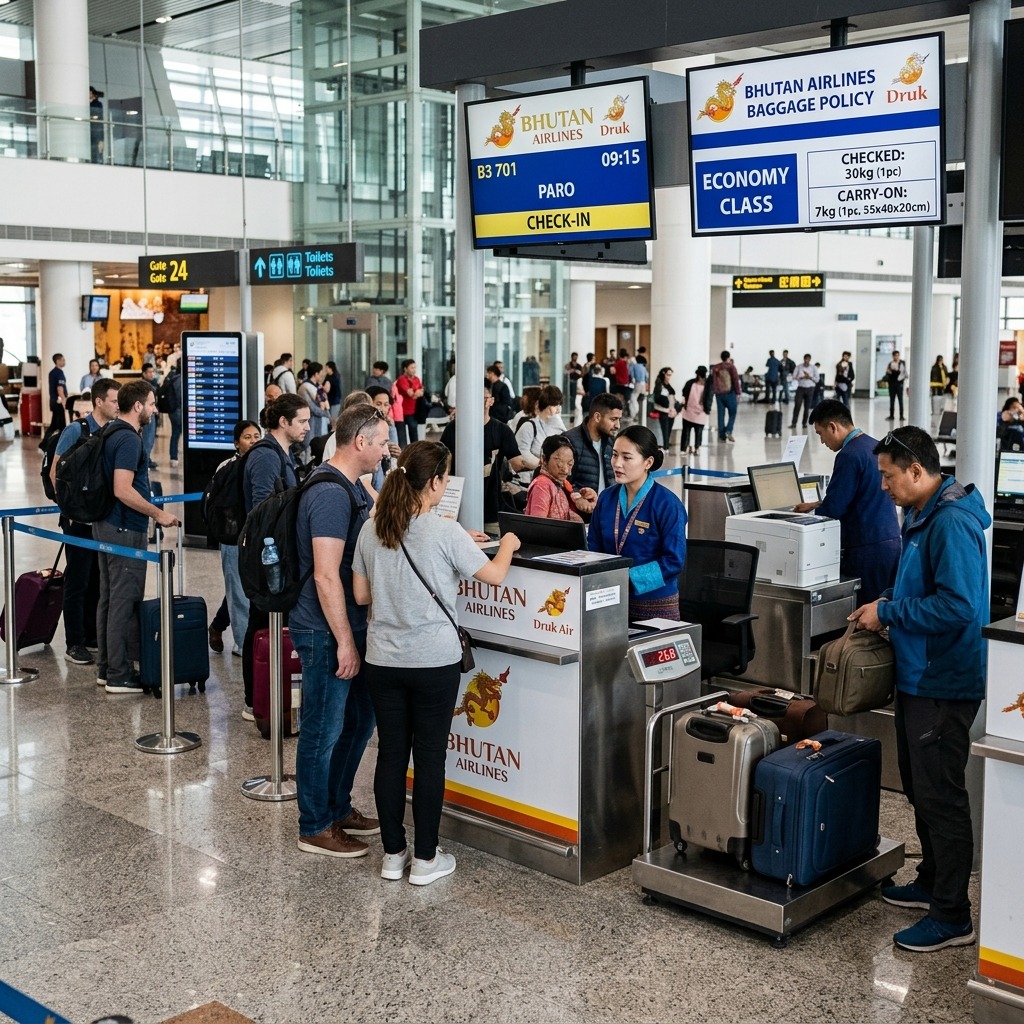
Bhutan Airlines allows 30 kg (Economy) or 40 kg (Business Class) of checked baggage on most international routes, with reduced limits on the Kathmandu-Paro sector. Carry-on bags are capped at 7 kg and 55 x 40 x 20 cm. Excess baggage is charged per kilogram based on the route, and prepaid baggage purchased 6+ hours before departure saves up to 15%.
Flying to the “Land of Happiness” comes with a few logistical quirks, and baggage rules are one of them. Because Paro International Airport sits in a narrow mountain valley, Bhutan Airlines’ Airbus fleet operates under tighter weight restrictions than many international carriers. Knowing the exact numbers before you pack can save you both money and stress at check-in.
What is Bhutan Airlines’ baggage allowance?
Bhutan Airlines’ baggage allowance depends on your cabin class and route. On standard international sectors, Business Class passengers get 40 kg of checked baggage, while Premium Economy and Economy passengers get 30 kg. On the Kathmandu-Paro sector specifically, allowances drop to 30 kg (Business) and 20 kg (Premium Economy/Economy).
Here’s the full breakdown by class and sector:
|
Route Type |
Business Class |
Premium Economy / Economy |
|
Most international sectors |
40 kg |
30 kg |
|
Kathmandu–Paro sector |
30 kg |
20 kg |
A few important notes on how this allowance works:
- Through-checked baggage is measured from your original point of departure to your final destination, provided there’s no stopover.
- If you take a stopover at an intermediate point, Bhutan Airlines reassesses your baggage allowance and charges from that stopover point onward.
- Code-share flights follow the baggage rules of whichever airline is the operating carrier not necessarily Bhutan Airlines’ own policy.
- Children over 12 years old receive the same baggage allowance as adults, both for checked and carry-on baggage.
Always check the baggage allowance printed on your actual ticket, since fare type can affect your specific entitlement.
What are Bhutan Airlines’ hand baggage rules?
Bhutan Airlines permits one carry-on bag measuring no more than 55 cm x 40 cm x 20 cm and weighing a maximum of 7 kg. Bags exceeding these dimensions won’t be allowed in the cabin they’ll be tagged with a “Limited Release Baggage Label” at the gate and loaded into the hold instead.
Beyond your one carry-on bag, Bhutan Airlines allows you to bring one additional item free of charge, subject to security screening. Permitted extras include:
- A lady’s handbag or gentleman’s satchel
- An overcoat, wrap, rug, or blanket
- A camera or binoculars
- Reading material for the flight
- A folding umbrella or walking stick
- A laptop or cell phone
- Shaving kit (excluding razor blades and straight razors)
- Medicines needed during the flight, such as an asthma inhaler
- A collapsible wheelchair, crutches, or braces, if the passenger depends on them
- A gift item purchased at the airport duty-free shop
If you’re traveling with an infant, you can bring one extra bag containing a change of clothes, nappies, and baby food, plus an infant carrying basket and feeding bottle. This bag must also stay within the 55 x 40 x 20 cm limit and be stored in the overhead bin or under the seat.
How much are Bhutan Airlines’ extra baggage charges?
Bhutan Airlines charges excess baggage per kilogram, with rates varying by route and currency. Based on published route data, excess fees range from roughly USD 1.60 per kg on shorter regional sectors (like Paro–Kolkata) up to approximately USD 6.20 per kg on longer routes (like Kolkata–Bangkok).
Here’s an approximate per-kilogram breakdown by route:
|
Route |
Rate (Local Currency) |
Approx. USD/kg |
|
Paro–Kolkata / Kolkata–Paro |
Nu/INR 95 |
~$1.60 |
|
Paro–Kathmandu |
Nu 95 |
~$1.60 |
|
Kathmandu–Paro |
NPR 150 |
~$1.60 |
|
Paro–Bangkok |
Nu 185 |
~$3.10 |
|
Bangkok–Paro |
THB 175 |
~$5.50 |
|
Bangkok–Kolkata |
THB 160 |
~$5.00 |
|
Kolkata–Bangkok |
INR 380 |
~$6.20 |
These figures are approximate, sourced from published third-party travel guides, and subject to change with currency fluctuations. Always confirm current rates directly with Bhutan Airlines or your travel agent before departure.
How can I avoid paying full excess baggage rates?
The most reliable way to reduce excess baggage costs is to prepay online at least six hours before departure, which unlocks discounts of up to 15% off the standard airport rate. A second option, priority baggage tagging, doesn’t reduce weight charges but does speed up baggage claim on arrival.
A few conditions apply to prepaid baggage:
- Only available to passengers with Bhutan Airlines tickets identified by the “786” prefix.
- Must be purchased at least six hours before departure once you’ve completed early check-in at the airport counter, you can no longer buy prepaid baggage and will pay standard airport rates instead.
- If your flight date or time changes, your prepaid baggage allowance carries over automatically. If your origin or destination changes, you’ll need to pay any price difference or request a refund.
- Passengers departing from India will have India GST (K3 tax) added on top of the prepaid baggage fee.
- Prepaid baggage is non-refundable for no-shows, and unused weight allowance can’t be transferred to a future flight.
- Round-trip ticket holders must pay separately for excess baggage on each direction if needed.
Cost example: Suppose you’re flying Paro to Bangkok and are 10 kg over your Economy allowance. At the standard rate of roughly Nu 185/kg, that’s about Nu 1,850 (~USD 31) at the airport. Prepaying at a 15% discount would bring that down to approximately Nu 1,572 (~USD 26) a savings worth locking in if you know your excess weight in advance.
What is priority baggage tagging and how much does it cost?
Priority baggage tagging costs BTN 500 per bag and ensures your luggage comes out on the arrival belt alongside Business Class bags, rather than in standard order. It’s free for passengers already flying Business Class and can be added at booking, at the counter, or during check-in.
Keep in mind: this service is non-refundable once purchased, even if you voluntarily cancel your ticket, unless Bhutan Airlines cancels the flight itself. It’s also non-transferable and unrelated to fragile baggage handling.
What are Bhutan Airlines’ check-in procedures?
Bhutan Airlines check-in counters open 180 minutes (three hours) before scheduled departure and close 45–60 minutes prior, depending on the airport. Web check-in is available starting 48 hours before departure, and the boarding gate itself closes 30 minutes before departure time.
Here’s a quick reference for timing:
|
Check-in Milestone |
Timing |
|
Web check-in opens |
48 hours before departure |
|
Airport counters open |
180 minutes before departure |
|
Recommended arrival (individuals) |
At least 60 minutes before departure |
|
Recommended arrival (groups of 9+) |
At least 120 minutes before departure |
|
Boarding gate closes |
30 minutes before departure |
Passengers who arrive after the recommended cutoff risk being offloaded, with their seat released to a standby passenger. If you’re connecting through a partner airline outside India or Bangkok, you’ll need to notify the Bhutan Airlines counter in advance and confirm with the transit carrier that your bag has arrived at the connection point.
What does the Bhutan Airlines seat map look like?
Bhutan Airlines operates a fleet of Airbus A319 aircraft (with one A320 also in service), typically configured with around 126 seats split between a small Business Class cabin at the front and a larger Economy section behind it. Exact seat counts vary slightly by aircraft and source, generally ranging between 8–12 Business seats and 114–117 Economy seats.
Business Class seats offer extra legroom and a greater recline angle, while Economy seating is designed with generous legroom given the aircraft’s regional, medium-haul role. If you’re flying into Paro, window seats on the left side (when departing from Kathmandu) are popular for their Mount Everest views on clear days though this depends on flight path and isn’t guaranteed on every departure.
What items require special duty-free handling?
Duty-free purchases from Bhutan’s departure airport are allowed onboard only if carried in identifiable shop bags with a cash receipt attached. If you’re transiting through a security checkpoint again including after departing India duty-free liquids or gels over 100 ml purchased in India will not be permitted through the second screening.
This is a detail many travelers miss: an item that’s perfectly fine to carry from Paro may be confiscated at a transit stop if it was purchased in India and exceeds the 100 ml liquid limit. Items purchased at your actual transit country’s airport, however, are permitted under that country’s local rules.
Tips for packing within Bhutan Airlines’ limits
- Weigh your bags at home using a luggage scale to avoid surprises at the counter Bhutan Airlines’ 30 kg Economy allowance is stricter than many long-haul international carriers.
- Prepay for expected excess weight at least six hours before your flight to lock in the 15% discount.
- Distribute weight strategically pack heavier items like shoes and toiletries in checked baggage, keeping your 7 kg carry-on for essentials and valuables.
- Keep duty-free receipts accessible if you’re connecting through a second security checkpoint, particularly for liquids purchased in India.
- Confirm your route’s specific allowance, since the Kathmandu-Paro sector allowance is notably lower than other routes.
Frequently Asked Questions
Does Bhutan Airlines charge for the first checked bag?
No. Bhutan Airlines includes your first checked bag within the free baggage allowance 30 kg for Economy and 40 kg for Business Class on most routes. You’re only charged if your total checked weight exceeds this allowance.
Is there a separate baggage allowance for infants on Bhutan Airlines?
Infants aren’t entitled to the standard free baggage allowance, but parents may carry one extra bag with a change of clothes, nappies, and baby food, plus a feeding bottle and carrying basket, at no additional charge.
Can I buy extra baggage after checking in online?
No. Prepaid baggage must be purchased at least six hours before departure and before you complete early check-in at the airport counter. Once checked in, any excess weight is charged at standard airport rates instead.
Does Bhutan Airlines offer online check-in?
Yes. Bhutan Airlines offers web check-in starting 48 hours before scheduled departure, allowing passengers to check in without visiting the airport counter in advance.
What happens if my carry-on bag is too big at the gate?
Oversized carry-on bags are removed at the gate, fitted with a “Limited Release Baggage Label,” and loaded into the aircraft hold, subject to your checked baggage allowance and any applicable excess charges.
Is priority baggage tagging worth the BTN 500 fee?
It depends on your priorities. Priority tagging doesn’t reduce excess weight charges it simply gets your bag onto the arrival belt faster, alongside Business Class luggage. It’s most valuable for passengers with tight connections.
Why is the Kathmandu-Paro baggage allowance lower than other routes?
Bhutan Airlines applies a reduced allowance (20 kg Economy, 30 kg Business) specifically to the Kathmandu-Paro sector, likely due to operational weight restrictions tied to Paro’s high-altitude, mountain-valley runway.
Do Bhutan Airlines excess baggage rates apply in Bhutanese Ngultrum only?
No. Excess baggage rates are charged in the local currency of the departure point for example, Indian Rupees from India, Thai Baht from Thailand, or Nepali Rupees from Nepal with rates varying accordingly by route.
Does Indian GST affect prepaid baggage costs?
Yes. Passengers departing from Indian cities will have India’s GST (K3 tax) added on top of their prepaid excess baggage fee, in line with local regulatory requirements.
Can children get an adult carry-on allowance on Bhutan Airlines?
Yes. Children above 12 years old receive the same cabin and carry-on baggage allowances as adult passengers, both in weight and dimension limits.

Azeem breaks down airline baggage policies, fare-class benefits, and peak pricing rules into practical guidance for smooth trip planning. He verifies every fee and dimension against official airline sources so travelers can pack with confidence.