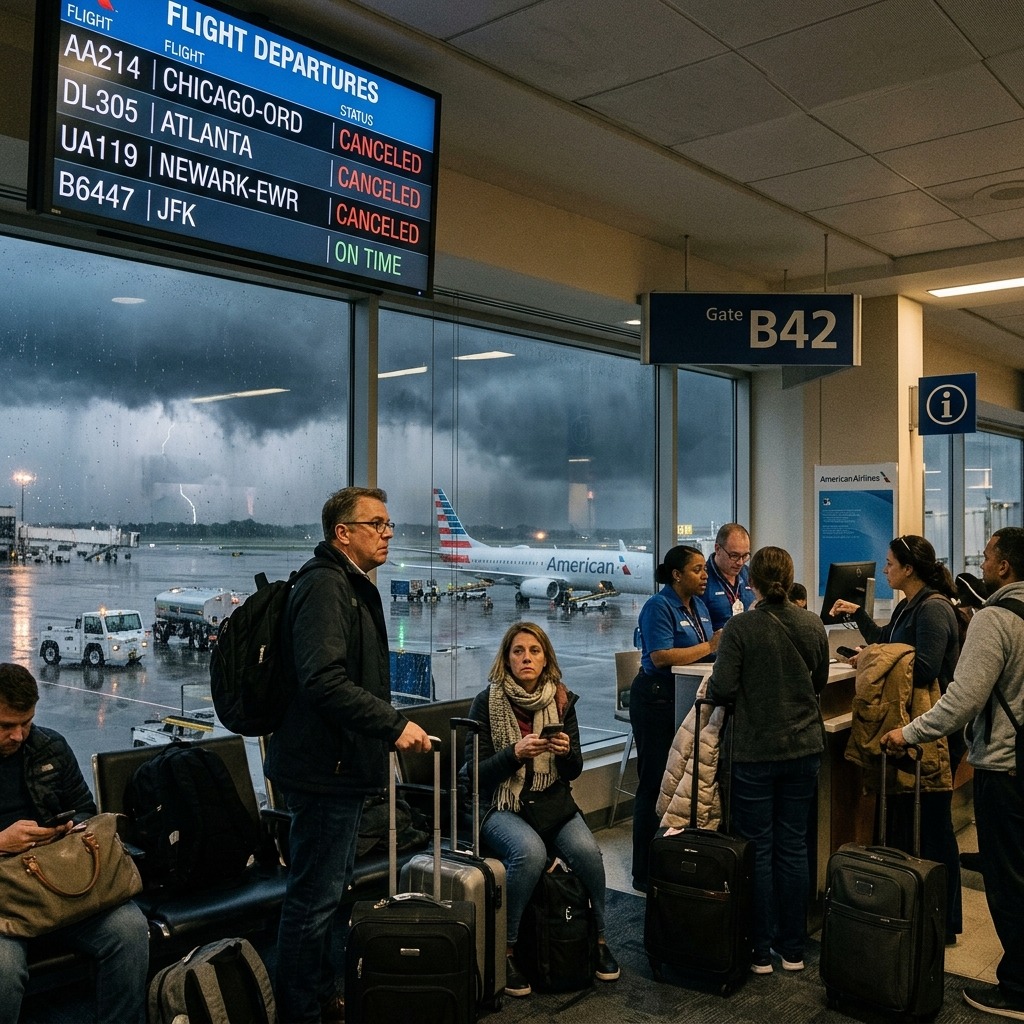
Why Do Airlines Cancel Flights? Everything You Need to Know in 2026
This article contains affiliate links. If you use them, we may earn a small commission at no extra cost to you – we only recommend services we’ve researched and trust.
Airlines cancel flights due to weather, mechanical issues, crew shortages, air traffic control constraints, fuel costs, and safety regulations. In 2025, more than 118,000 flights were canceled by the 10 largest U.S. carriers the worst on-time performance since 2014. Understanding the reasons helps you prepare, protect your rights, and respond quickly.
Flight cancellations are one of the most disruptive experiences in modern travel. You book months in advance, pack your bags, and arrive at the airport only to see those two words that ruin everything: Flight Cancelled.
According to the U.S. PIRG Education Fund’s Plane Truth 2026 report, nearly one in four U.S. flights roughly 1.66 million failed to arrive on time in 2025, including cancellations, delays, and diversions. That’s the worst performance the industry has recorded since 2014. Meanwhile, 1 in 12 flights on the 10 largest airlines arrived an hour or more late.
What Causes Flight Cancellations? (Overview)
Airlines cancel flights for a wide range of reasons, including dangerous weather, mechanical faults, crew unavailability, air traffic control restrictions, fuel disruptions, and low demand. No single factor dominates cancellations are typically the result of one trigger compounding quickly across a tightly scheduled network.
Here’s a snapshot of the most common cancellation causes, ranked by frequency:
|
Cause |
How Common |
Typical Notice Given |
|
Weather (storms, fog, snow) |
Most frequent |
Hours to same-day |
|
Crew scheduling/availability |
Very common |
Hours to same-day |
|
Mechanical/aircraft faults |
Common |
Hours to same-day |
|
Air traffic control restrictions |
Common |
Hours |
|
Fuel cost/operational decisions |
Growing in 2026 |
Days to weeks |
|
Low demand / route consolidation |
Less common |
Weeks to months |
|
Security incidents |
Rare |
Same-day |
Why Do Flights Get Cancelled Due to Weather?
Weather is the single most common cause of flight cancellations. Severe conditions including thunderstorms, hurricanes, heavy snow, freezing rain, and extreme fog can reduce visibility below safe minimums, damage aircraft, or make takeoff and landing physically impossible. When safety cannot be guaranteed, airlines cancel.
It’s not just the weather at your departure airport that matters. A storm in a completely different city can cascade across an entire network. Here’s why: airlines operate on tight rotational schedules. An aircraft flying from Chicago to Miami is often the same aircraft then flying from Miami to Dallas. If the first leg is cancelled due to a blizzard in Chicago, the Miami-Dallas flight may be cancelled too even though the weather in Miami and Dallas is perfect.
This domino effect is one of the least understood causes of flight disruptions. It explains why a sunny-day cancellation notification can still be legitimate.
Weather-related cancellation scenarios:
- Thunderstorms: Lightning near a runway can suspend ground operations entirely. Airlines won’t load passengers onto a jet if tarmac crews can’t safely work.
- Winter ice storms: Aircraft require de-icing before departure. If demand for de-icing exceeds capacity, delays compound into cancellations.
- Hurricanes: Airlines typically cancel flights into affected areas 24–48 hours in advance, often waiving change fees for passengers.
- Low visibility / fog: Airports have minimum visibility thresholds for landing. If a destination can’t guarantee instrument approach conditions, the inbound flight won’t depart.
Why Do Flights Get Cancelled Last Minute?
Last-minute cancellations within hours of departure are almost always caused by mechanical issues discovered during pre-flight inspections, a crew member exceeding their legally mandated rest hours, or a late-running inbound aircraft that arrives too late for a turnaround. These triggers are impossible to predict far in advance.
Federal Aviation Administration (FAA) regulations are strict about pilot and crew rest requirements. If a pilot’s cumulative flying hours push them close to legal limits, or a crew member calls in sick, the airline cannot legally substitute someone else without verifying that replacement’s own rest compliance. Finding a qualified, rested replacement on short notice especially at smaller airports with fewer staff often isn’t possible.
Aircraft mechanical checks also happen close to departure. Engineers conduct a pre-flight walk-around before every single flight. If they discover a fault even a minor-seeming one that aircraft is grounded until it’s fixed or replaced. At busy hubs, a spare aircraft might be available. At smaller regional airports, there often isn’t one.
Common last-minute cancellation triggers:
- Mechanical fault discovered during pre-flight inspection
- Pilot or crew member hits FAA rest-hour limits
- Inbound connecting aircraft delayed beyond turnaround window
- Weather deteriorates rapidly at destination
- Late security alert at airport
Why Do Airlines Cancel Flights Months in Advance?
Airlines cancel flights months in advance primarily for commercial and operational reasons: low ticket sales on a route, seasonal schedule optimization, fleet adjustments, or financial pressures that make a route unprofitable to operate. These cancellations are planned decisions, not safety emergencies.
This type of cancellation is actually the most manageable for travelers because there’s maximum time to rebook. Airlines regularly review their forward schedules and trim routes where demand doesn’t justify the cost. In early 2025, for example, Delta, Southwest, and United all announced flight reductions ahead of the summer season, citing weaker-than-expected demand and elevated fuel costs (according to Scripps News, April 2025).
Advanced cancellations also occur when:
- A new aircraft delivery is delayed, leaving a gap in fleet capacity
- An airline exits a market entirely (as Spirit Airlines effectively did with all routes from May 2026)
- Seasonal demand drops below break-even (e.g., winter routes to beach destinations)
- A government shutdown reduces TSA staffing, causing projected demand to drop (American Airlines cited this in its February 2026 financial report)
If you receive an advance cancellation notice, airlines are typically required to offer you a full refund or a rebooking on an equivalent flight. Use this time strategically rebooking early means better seat selection.
Why Are Lots of Flights Getting Cancelled Right Now? (2026 Context)
Flight cancellations increased significantly in 2025 and 2026 due to a combination of rising jet fuel prices triggered by the Iran war, the collapse of Spirit Airlines, ongoing air traffic controller shortages, and government shutdown disruptions to TSA staffing. These pressures arrived simultaneously, straining the entire industry.
The Iran War and Fuel Price Shock
The single biggest factor driving 2026 cancellations is the cost of jet fuel. The U.S.-Iran war, which began in late February 2026, choked off approximately 20% of the world’s oil supply via the Strait of Hormuz. Jet fuel prices roughly doubled within weeks.
The ripple effects were swift and severe:
- Spirit Airlines collapsed on May 2, 2026, canceling all 9,000+ scheduled flights through the end of May affecting an estimated 1.8 million seats and stranding thousands of passengers overnight. Spirit had budgeted $2.24 per gallon for jet fuel in 2026; by late April, prices had hit $4.51 per gallon, making its business model entirely non-viable. A proposed $500 million White House bailout fell through after creditors rejected the terms. (Source: Al Jazeera / CNN, May 2, 2026)
- Lufthansa cancelled 20,000 European short-haul flights between May and October 2026, citing soaring fuel prices that made many routes unprofitable. (Source: BBC / DW, April 2026)
- Air India raised fuel surcharges and cut 100 flights per day across domestic and international routes (Source: Al Jazeera, May 2026).
- American Airlines reported a net loss in Q1 2026, while the “Big Four” U.S. carriers (American, Delta, United, Southwest) either raised fares, cut flights, or both. (Source: FlightGlobal, April 2026)
Air Traffic Controller Shortage
The U.S. has faced a persistent shortage of air traffic controllers, which independently causes flight reductions and capacity constraints at major hubs. When ATC can’t handle full scheduled traffic volumes safely, airlines are forced to reduce operations.
TSA Staffing and Government Shutdowns
A partial government shutdown beginning in mid-February 2026 left TSA agents working without pay for approximately six weeks. Significant numbers called off work, causing hours-long security line backups and depressing travel demand further. American Airlines directly cited the shutdown as a cause of mandatory schedule reductions in its Q1 2026 financial report.
Why Are Flights Cancelled in the Middle East?
Flights in and through the Middle East are being cancelled or rerouted in 2026 due to active military conflict, geopolitical airspace closures, and GPS jamming that makes safe navigation impossible through specific corridors. Iran, Iraq, Kuwait, and Lebanon are the most heavily affected zones.
As of July 2026, the European Union Aviation Safety Agency (EASA) maintains strict “do-not-fly” recommendations across multiple flight information regions (FIRs) in the region.
|
Country |
Airspace Status (July 2026) |
Impact on Flights |
|
Iran (Tehran FIR) |
Full closure / severely restricted |
No overflights; major detour required |
|
Kuwait |
Prohibited until August 4, 2026 |
All overflights banned; arrivals need approval |
|
Iraq & Lebanon |
EASA “do not operate” recommendation |
Most carriers avoiding entirely |
|
UAE & Oman |
Open but heavily managed |
GPS jamming reported; managed corridors |
|
Qatar & Jordan |
Fully open |
Normal operations |
|
Saudi Arabia |
Fully open; operating at peak bypass capacity |
Primary southern detour route |
The Middle East sits at the geographic center of the world’s busiest long-haul aviation corridor connecting Asia, Europe, and Africa. When central routes are closed, airlines must detour through Central Asia (via the Caucasus and Afghanistan) or south via Egypt and Saudi Arabia. For passengers flying Kuala Lumpur to London, for example, these detours can add 30–90 minutes of flight time.
Major carriers most affected include Emirates (Dubai), Qatar Airways (Doha), Etihad (Abu Dhabi), Singapore Airlines, Lufthansa, and Turkish Airlines, all of which operate heavily through Middle Eastern hubs.
How Do Airlines Decide Whether to Cancel or Delay a Flight?
Airlines prefer delays over cancellations whenever possible because cancellations are more expensive triggering rebooking costs, compensation obligations, and passenger disruption. An airline will choose to cancel only when the operational problem cannot be resolved within a viable timeframe or when safety cannot be guaranteed.
The tipping point varies by circumstance:
|
Scenario |
Likely Outcome |
Why |
|
Storm expected to clear in 2-3 hours |
Delay |
Quicker to wait than reaccommodate all passengers |
|
Crew member sick with no replacement available |
Cancellation |
No legal workaround for unstaffed flight |
|
Mechanical fault fixable on-site in 4 hours |
Delay |
Repair cheaper than reaccommodating passengers |
|
Mechanical fault requiring part from another city |
Cancellation |
Turnaround time makes delay impractical |
|
Route running at 30% load factor (low demand) |
Pre-emptive cancellation |
Cheaper to cancel and consolidate passengers |
|
Airspace closed at destination |
Cancellation |
No viable routing |
Airlines also factor in the “ripple effect.” Delaying one aircraft by four hours means every subsequent flight using that aircraft will also be late. If holding means four other flights miss their windows, cancellation and redeployment of the aircraft elsewhere may be the more rational operational choice.
What Happens If an Airline Cancels a Flight?
If an airline cancels your flight, you are entitled to a full refund regardless of whether the cancellation was within the airline’s control. In the U.S., the Department of Transportation (DOT) requires airlines to provide cash refunds for cancelled flights. You may also be offered a rebooking on the next available flight or travel credit.
Under current DOT rules, here’s what you should know:
Your guaranteed rights (U.S. domestic flights):
- A full refund to your original payment method if you choose not to travel
- Rebooking on the next available flight at no extra charge
- In cases where the cancellation is the airline’s fault, many carriers now voluntarily provide meal vouchers, hotel accommodation, and ground transport though this is not federally mandated for all carriers
What you’re NOT automatically entitled to:
- Cash compensation for the inconvenience itself (unlike EU regulations, which require set payment amounts under EC 261/2004)
- Reimbursement for non-refundable hotel or activity bookings
- Upgrades on replacement flights
Practical steps when your flight is cancelled:
- Don’t wait at the gate call the airline’s customer service line or open the app immediately. Phone queues and app rebooking options often move faster than airport desk lines.
- Document everything screenshot your cancellation notice, save all receipts for additional costs incurred.
- Ask specifically about meal vouchers, hotel accommodation, and ground transport some airlines provide these on request even when not required.
- Check your travel insurance policy many travel insurance plans cover cancellation-related hotel and rebooking costs.
- If your flight was Spirit Airlines (post-May 2, 2026) contact the travel agent or card provider you booked through, as Spirit is no longer operating. United, Delta, JetBlue, Southwest, and others capped fares at approximately $200 one-way for affected Spirit passengers in the immediate aftermath.
- If your flight was cancelled by a European carrier, or your itinerary touched the EU/UK, you may be entitled to fixed cash compensation (€250–€600) under EC 261/2004 on top of any refund. Rather than filing yourself and dealing with airline denials, AirHelp reviews eligibility for free and files the claim end-to-end – you only pay if they win.
If you need to proactively cancel your own flight, see our complete [how-to-cancel guide ]. If your flight was cancelled and you want to understand your full compensation entitlements, see our [passenger rights guide →].
Know Your Flights Before You Book: 5 Tips to Reduce Cancellation Risk
Not every cancellation can be avoided, but you can reduce your exposure:
- Book early-morning departures the first flight of the day is far less likely to be caught in a cascade delay from earlier flights
- Choose direct routes where possible connecting flights double your cancellation exposure
- Pick airlines with lower cancellation rates in 2025, Hawaiian and Allegiant had the lowest cancellation rates among major U.S. carriers; Frontier and American had the highest (U.S. PIRG, 2026)
- Buy travel insurance especially for international itineraries routed through the Middle East in 2026
- Monitor route status in the days before travel for international flights, check NOTAM advisories (Notice to Air Missions) and airline notifications
Frequently Asked Questions
How often do airlines actually cancel flights?
Most major airlines maintain a cancellation rate of around 1–2% under normal conditions. In 2025, however, the cancellation rate among the 10 largest U.S. carriers rose to approximately 1.53% with 118,000+ total cancellations marking the worst on-time performance since 2014 (U.S. PIRG, 2026).
Can an airline cancel a flight and not offer a refund?
No. Under DOT regulations, if an airline cancels your flight, you are entitled to a full cash refund to your original payment method even for non-refundable tickets if you choose not to travel on the rebooked alternative.
If you flew an international itinerary, a refund alone may not be your full entitlement – EU, UK, and Brazilian regulations often layer additional cash compensation on top. Check your compensation eligibility here – it takes 3 minutes and costs nothing to find out.
Why would a flight be cancelled on a clear-weather day?
Clear-weather cancellations are almost always caused by crew unavailability (rest-hour limits, illness), mechanical faults found during pre-flight inspection, or a late inbound aircraft that arrived too late for a legal crew turnaround.
How much notice does an airline have to give before cancelling a flight?
There is no minimum U.S. notice requirement for flight cancellations. Airlines must notify passengers as soon as the decision is made but cancellations can and do happen with less than one hour’s notice.
Why did Spirit Airlines cancel all flights in 2026?
Spirit Airlines canceled all flights on May 2, 2026, and permanently ceased operations. The airline’s bankruptcy exit plan collapsed after the U.S.-Iran war caused jet fuel prices to nearly double from a projected $2.24/gallon to $4.51/gallon by late April 2026 making the airline financially unviable. A proposed $500M government bailout fell through after creditors rejected the terms (Source: CNN / Al Jazeera, May 2, 2026).
Are flights being cancelled because of the Iran war in 2026?
Yes, both directly and indirectly. The Iran war triggered a ~100% spike in jet fuel prices, leading airlines including Lufthansa (20,000 flights cut), Spirit Airlines (full shutdown), and Air India (100 daily flights cut) to reduce schedules. Additionally, Middle East airspace closures in Iran, Kuwait, Iraq, and Lebanon have forced long-haul reroutes globally.
Do airlines prefer to delay or cancel a flight?
Airlines strongly prefer delays. A delay keeps the crew and aircraft operational, while a cancellation triggers mandatory rebooking obligations, potential compensation costs, and complex crew repositioning. An airline will only cancel when a delay is operationally impractical or safety cannot be ensured.
Can a flight be cancelled because there aren’t enough passengers?
Yes. Airlines can cancel flights for low demand particularly when fuel costs make an underloaded route unprofitable. This type of cancellation is usually communicated weeks or months in advance, and passengers are typically offered full refunds or rebooking.
What is a “cascade cancellation” and how does it affect my flight?
A cascade cancellation happens when one initial disruption usually weather or a mechanical fault at another airport triggers a chain reaction across the network. Because most aircraft fly multiple routes per day, a cancellation on the first leg can make the crew or aircraft unavailable for later flights, even flights on entirely unaffected routes.
Which airlines had the most and least cancellations in 2025?
Among the 10 largest U.S. carriers in 2025, Hawaiian Airlines had the lowest cancellation rate and Allegiant the lowest overall. American Airlines had the highest cancellation rate, followed by Frontier and JetBlue. For on-time arrivals, Hawaiian and Delta performed best; Frontier and American performed worst (Source: U.S. PIRG Plane Truth 2026 Report).

Muhammad Naeem is a travel researcher with 5+ years of experience analyzing airline rules and global travel regulations. He specializes in simplifying complex airline policies to help travelers avoid extra fees and fly with confidence. His work focuses on accuracy, clarity, and up to date information across international carriers.